The Bigger Picture: Visual Archives and the Smithsonian
Posts tagged with: Women's History Month
Link Love: 3/29/13
- It’s that wondrous time of year again in D.C., the cherry blossoms are popping! (via Smithsonian Retina blog)
- Continuing the theme of Groundbreakers this Women’s History Month, The National Museum of American History uncovered this story about a Latina woman, Loreta Janeta Velazquez, who disguised herself as a man in order to fight in the Civil War. (via O Say Can You See)
- The Library of Congress updated its Chronicling America website with 800,000 digitized, historic newspapers from Indiana, North Dakota, Arizone, Louisiana, New Mexico, and Texas. (via Infodocket)
- Google Art Project just added the first artworks from China; 50 pieces from the Hunan Provincial Museum in central China. (via Infodocket)
- Ever wondered what happens when you drop your library box into the returns box? Meet the Robo-librarian from Seattle. (via Infodocket)
The Life Behind the Photograph
Throughout March, we will be celebrating Women's History Month with new photos to the Flickr Commons and a series of blog posts about women in science from the Archives' collections.
Context matters. Tell us the "who, when, where, and why" of a photograph and suddenly (like an unexpected inheritance) the image acquires abundant meaning and intellectual capital.
In 2012, the Flickr community helped the Smithsonian Institution Archives establish such context for a previously unidentified image of Norwegian biologist Kristine Elisabeth Heuch Bonnevie (1872-1948). Once we knew the "who," then we could easily add the "when, where, and why."
In 1911, Bonnevie had been elected as the first female member of the Norwegian Academy of Science and Letters, an event so momentous that it was praised in the New York Times as a "triumph" and "another advance for women." The following year, Bonnevie became the first woman to be appointed as a university professor in Norway and in 1916 was made director of the newly established Institute for Human Heredity in Oslo.
Ida H. Stamhuis and Arve Monsen have argued that supportive colleagues played a role in Bonnevie’s success. At a crucial venture, the historians note, Bonnevie's supervisor even dared to confront "the woman issue" directly. In the conclusion to a recommendation letter, he declared: "That the suggested applicant is a woman should not be an obstacle to her employment. Rather, it seems to me, the fact that it is still far more difficult for women than for men to reach an independent position in society, in itself urges us to make this choice."
By the 1920s, Bonnevie had become active in international science and politics. In 1922, she served as an organizer (one of a few women in that role) of the Second International Congress of Eugenics and, that same year, became (along with physicists Marie Curie and Albert Einstein) an organizing member of the International Committee on Intellectual Cooperation, part of a League of Nations effort to encourage collaboration in the sciences and humanities. She began regular visits to the United States to lecture to university and public audiences. During one such trip, she spent a few days at Vassar College, telling a reporter for the Vassar Miscellany News (October 26, 1932) that the worldwide Depression had increased the importance of the League of Nations effort: "in this time of impassable economic barriers there [is] more need than ever for cultural understanding between nations."

Such sensitivity to political and social contexts distinguished Bonnevie's life and career. After World War II, she was honored for organizing food deliveries to the Norwegian underground during the Nazi occupation. And the prestigious Kristine Bonnevie Lectures in Evolutionary Biology pay tribute every September to her worldwide scientific legacy.
The photograph of Bonnevie in the Smithsonian Institution Archives had no accompanying material and its obverse inscription was difficult to decipher. Now, however, we know that this was one of several photographs of scientists taken by journalist Watson Davis in Geneva, Switzerland, in July 1926, when he covered a meeting of the International Committee on Intellectual Cooperation.
At the Geneva meeting, Davis and biologist Vernon Kellogg had attempted to persuade Bonnevie's committee to support establishment of a European "Science Service" modeled on the successful American organization. Only "by making the new results of the intellectual part of the world part of the general thought-stream of a large part of mankind," Davis wrote, can "civilization be raised and maintained consistently upon a higher spiritual and intellectual level." The smiling, sprightly scientist that Davis photographed that summer, in fact, exemplified just such ideals throughout her career.
Related Resources
- National Library of Norway flickr photostream, includes images of Kristine Elisabeth Heuch Bonnevie
Related Collections
- Record Unit 7091 - Science Service, Records, circa 1910-1963, Smithsonian Institution Archives
- Accession 90-105 - Science Service, Records, 1920s-1970s, Smithsonian Institution Archives
Roxie Collie Laybourne: Remembering a Groundbreaker
In 1931, Roxie Collie listed airplanes, tennis racquets, and windy days as interests under her name in her yearbook from Meredith College in Raleigh, N.C. The eldest in a family of 15 children, her hobbies included the outdoors, animals, engines, and model airplanes, which were considered improper for a female during that time. In college she had the opportunity to play basketball and participate in track, as well as being the first to wear blue jeans at the all-girls college. She also enjoyed mowing the college’s courtyard in her coveralls. She received her B.A. from Meredith in 1932, and her M.S. in plant ecology from the George Washington University in 1951.
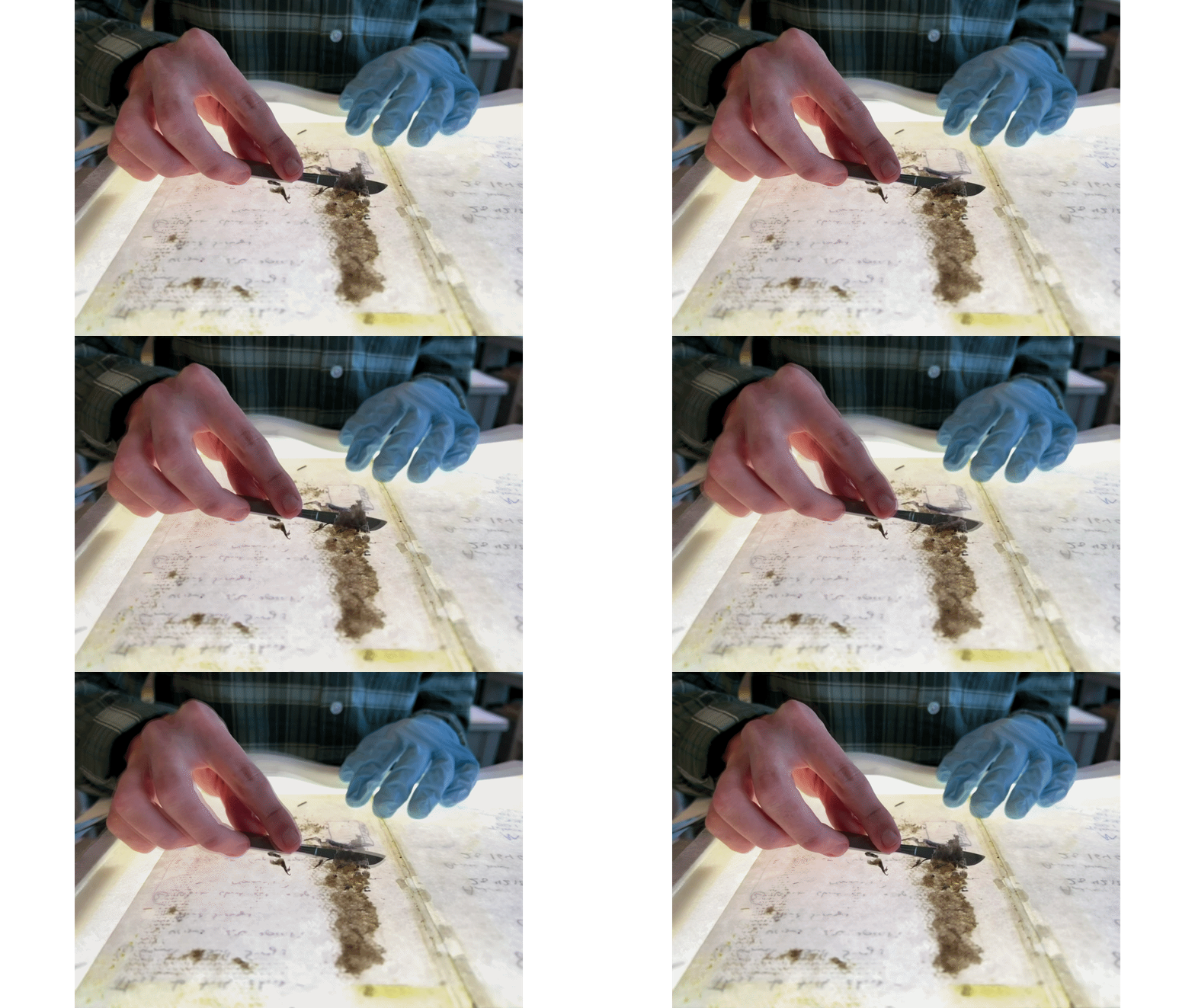
That pioneering spirit led Roxie Collie Laybourne to go on to create the important field of forensic ornithology, which identifies dead birds from feather samples or fragments which can be quite small. Some aircraft accidents have been caused by bird strikes (collision between birds and aircraft) and forensic ornithology has improved safety through the use of bird data, by making modifications to flight plans and creating programs to scare away birds at some airports.
Laybourne worked on aircraft engines during college and took an aeronautics correspondence course, after not being able to attend aviation school because she was female. She even got into trouble with her college after going to the airport to see Amelia Earhart. After graduating she worked at the National Fisheries Laboratory in Beaufort, N.C., and the North Carolina State Museum before coming to the Smithsonian in 1944 in the Division of Birds as a museum aide for a short-term position. Nevertheless, she stayed on at the Smithsonian with the U.S. Fish and Wildlife Service Bird and Mammal Laboratory, and founded the forensic ornithology program in the 1960s.
Her method was to identify species of birds from feathers by using light and scanning electron microscopy, in conjunction with studying the substructure of the wings. The feather identification program came about after Laybourne assisted in the investigation of a fatal crash at Logan Airport in Boston in 1960 and starlings were determined to be the cause. Laybourne then started using the Smithsonian’s collection of preserved bird specimens for feather study to identify species that were involved in bird strikes.
Her techniques and tools are still used today and even have aided criminal investigations. One case Laybourne assisted with was a homicide involving a woman who shot her husband in his sleep and some of the feathers from the pillow went in with the bullet. Her work also aided various agencies, including the Federal Aviation Administration, the National Transportation Safety Board, the FBI, and the U.S. military.
Known as the “Feather Lady, ” she also taught bird-skinning courses to many budding ornithologists.
In a 2001 oral history interview with Smithsonian Historian Pamela Henson, Laybourne talked about mental challenges of the work and said it was not meant for everyone. She considered the field to still be developing. Laybourne retired in 1988 but still performed feather identifications as a Smithsonian Research Associate until her death in 2003 at age 92. The Feather Identification Lab at the Smithsonian continues this important work.
Audio clips from Roxie C. S. Laybourne Interviews, 2001, Smithsonian Institution Archives, Record Unit 9610.
Roxie Laybourne talking about the importance of sharing knowledge.
Roxie Laybourne talking about her approach to life.
Roxie Laybourne talking about working at the Smithsonian Institution.
Related Collections
- Record Unit 9610, Roxie C. S. Laybourne Interviews, 2001, Smithsonian Institution Archives
- Accession 04-086, National Museum of Natural History, Division of Birds, Curatorial Records, 1972-2000, Smithsonian Institution Archives
Related Resources
Ruth Murray Underhill: Woman of the People
Throughout March, we will be celebrating Women's History Month with new photos to the Flickr Commons and a series of blog posts about women in science from the Archives' collections.
It is likely that the readers of this piece have never heard of Ruth Murray Underhill. If you are not familiar with Dr. Underhill’s life and work, her resume includes the following: social worker; european traveler; World War I Red Cross volunteer; Ph. D. , Columbia University; Supervisor of Education, U.S. Bureau of Indian Affairs; Professor of Anthropology, University of Denver; author; and scholar. Intrigued? If so, read on, and I will try to convey the accomplishments of this remarkable Woman of the People.
Ruth Murray Underhill was born on August 22, 1884 into a Quaker family residing in Ossining, New York. Her father, Abram Sutton Underhill, practiced as a lawyer in New York City. Her mother, Anna Taber Murray, raised Ruth, her two brothers and one sister, on the family farm, instilling pacifist values, the benefits of honest labor, and personal enlightenment through education among Ruth and her siblings. The Underhill’s were a family of means, and Ruth enjoyed the benefits of a robust home library and family sojourns to Europe. Her formal education began at the Ossining School for Girls and continued at the Bryn Mawr College Preparatory School in Pennsylvania. Ruth enrolled in Vassar College in 1901, studying English and Comparative Literature, while also continuing her interests in human culture and languages. She was elected to Phi Beta Kappa, and completed her curriculum with honors, receiving her A.B. degree in 1905. After a brief stint teaching Latin at a boy’s military academy in Ossining, Ruth moved to Boston and became a social worker for the Massachusetts Society for the Prevention of Cruelty to Children. Still yearning for knowledge and human experience, Ruth left for Europe in 1906, where she traveled extensively, studied social science and languages at the London School of Economics and the University of Munich, respectively.
Ruth Underhill returned to New York in 1908 and found employment in social work. The outbreak of World War I led Ruth to volunteer for the American Red Cross, including service in Italy as a relief worker assisting Italian orphans. Following the war, and perhaps as a result of its harsh realities, Ruth’s interest in social work began to wane, as she discovered that her efforts did not impact society as much as she had hoped. She considered other options, which included returning to the family farm and embracing traditional female roles. Starkly independent, well-educated, ambitious, and eager to tread her own path, Ruth quickly realized that she would never be happy yielding to tradition. She contemplated how she could satisfy her desire for independence in a male dominated society, and began to concentrate on her writing. In 1920, Ruth published her first novel, White Moth, which featured a woman achieving a supervisory role in the business world; a bold rejection of conventional female subservience!
For a brief period, Ruth Underhill was married to one Charles Crawford, who she soon found to be “the wrong man.” Their marriage was quickly dissolved, without children. In the immediate aftermath of divorce, she began taking courses at Columbia University, where she met Ruth Benedict, then an Assistant Professor in Anthropology, who encouraged Underhill to pursue studies as an Anthropologist. Franz Boas, the “Father of Modern Anthropology,” was the chair of the Anthropology Department. Boas provided Underhill with a small stipend to study the Papago Indians (Tohono O’odham) . Underhill visited the Papago reservation in Southern Arizona four times during the period 1931-1933, living and working with Maria Chona, an elder Papago woman who, like Underhill, was fiercely independent, and shunned traditional female roles. In 1936, Underhill published, Autobiography of a Papago Woman, Maria Chona’s autobiography, and the first published history of a Southwestern Native American woman. Ruth completed her dissertation, "Social Organization of the Papago Indians," and received her Ph. D. in Anthropology in 1937.
While working on her dissertation, Ruth Underhill gained valuable experience at Barnard College as an Assistant in Anthropology under the tutelage of Gladys Reichard, an Anthropologist who spent more than twenty-five years studying Navajo culture and the roles of Navajo women. In 1934, Underhill and Reichard became involved with the Bureau of Indian Affairs Hogan School project, which taught the Navajo language to members of the Navajo tribe. Ruth was also tasked with teaching applied ethnology to Bureau of Indian Affairs (BIA) employees. Underhill was employed by the Soil Conservation Service from 1935-1937, where she conducted surveys concerning economic and social life among Southwestern Native American groups. Later in 1937, Ruth was transferred back the BIA and received the title Associate Super visor of Indian Education. Although she was now stationed in Sante Fe, NM, Ruth continued her work with the Papago, publishing A Papago Calendar Record in 1938 and Social Organization of Papago Indians in 1939.
As Associate Supervisor of Indian Education, Underhill traveled through the Southwest, assisting reservation teachers with the development of curriculum for Native American schools. Ruth was promoted to Supervisor of Indian Education in 1944, and transferred to Denver, CO. She retired from the BIA in 1948 and accepted a Professorship in Anthropology at the University of Denver, where she taught until 1952. Underhill traveled extensively in her retirement including a trip around the world in 1952 – 1953. Ruth returned to Denver, where she lived in a log cabin, and continued to write and serve as a consultant on Native American matters.
Ruth Murray Underhill died on August 15, 1984, one week prior to her 100th birthday, and two months removed from receiving a special recognition citation from the American Anthropological Association for her body of work as an Anthropologist. She published extensively throughout her life, and was a spokesperson for the rights of Native American women. Both the University of Denver and the University of Oregon hold archival collections of her papers.
Related Resources
- Women Anthropologists: Selected Biographies, edited by Ute Gacs ... [et al.] - Ruth Murray Underhill
- American National Biography Online - Ruth Murray Underhill
- Ruth Murray Underhill - University of South Florida, Anthropology Department
Related Collections
- Accession 90-105 - Science Service, Records, 1920s-1970s, Smithsonian Institution Archives
- Ruth Underhill Papers, University of Denver
- Ruth Murray Underhill Papers, University of Oregon
A Pioneer Mammalogist: Viola Shelly Schantz
Throughout March, we will be celebrating Women's History Month with new photos to the Flickr Commons and a series of blog posts about women in science from the Archives' collections.

Recently, I was given a small amount of documents to scan which belonged to a Ms. Viola Schantz. The first folder contained a series of letters congratulating Ms. Schantz on her retirement from the Fish & Wildlife Service. First deduction: this lady was a well-liked coworker who had worked there for many years. The next folder had a series of photographs of Ms. Schantz. One was of her receiving an award upon her retirement from the Secretary of the Interior. Second deduction: this lady was pretty important, and also vaguely reminds me of old pictures of my grandmother. Thus commenced a brief search on the Internet to see if we we're related somewhere down the line. We're not.
Yet upon further research, I've discovered several things about this remarkable woman. Viola Shelly Schantz certainly had a long and extremely productive career, serving in different prestigious positions simultaneously throughout a period of forty-three years. Serving as a Biological Aide, Biologist, and Systematic Zoologist with the U.S Fish and Wildlife Service, as curator of the North American Mammal Collection and treasurer of the American Society of Mammalogists, Viola Schantz was one of the premier mammalogists of her day.
Oh, and she started all this in 1918.
At this time there was little precedence for a lady biologist, though there were several notable exceptions that Schantz herself paid homage to in various articles she wrote for the Journal of Mammalogy. Generally, women who entered the scientific field during the early part of the 20th century were the wives of other scientists, but Viola Schantz was an exception. She blazed her own path, and a number of firsts for women in her field belong to her. She was one of a small group of women to be founding members of the American Society of Mammalogists, and was the longest serving Officer of that society as treasurer. She also co-authored an extensive index of the Journal of Mammalogy; a task that I imagine was no easy assignment. Obviously, she was quite brilliant. I'm no biologist, but after reading her articles that were published in the Journal of Mammalogy, I can say with relative certainty that she really knew what she was doing. Her articles are extremely detailed and observant, and cover a variety of topics, from a newly discovered sub-species of badger to various unusual specimens that crossed her path at the U.S. Biological Survey. Mostly they seem to cover badgers; seriously, if you've ever had the inclination to read up on the various subspecies of American badgers and memorize every single detail about their physical characteristics, her articles are a great place to start. The details of her observations are fascinating. Schantz describes the various colors and shapes of these specimens to the point where one could picture the animal vividly without knowing anything else about the creature!

Among the photographs I scanned in Ms. Schantz's collection here at the Archives, there was one that stood out. It's a photo of Viola standing in front of an open storage drawer laden with mammal pelts. She's holding up one of the specimens for examination. The photograph says a lot about what Viola did from day to day, observing and studying these mammal specimens to learn more about how they lived their lives.
So, during Women's History Month, it's important to step back and remember all of the lovely ladies who came before us and strove to forge a career for themselves. More often than not, we let the fact that these women were the first women in their fields overshadow the remarkable work they did. I think Ms. Schantz might have thought this as well when she wrote articles about the women of science that had been her predecessors. She discusses the obstacles they had to overcome, yes, but she focuses on the work they accomplished. Mrs. M. A. Maxwell, for instance, who personally collected an extensive array of animals from Colorado for a huge exhibit (over a hundred animals and about four hundred birds, no small feat). Or Mrs. A. G. Wallihan, who had, in Schantz's words, "a heart alive to all the beauties of nature," and poured that heart into her wildlife photography. Schantz herself certainly had a heart alive as well. A heart alive for the mammals she so tirelessly worked to preserve. Particularly badgers.
Related Resources
- Dawn M. Kaufman, Donald W. Kaufman and Glennis A. Kaufman, "Women in the Early Years of the American Society of Mammalogists (1919-1949)," Journal of Mammalogy , Vol. 77, No. 3 (Aug., 1996), pp. 642-654.
- Viola S. Shanz, "A New Badger from Wisconsin," Journal of Mammalogy , Vol. 26, No. 4 (Nov., 1945), p. 431.
Related Collections
- Record Unit 7288 - Viola Shelly Shantz Collection, 1961-1962 and undated, Smithsonian Institution Archives
- 1 of 2
- ››
Produced by the Smithsonian Institution Archives. For copyright questions, please see the Terms of Use.
About
Smithsonian on Flickr Commons
Topics/Tags
- See Here (614)
- American History (553)
- Science (437)
- Archive (338)
- Cities/Places (282)
- Exhibitions (236)
- Web/Tech (215)
- Photo History (190)
- Link Love (157)
- Politics/Government (154)
Blog Roll
Categories
- Collections in Focus (1002)
- What Gets Saved (342)
- Behind the Scenes (213)
- Smithsonian History (141)
Monthly Archive
- June 2013 (14)
- May 2013 (32)
- April 2013 (26)
- March 2013 (26)
- February 2013 (26)
- January 2013 (28)
- December 2012 (26)
- November 2012 (28)
- October 2012 (32)
- September 2012 (26)
- August 2012 (31)
- July 2012 (26)
- June 2012 (27)
- May 2012 (27)
- April 2012 (27)
- March 2012 (28)
- February 2012 (27)
- January 2012 (26)
- December 2011 (31)
- November 2011 (28)
- October 2011 (35)
- September 2011 (31)
- August 2011 (35)
- July 2011 (41)
- June 2011 (43)
- May 2011 (33)
- April 2011 (40)
- March 2011 (43)
- February 2011 (35)
- January 2011 (36)
- December 2010 (42)
- November 2010 (40)
- October 2010 (44)
- September 2010 (37)
- August 2010 (39)
- July 2010 (38)
- June 2010 (37)
- May 2010 (42)
- April 2010 (44)
- March 2010 (47)
- February 2010 (40)
- January 2010 (39)
- December 2009 (43)
- November 2009 (34)
- October 2009 (11)
- September 2009 (11)
- August 2009 (12)
- July 2009 (14)
- June 2009 (10)
- May 2009 (12)
- April 2009 (14)
- March 2009 (10)
- January 2009 (1)