Smithsonian Institution Archives
  • Collections
  • Services
  • Smithsonian History
  • About
  • Education
  • Blog
  • Forums
  • Press
  • Audiences
  • Donate

The Bigger Picture: Visual Archives and the Smithsonian

Posts tagged with: Conservation

Highlight from the Photo Cold Vault: Gelatin Dry Plate Negatives

by Eden Orlove, Contractor, Collections Care Division on May 9, 2013

As a contractor at the Smithsonian Insitution Archives, I work with the photographic collections stored in our cold vault.  Among the various photographic formats found there are a particular type of glass plate negatives; gelatin dry plate negatives.

Invented by Richard Leach Maddox in 1871, gelatin dry plate negatives became the most popular form of negative in use from 1880 to 1900.  Maddox developed a technique to fix a light-sensitive gelatin emulsion to a glass plate.  Previously, photographers used the collodion negative process, which often required them to create portable dark rooms or prepare negatives on site.  Gelatin dry plate negatives utilized different sensitizing, fixing, and development solutions that provided faster exposure times, less toxicity, and a significantly easier and less cumbersome production process.  With the invention of lightweight flexible film, photographers stopped regularly using the gelatin dry plate negative process, although it is still sometimes used today for highly specialized photography , such as the creation of precise astronomical measurements.

A large number of the Smithsonian Institution Archives' holdings of glass plate negatives (which number circa 20,000) are kept in a special storage facility referred to as the cold vault.  The temperature and humidity are controlled and kept low, so when working in the vault it is important to bundle up!

Eden Orelove in the SIA cold vault, 2013

I have been working over the last year to improve the preservation of the glass plate negative collections in the cold vault.  The glass plates have been rehoused in specially designed conservation boxes that provide essential support and padding.

Box of rehoused glass plate negatives, 2013.

While gelatin dry plate negatives tend to have an excellent shelf life, their glass composition makes them fragile.   When I discover a broken negative, I piece it back together, digitize it, create metadata for the image and stabilize it in a sink mat.

Stabilized broken glass plate negative, 2013

The gelatin dry plate negatives in the Archives' collections are a rich historical resource and it is a privilege to know that the work I do to stabilize and rehouse them  will preserve the negatives for future generations.  Be on the look out for my upcoming post that will highlight another photographic format held in the cold vault: lantern slides.

Related Resources

  • What Does a Photograph Archivist Do?, The Bigger Picture blog, Smithsonian Institution Archives
  • Putting It All Together: The Assembly and Rehousing of Glass Plate Negatives, The Bigger Picture blog, Smithsonian Institution Archives
  • Unlocking the Vault, The Bigger Picture blog, Smithsonian Institution Archives

Related Collections

  • Accession 11-006 - United States National Museum, Division of Graphic Arts, Photographic Collection, 1860-1960, Smithsonian Institution Archives
Categories: What Gets Saved
Tags: Archive, Photo History, Conservation
Comments: View 4 comments, or Give us yours!
All comments are moderated and subject to approval. Further information is available in The Bigger Picture’s Commenting Guidelines.

Mounting Photographs with Earth Magnets

by Greta Glaser, Conservation Intern on May 7, 2013

Among the photographic records (Record Unit 95 - Photographic Collection, 1850s- ) at the Smithsonian Institution Archives is a portrait of Charles Greeley Abbot, an American astrophysicist and the fifth secretary of the Smithsonian. The portrait is a photograph of a painting of Abbot, which in turn was painted in reference to an even earlier photograph of Abbot. The photograph is mounted onto a gray board and beneath it is a penciled inscription from the painter – Samantha G. Huntly – dedicating it to Mary Vaux Walcott, the wife of Charles Doolittle Walcott who was the fourth secretary of the Smithsonian.

Portrait of Charles Greeley Abbot, silver gelatin developed-out photograph; the mount is broken in two places along the right edge. By Greta Glaser.At some point in the past the board broke in two places, creating a larger piece containing the photograph and two smaller pieces. Fortunately, the photograph itself survives in stable condition. Sometimes a conservator may consider unmounting the photograph, separating it from the broken board which is no longer offering it the physical support it needs. However, in this case the break runs through the artist's inscription. Separating the photographic portrait of Abbot from the inscription could potentially disassociate it with the inscription, which is what makes it a special and unique object.

All conservation treatments carry various levels of risk. Ultimately it was decided that unmounting the photograph and the facing paper, the frontmost layer of board, with the inscription on it was both a risky and time-consuming treatment in which the benefits did not necessarily outweight the risks at the time. Instead, I decided to create a new housing for the print that would hold it securely to help ensure that no further damage is inflicted on the print or its mount. This way the option to treat the object remains open, should the need ever arise.

The mounted photograph inside its new housing. By Greta Glaser.

The mat was constructed using museum-quality board and earth magnets. Earth magnets are very strong magnets made from rare earth metals, such as neodymium or samarium. They are much stronger than iron magnets, and even tiny earth magnets can have enough attraction to hold several layers of board together. I embedded small earth magnets into the boards in several places and secured them with adhesive. This way the photograph and its mount are held in place with gentle but firm, even pressure. Before the photograph went back into storage in its new housing, I locally consolidated the broken edges of the board with methyl cellulose using a small brush to keep the brittle edges from flaking.

The back of the new housing with signs to indicate where magnets are embedded. By Greta Glaser.

One caution when working with these strong magnets is that they should not come close to electronic or magnetic media, such as cell phones, computers, or VHS tapes. To warn users about the placement of the magnets I pasted small caution signs on the outside of the mat.

A copy of the inscription on the mount; it reads “To Mary Vaux Walcott/ with sincere regards of the painter/ [painted by ->] Samantha G. Huntly". By Greta Glaser.

So viewers can read the inscription on the board without removing it from its protective housing, I pasted a copy of the inscription on the inside flap of the window mat. The photograph is now in climate controlled storage at the Archives and in a more stable housing that will reduce further damage to the inscribed board.

Related Resources

  • How the DAM (Denver Art Museum) Uses Rare-Earth Magents with Art Installations, Denver Art Museum blog

Related Collections

  • Record Unit 95 - Photographic Collection, 1850s- , Smithsonian Institution Archives
Categories: Behind the Scenes
Tags: Archive, Conservation
Comments: View 2 comments, or Give us yours!
All comments are moderated and subject to approval. Further information is available in The Bigger Picture’s Commenting Guidelines.

See Here: 5/6/2013

by Kira M. Cherrix on May 6, 2013
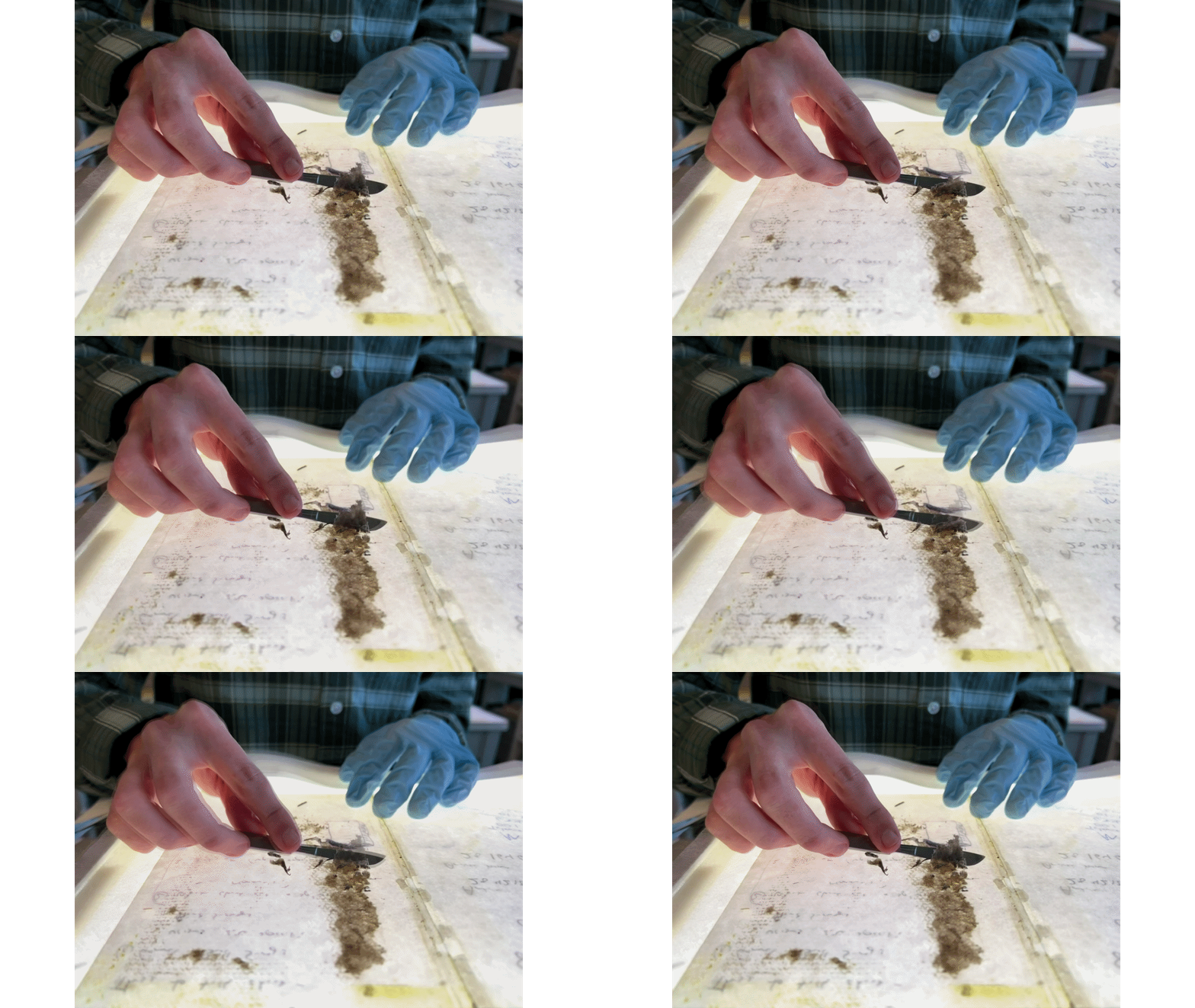
Jane Norman repairing artifact, by Tsantes, John, 1987, Smithsonian Archives - History Div, 2002-32268.
Categories: Collections in Focus
Tags: See Here, Conservation
Comments: View comments, or Give us yours!
All comments are moderated and subject to approval. Further information is available in The Bigger Picture’s Commenting Guidelines.

See Here: 5/3/2013

by Kira M. Cherrix on May 3, 2013
Bactrian Camels at CRC, by Unknown, 1980, Smithsonian Archives - History Div, 96-1017.
Categories: Collections in Focus
Tags: See Here, Conservation
Comments: View comments, or Give us yours!
All comments are moderated and subject to approval. Further information is available in The Bigger Picture’s Commenting Guidelines.

Off with their Heads?: Matchbooks in Archives

by Nora Lockshin on May 2, 2013

A juvenile Brookesia micra standing on the head of a match. Creative Commons Licence courtesy Wikimedia Commons, Frank Glaw, Jörn Köhler, Ted M. Townsend, Miguel Vences.I have a special spot in my heart for oddball items in the archives.  When a colleague approaches me with a question such as: "Nora, we have artists' matchbooks! Should we remove them? Will they spontaneously ignite? Will someone try to light them and set fire to the archives accidentally, or worse, on purpose?!," I delight in putting my creative problem-solving mind to work.  Also, I get to learn new words, such as phillumeny (the hobby of collecting matchbox labels, printed matchbox outers, matchboxes, matchbook covers, matchbooks, and other forms of match packaging).

There are various references available on professional list-serves about this particular topic, with intervention suggestions ranging from the more mild "put them in a steel box," to the A-for-effort but less scientifically solid  "dip the heads in wax to make them inert/discourage striking" (wax is flammable, and probably already a component of some matches) to the commandingly drastic and familiar to fans of Lewis Carroll's Queen of Hearts: "Off with their heads!"  (i.e. cut off the offending flammable tips).The Queen of Hearts shouting at Alice, by John Tenniel, in Lewis Carroll's, "Alice's Adventures in Wonderland."

The archivists’ and librarians’ concerns are certainly valid. The chemicals in the flammable tip may suffer natural degradation through natural aging, but it is probably unlikely that a match of this mid-twentieth century vintage may spontaneously combust. Where loose early matches of the pre-safety match era may rattle around and cause friction enough to ignite the flammable head, it is unlikely that a set of twentieth century wooden or paperboard strip matches would move enough to spark an ignition.

In fact, the safety match (including the separation of the flammable chemicals and by design moving the striker plate to the outside of containers) was designed in the mid-19th century specifically to prevent this sort of accident.  If a curious person were to attempt to strike a match, I would say there are perhaps other security and access issues to be considered. 

While all of proposed solutions discussed above may have their merit, in our case the last option is unacceptable or at least never the first choice without due consideration. Of two sets of matchbooks from the Archives of American Art’s Leo Castelli Gallery collection, the dyed pink wooden match strip with bright yellow heads was possibly chosen for its aesthetic properties. This earlier set of matchbooks appears to be a unique, amateur production, as the cover is actually a folded silver gelatin photograph printed two-up side-by-side on Leica paper that can be dated to circa 1965-1967, based on the archivist Sarah Haug's identification of the people (Leo Castelli, Mrs. Castelli and Roy Lichtenstein at their table; the image may record a celebratory dinner at table in Paris or Venice. A catalog on the table may be from a contemporary exhibition featuring Lichtenstein’s work.)  The more recently printed set was assembled by a professional matchbook company in Mexico, so there must be more, but these are the only ones that we know of and hold in our collection. If more c. 1965-1967 Castelli Gallery matchbooks came to light (. . . apologies to the editor), it might be considered feasible to retain the example in best condition, while sacrificing the heads of the rest to promote safety culture. However, having learned all I have about safety matches as of this writing, I would not recommend it for matches after 1911.  

In conservation literature, there is not much discussion of matches or matchbooks in archives and libraries, being perhaps overlooked as not hugely important among the more critical "hazardous holdings in collections."  Of more concern is the the storing of matchsticks in match-safes, many early models of which are made from the flammable product celluloid (cast cellulose nitrate or Bakelite) perhaps have more due attention. Those, however, come under my object conservator colleagues' jurisdiction, and are less likely to be handled by non-staff and more likely to be separated for collections safety.

The greatest risk to the Castelli matches and matchbooks is that as small, pocket-size objects, they are subject to damage from sliding around in their folder. At least one of the matchheads is compromised from prior incident or incautious handling, causing the friable tip of one to crumble and shed the flammable tip.  A conservator's consolidant material might be used here to retain the rest of that tip, but a preventative housing would do just as well, and protect the overall structures too. 

This set presents the challenge and a solution for rehousing sets of matchbooks in the Leo Castelli Gallery Records.

As an interventive yet not too radical solution, I came up with the double-sided sink mat shown in the Flickr set, which accomodates the matchbooks' uneven thickness, restricts movement, and allows ease of handling. With two examples of each matchbook, I was able to mount them in two ways, one open to show the full image on one side, and also the intended intial view, closed, appearing as a normal matchbook would, to approximate the user’s experience of being handed a small personal item. The two matchbook covers from the sixties differ in exposure and density, so the one in better condition was chosen as the one to display open in the sink mat.  Alternately, one could use corner or strip mounts intended for thicker artworks on board, or simply slip them into appropriately sized polyethylene or Mylar pocket/print sleeves for small objects.  I think the polyethylene might have a little more forgiveness and grip than the Mylar. Do you have any other solutions?   Conservators, collections managers, archivists, lend me your ideas!

Related Resources

  • British Matchbox Label and Bookmatch Society

Related Collections

  • Eleanor Wolpe Matchbook Collection, 1950-1990, Archives Center, National Museum of American History
  • Elion-Weingarten Matchbook Collection, 1930-1983, Archives Center, National Museum of American History
  • Leo Castelli Gallery records, circa 1880-2000, bulk 1957-1999, Archives of American Art
Categories: What Gets Saved
Tags: Archive, Artist, Conservation
Comments: View 3 comments, or Give us yours!
All comments are moderated and subject to approval. Further information is available in The Bigger Picture’s Commenting Guidelines.
  •  
  • 1 of 28
  • ››

Produced by the Smithsonian Institution Archives. For copyright questions, please see the Terms of Use.

Stay in touch!

Facebook Twitter Flickr YouTube SlideShare
Join our eNewsletter

About

Connecting you to America’s past with a behind-the-scenes exploration of the Smithsonian’s history, treasures, and the challenges that Archives face preserving collections. More details...

Smithsonian on Flickr Commons

Topics/Tags

  • See Here (611)
  • American History (542)
  • Science (430)
  • Archive (330)
  • Cities/Places (278)
  • Exhibitions (234)
  • Web/Tech (210)
  • Photo History (189)
  • Link Love (153)
  • Politics/Government (153)

Blog Roll

All Smithsonian blogs
American Historical Association Blog
American Institute of Conservation Blog
Archives Next
Archives of American Art
Around the Mall
Field Book Project
Hanging Together
Library of Congress Blogs
National Archives (US) Blogs
National Museum of American History, O say can you see?
Smithsonian Collections Blog
Smithsonian Libraries
Teaching American History

Categories

  • Collections in Focus (990)
  • What Gets Saved (337)
  • Behind the Scenes (212)
  • Smithsonian History (135)

Recent Posts

  • Women in Science Wednesday: Mary Alice McWhinnie
  • Twenty-Six and Blooming!
  • Sneak Peek 5/20/2013
  • Link Love: 5/17/2013
  • See Here: 5/17/2013

Monthly Archive

  • May 2013 (23)
  • April 2013 (26)
  • March 2013 (26)
  • February 2013 (26)
  • January 2013 (28)
  • December 2012 (26)
  • November 2012 (28)
  • October 2012 (32)
  • September 2012 (26)
  • August 2012 (31)
  • July 2012 (26)
  • June 2012 (27)
  • May 2012 (27)
  • April 2012 (27)
  • March 2012 (28)
  • February 2012 (27)
  • January 2012 (26)
  • December 2011 (31)
  • November 2011 (28)
  • October 2011 (35)
  • September 2011 (31)
  • August 2011 (35)
  • July 2011 (41)
  • June 2011 (43)
  • May 2011 (33)
  • April 2011 (40)
  • March 2011 (43)
  • February 2011 (35)
  • January 2011 (36)
  • December 2010 (42)
  • November 2010 (40)
  • October 2010 (44)
  • September 2010 (37)
  • August 2010 (39)
  • July 2010 (38)
  • June 2010 (37)
  • May 2010 (42)
  • April 2010 (44)
  • March 2010 (47)
  • February 2010 (40)
  • January 2010 (39)
  • December 2009 (43)
  • November 2009 (34)
  • October 2009 (11)
  • September 2009 (11)
  • August 2009 (12)
  • July 2009 (14)
  • June 2009 (10)
  • May 2009 (12)
  • April 2009 (14)
  • March 2009 (10)
  • January 2009 (1)
Smithsonian Institution Archives
eNewsletter Facebook Twitter Flickr Historypin YouTube SlideShare Browsealoud
Smithsonian Institution
  • Privacy
  • Copyright
  • Contact