The Bigger Picture: Visual Archives and the Smithsonian
Posts tagged with: click! photography changes everything
Just Published! Photography Changes Everything

About seven years ago, I was invited by Merry Foresta—director of the Smithsonian Photography Initiative from 2000 to 2010—to participate in a project that was designed to explore and raise awareness of the fourteen-million-or-so photographs residing in various Smithsonian collections and archives. The challenge was both daunting and a dream come true, given my fascination with, and respect for, the roles photographic images play in visual culture and in the shaping of institutions as complex as the Smithsonian. In 2007, and while I was working as a creative consultant to the Photography Initiative, an idea for a new project began to form. In conversation with Smithsonian curators, researchers, and staff, it became increasingly obvious how all around the National Mall—and by extension, all around the world—we use photography for various reasons and to different ends. The more people I met with the clearer it became to me that photography, which most of us think of as a documentary tool is, more importantly, an active agent of change in our culture, work, and daily life.
Given the Photography Initiative’s innovative website and its role in facilitating the digitization of images across the Smithsonian, we created an online project—click! photography changes everything —to explore the medium’s utility, power, and reach. Working closely with Merry, Effie Kapsalis, Susannah Wells, and Catherine Shteynberg, I made lists of people we hoped to engage and whose inclusion would bridge a broad range of experiences and perspectives. While many project participants were affiliated with the Smithsonian, we reached out beyond the Smithsonian to, for example, artists; experts in the media, merchandizing, and medicine; photographic and digital innovators; celebrities and public figures; and students and teachers. We targeted people who study photography’s role in culture and everyday lives, as well as those who rely heavily on photographic imaging in their specific work, but are seldom asked to talk about when or why or how of what they do.
Each project participant was asked to consider how photography transformed their personal life or areas of professional interest. The interdisciplinary stories they told and the images they’ve shared—on the website, and now in the just-published book version of the project, Photography Changes Everything (Aperture/Smithsonian, 2012)—reveal that photography, far from being a shared language, is complex and subject to rules, specific criteria, and expectations that vary from one context and field to another. And if we tend to think of photographs as rear-view mirrors, the reality, as this project proves, is that photography aggressively moves us forward and in that process, changes what we see and want, where we go, what we do, who we are, and what we remember .
We never imagined, when we started exploring photographic images in Smithsonian collections, that we’d end up creating yet another archive, one filled with provocative, informative, and entertaining stories about photography itself. But we did. And now, with its online presence and in its new print version, the project is reaching audiences and triggering conversations we couldn’t have anticipated a few years back. A standing-room-only launch event for Photography Changes Everything was held in Los Angeles in June. Come this fall, a Washington, DC special event planned for September 12 and additional events in New York are yet to be announced. We’ll keep you posted on details and hope to see you at one or another!
Sifting Through Archives and Snooping Through Desks
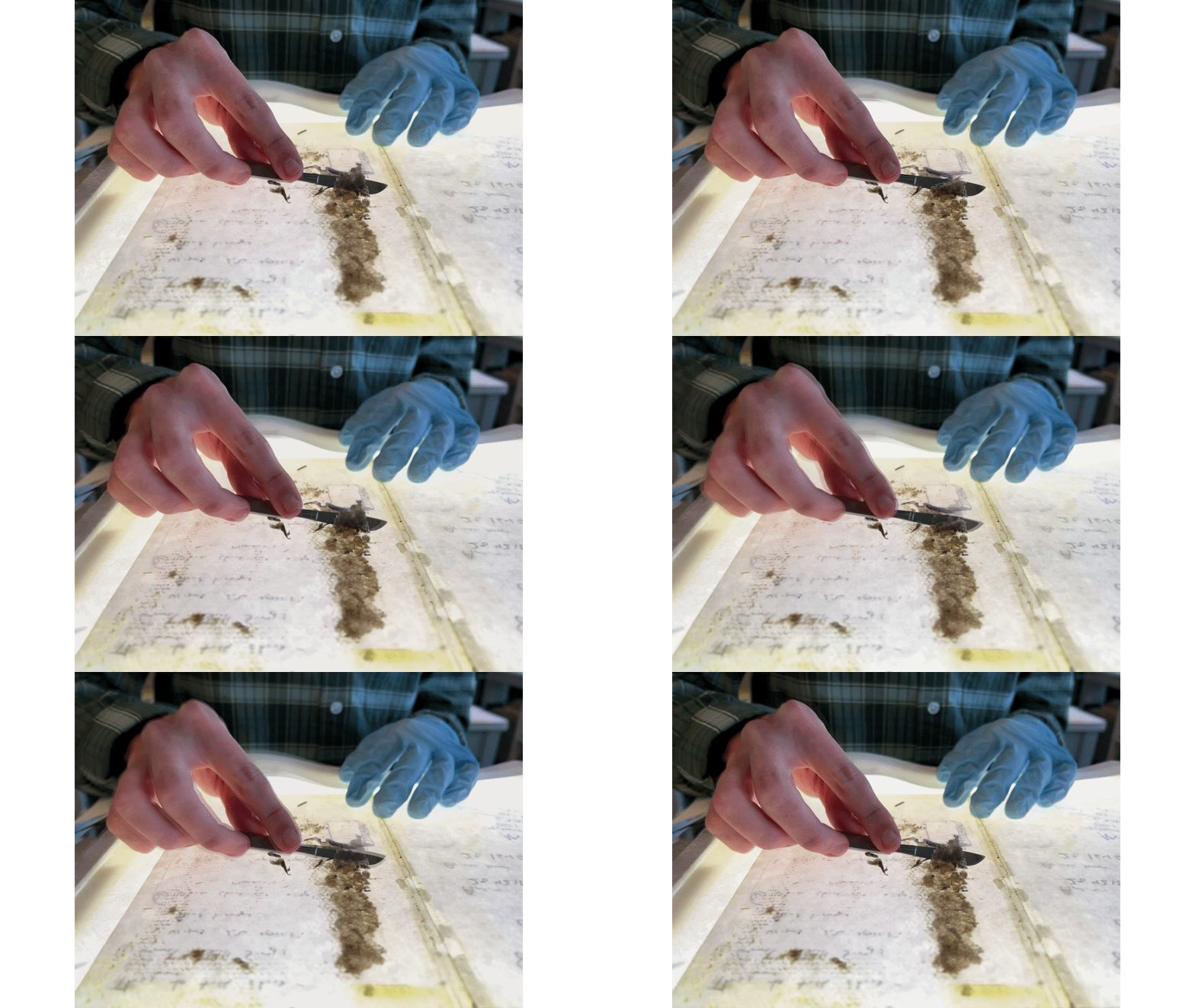
A remarkable archival find came to light in mid-April, when Kenneth Price—professor of American literature at the University of Nebraska-Lincoln, and co-director of The Whitman Archive—announced that while researching in a National Archives vault in Washington D.C., he came upon approximately three thousand previously unknown documents that were written by the poet Walt Whitman when he worked as a government clerk between 1864 and 1874.
Whitman took jobs as a copyist and scribe to earn money while to support his work as a poet. The material Price found came from the records of the attorney general’s office, where Whitman worked after he was fired from a similar job in the Indian Bureau of the Department of the Interior. His dismissal there came after Secretary of the Interior James Harlan, found a copy of Leaves of Grass either on or in Whitman's desk while snooping through the building after hours. According to an entry in The Whitman Archive, “Since Whitman was in the process of editing poems for subsequent editions, Harlan found numerous underlined, amended, and marked off passages. Curious, he carried it back to his office. Upon further reading, he declared the book obscene and its author immoral,” which prompted Harlan to discharge Whitman the following day.
According to a report published in the The Guardian, Prof. Price thinks this new material in Whitman’s hand—dealing with issues such as the rise of Ku Klux Klan, the westward spread of the railroads, and the trial of Jefferson David, President of the Confederacy—will shed light on Whitman’s ideas about democracy and his writing. "This was an age of high hopes but also big problems, and Walt Whitman was there in the thick of it," Price commented. It’s hard to say, in hindsight, whether Whitman was responsible in any way for the content of the materials he handled or transcribed, but Price feels that future biographers will need to consider how the information Whitman was exposed to may have impacted his intellectual and literary evolution.
In this short video and the video above, Price describes what it felt like to strike archival gold and uncovers what’s long gone unseen. And if you’re interested in getting a very different perspective on Walt Whitman and visibility, read this fascinating piece that Leo Braudy, a scholar of celebrity, wrote about Whitman’s relationship to fame and photography for the Smithsonian Photography Initiative’s project, click! photography changes everything.
In Her Own Image
Women have often been described as muses, inspirational figures whose aura and/or beauty and/or power inspire male artists to produce works of art. Think of Kiki of Montparnasse (also known as Alice Ernestine Prin) who, early in 20th century Paris, charmed artists including Modigiliani, Alexander Calder, and Man Ray; and sat for portraits by photographers, including Andre Kertesz. A French country girl turned model/singer/actress/artist, she was, according to Billy Kluver and Julie Martin biography, Kiki’s Paris: Artists and Lovers 1900-1930, one of the early 20th century’s truly independent women. Around the same time and back in the United States, another young woman, Georgia O’Keeffe, was also described in similar terms—a muse who riveted an artist’s attention (in her case, photographer Alfred Stieglitz) and became, on her own, a trailblazing talent and a larger-than-life public figure. Photography helped O’Keeffe to shape her own life-path, celebrity and legacy, too. Her shrewd understanding of how photographic images of her would be useful to focus attention on the images she made as a painter are fascinating to consider, particularly from our vantage point in what’s often described as a celebrity- crazed, reality-TV addicted world.
In a wonderful piece Barbara Buhl Lynes, curator at the Georgia O’Keeffe Museum, wrote for click! photography changes everything, she explains that while Stieglitz’s photographs of O’Keeffe in the late teens and 1920s may have triggered a sensation, it was how O’Keeffe herself went on the exploit the power of photography to her own ends that is, particularly in National Women’s Month, the more interesting part of the story. You can read more about the story of O’Keeffe’s success in determining and controlling her own destiny, as well as our image of her.
Footage of the 92 year old Georgia O'Keeffe taken in and around her home in New Mexico.
Women have often been described as muses, inspirational figures whose aura and/or beauty and/or power inspire male artists to produce works of art. Think of Kiki of Montparnasse (also known as Alice Ernestine Prin- https://secure.wikimedia.org/wikipedia/en/wiki/Alice_Prin) who, early in 20th century Paris, charmed artists including Modigiliani and Alexander Calder, and Man Ray (http://www.flickr.com/photos/confetta/2973043917/) and sat for portraits by photographers, including Andre Kertesz (http://chagalov.tumblr.com/post/961277151/kiki-de-montparnasse-paris-1927-by-andre)). A French country girl turned model/singer/actress/artists, she was, according to Billy Kluver and Julie Martin biography, Kiki’s Paris: Artists and Lovers 1900-1930, one of the early 20th century’s truly independent women.
Around the same time and back in the United States, another young woman, Georgia O’Keeffe, was also described in similar terms—a muse who riveted an artist’s attention (in her case, photographer Alfred Stieglitz [http://click.si.edu/Image.aspx?image=5220&story=700&back=Story]) and became, on her own, a trailblazing talent and a larger-than-life public figure. Photography helped O’Keeffe to shape her own life-path, celebrity and legacy, too. Her shrewd understanding of how photographic images of her would be useful to focus attention on the images she made as a painter are fascinating to consider, particularly from our vantage point in what’s often described as a celebrity- crazed, reality-TV addicted world. In a wonderful piece Barbara Buhl Lynes, curator at the Georgia O’Keeffe Museum, wrote for click! photography changes everything (www.click.si.edu), she explains that while Stieglitz’s photographs of O’Keeffe in the late teens and 1920s may have triggered a sensation, it was how O’Keeffe herself went on the exploit the power of photography to her own ends that is, particularly in National Women’s Month, the more interesting part of the story. You can read more about the story of O’Keeffe’s success in determining and controlling her own destiny and our image of her (http://click.si.edu/Story.aspx?story=700).
I Am My Own Commodity
While the economy may be perking up, the recession we’re still climbing out of has made one thing clear; if you need to earn a living, you’ve got to think entrepreneurially. Read enough success stories about former executives who’ve become cupcake moguls and a path becomes clear: take the dreams and skills you have, along with whatever compelling back story you can point to and exploit them in whatever media you have access to. If you’ve ever thought about branding and/or marketing yourself, you might learn something from this photograph of the American sculptor, Edmonia Lewis. As Jacqueline Serwer, chief curator at the National Museum of African American History and Culture (NMAAHC), described it for a story in click! photography changes everything, this small, cardboard-mounted promotional piece was circulated by Lewis to create buzz and build an audience and financial support for her ambitious sculptural works.
In addition to commissioning this carte-de-visite from Henry Rocher, one of Chicago’s better known portrait photographers, Lewis also took out an advertisement in the Chicago Tribune, promoting the return of the “young and gifted Colored Sculptor of Rome, Italy.” The public was invited to purchase tickets to view Lewis’ sculpture and meet the artist, herself. This novel strategy was clever and profitable; by Lewis’ own reckoning, she earned $6,000 in admission and raffle sales in Chicago, and the growing interest her publicity and the work itself soon led to its display in exhibitions in California and inclusion in the Fine Art section of the 1876 Philadelphia Centennial. While it wasn’t until the mid-twentieth century that film star Elizabeth Taylor could proudly proclaimed “I am my own commodity,” Lewis’ photograph and marketing scheme are reminders of the creative ways 19th century women engineered their own pathways to success.
For All the World to See
The Smithsonian Institution Archives will be celebrating African American History Month throughout February with a series of related posts on THE BIGGER PICTURE.
This coming June, For All the World to See: Visual Culture and the Struggle for Civil Rights—organized by Research Professor Maurice Berger for the Center for Art, Design, and Visual Culture (CADVC) at the University of Maryland Baltimore County and the Smithsonian’s National Museum of African American History and Culture (NMAAHC)—opens at the Smithsonian's National Museum of American History.
For All the World to See is the first comprehensive museum exhibition to explore the historical role played by visual images in shaping, influencing, and transforming the fight for civil rights in the United States. Comprised of over 250 objects—including posters, photographs, magazines, newspapers, books, pamphlets, political buttons, comic books, toys, postcards, and clips from film, newsreels, and television—much of the show’s content comes from the Civil Rights Archive that Berger assembled over a six year period for CADVC. Interestingly, while the objects in the archive are important historical artifacts, most were found and purchased on online sites like eBay and Bookfinder, rather than from more conventional vendors of art and historical materials, such as galleries and bricks-and-mortar auction houses.
Through the presentation of iconic materials that document the everyday lives of both black and white Americans, For All the World to See attempts to reach museum visitors on a deeply personal and moving level as it offers insights into the way visual imagery forever changed the cultural and social landscape of the United States. To see an online preview of the exhibition, click here. And to read the story Maurice Berger contributed to the Smithsonian Photography Initiative’s project, click! photography changes everything, click here.
- 1 of 17
- ››
Produced by the Smithsonian Institution Archives. For copyright questions, please see the Terms of Use.
About
Smithsonian on Flickr Commons
Topics/Tags
- See Here (614)
- American History (553)
- Science (436)
- Archive (338)
- Cities/Places (282)
- Exhibitions (236)
- Web/Tech (215)
- Photo History (190)
- Link Love (157)
- Politics/Government (154)
Blog Roll
Categories
- Collections in Focus (1001)
- What Gets Saved (342)
- Behind the Scenes (213)
- Smithsonian History (141)
Monthly Archive
- June 2013 (13)
- May 2013 (32)
- April 2013 (26)
- March 2013 (26)
- February 2013 (26)
- January 2013 (28)
- December 2012 (26)
- November 2012 (28)
- October 2012 (32)
- September 2012 (26)
- August 2012 (31)
- July 2012 (26)
- June 2012 (27)
- May 2012 (27)
- April 2012 (27)
- March 2012 (28)
- February 2012 (27)
- January 2012 (26)
- December 2011 (31)
- November 2011 (28)
- October 2011 (35)
- September 2011 (31)
- August 2011 (35)
- July 2011 (41)
- June 2011 (43)
- May 2011 (33)
- April 2011 (40)
- March 2011 (43)
- February 2011 (35)
- January 2011 (36)
- December 2010 (42)
- November 2010 (40)
- October 2010 (44)
- September 2010 (37)
- August 2010 (39)
- July 2010 (38)
- June 2010 (37)
- May 2010 (42)
- April 2010 (44)
- March 2010 (47)
- February 2010 (40)
- January 2010 (39)
- December 2009 (43)
- November 2009 (34)
- October 2009 (11)
- September 2009 (11)
- August 2009 (12)
- July 2009 (14)
- June 2009 (10)
- May 2009 (12)
- April 2009 (14)
- March 2009 (10)
- January 2009 (1)