The Bigger Picture: Visual Archives and the Smithsonian
Posts tagged with: Architecture
See Here: 5/13/2013
Link Love: 3/15/2013
- A daughter's research brings greater knowledge of the Curtiss-Wright Aeronautical Engineering Cadettes and their contributions to America's World War II efforts. [via AirSpace, NASM]
- Rediscovered . . . National Geographic launches a new tumblr, Found, to showcase forgotten images from its archives. [via PetaPixel]
- UCLA Library recently announced its Broadcast NewsScape, a broadcast news research and education platform that contains nearly two hundred thousand news programs from the United States and around the world from 2005 to the present. [via Internet Archive Blogs]
- Another area of digital preservation that is getting some support . . . Stanford and the National Institute of Standards and Technology are collaborating to preserve over 15,000 software programs created between 1975 and 1995. [via InfoDocket]
- A B.I.G. (namely the architectural firm Bjarke Ingels Group) plan is in store for the Smithsonian Institution Castle and the surrounding Quadrangle complex as it undergoes a redesign. [via core77]
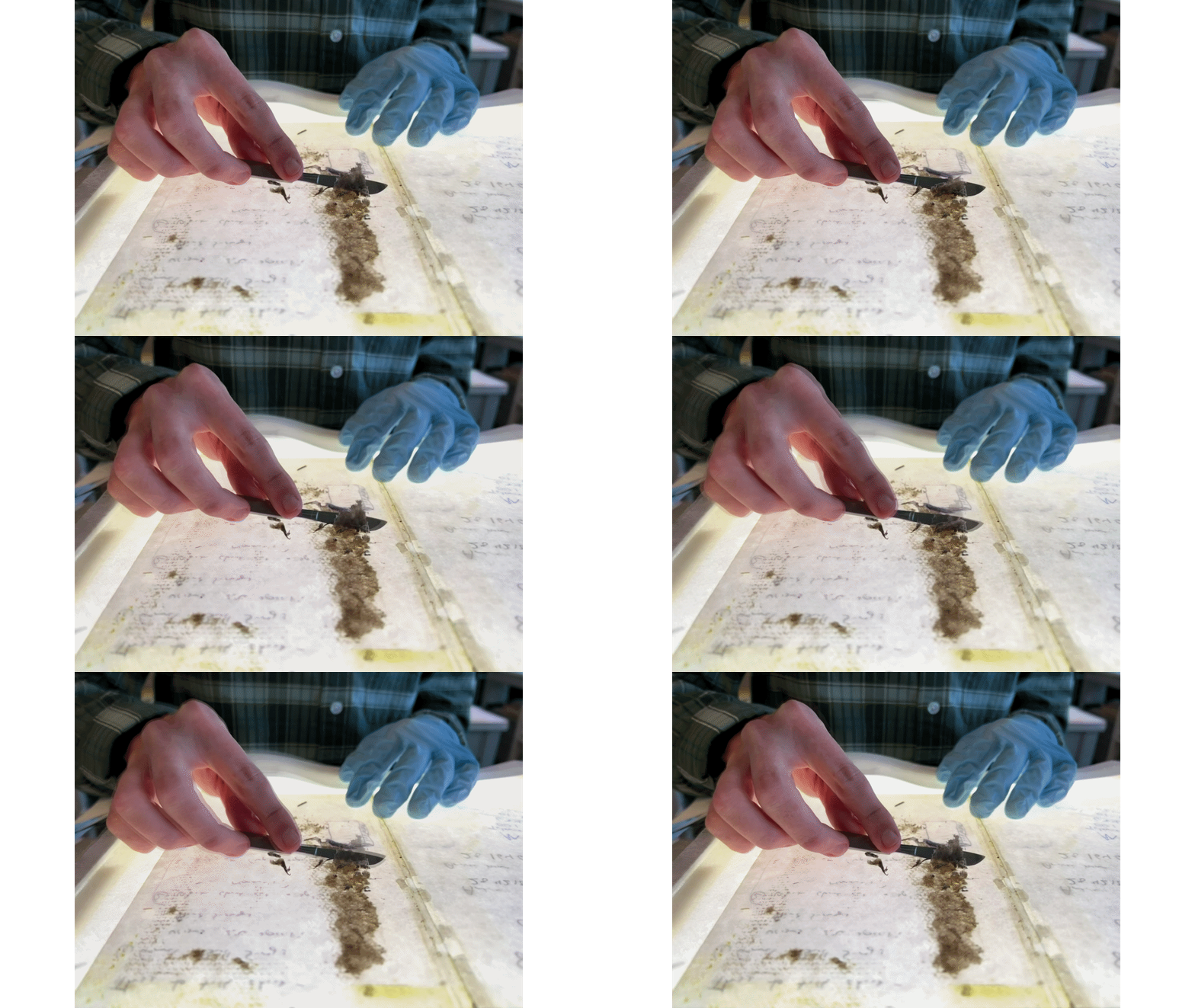
- Tears in the pages of my kids books are simple to fix, I just get out the Scotch tape. But when it comes to repairing torn pages in volume III of Conrad Gessner’s seminal work Historiae Animalium (1551-1558) a more delicate fix is in order. [Unbound, SIL]
- Photographer Mark Brodie provides a glimpse into a world that few of us will see or experience while train hopping over 50,000 miles and visiting 46 U.S. states on over 170 different freight trains. [via PetaPixel]
Link Love: 2/22/2013
The ABC of Architects from fedelpeye on Vimeo.
- For your architecturally minded child, Argentinian architect Andrea Stinga and creative director Federico Gonzalez, put together this video of significant architects from A to Z. [via Core77]
- 19 degrees of separation. New research suggests that any website is connected to another by no more than 19 links. [via InfoDocket]
- It may not come to mind at first, but the food you eat often times has a politcal narrative associated with it. The exhibition, FOOD: Transforming the American Table,1950-2000, at the National Museum of American History explores some the cultural and political aspects that are part of our consumption of food. [via O say can you see?, NMAH]
- Amatuer street photographer Vivian Maier, who was unknown until real estate agent, John Maloof, purchased a box of hers that contained 30,000 prints and negatives, is now the subject of an upcoming documentary. [via PetaPixel]
Architect Victor Lundy at the Smithsonian
Happy 90th birthday to the wonderful Victor Lundy! Lundy's architecture defines a kind of organic mid-century modernism, and he is admired as much for his sculptural sense of form as for his innovative use of engineering technology. Both of these qualities are on view in the work that he created for the Smithsonian in the mid-1960s – a series of "shade structures" for the terrace of the new Museum of History and Technology (as the National Museum of American History was then known). The creation of a terrace café to enliven the Mall formed part of the Smithsonian's contributions to Lady Bird Johnson's campaign to beautify Washington.
Lundy's work is rooted in his superb draftsmanship, and he still paints and draws today from his home and studio in Texas. After serving in the U.S. Army during World War II, he studied under Walter Gropius at Harvard, where among his classmates were I. M. Pei, Edward Larrabee Barnes, and Paul Rudolph. He then moved to Sarasota, Florida, in the 1950s, where he started his first office – rising to prominence in the heady environment of Sarasota’s modernist movement. While he is perhaps best known for his churches, with their inventive and inspired rooflines (see for example his First Unitarian Church in Westport, Connecticut), my personal favorite are the "Space Flowers" he designed for the New York World's Fair of 1964-65.
In 1965, when Lundy started working with the Smithsonian, he was one of several featured in a landmark exhibition about contemporary American architecture held in the Soviet Union (the other architects were Louis Kahn, Robert Venturi, Paul Rudolph, and Charles Eames). The Smithsonian that year was celebrating the Bicentennial of James Smithson's birth with a three-day celebration and an academic procession full of pomp and circumstance along the Mall.
The six shade structures, which Lundy likened to "abstract trees," were unveiled on September 1, 1965. The slatted canopies – three on either side of the Mall entrance to the museum – intercepted the sun, while still allowing light and breezes to filter through. The museum's chief of exhibits at the time, Benjamin Lawless, said, "It creates a graceful pattern of swooping cables and lines and will soften the contour of the building and put some life in the area . . ." The shade structures lasted until the late 1970s, when they were removed on account of deterioration. Lundy had intended for them to be taken down each fall and stored over the winter, to extend their life span, but this had not happened. Briefly in 1978 there was a flurry of correspondence regarding the feasibility of remaking them in more permanent materials, such as aluminum and stainless steel, but the project was ultimately not pursued. The Archives has some images of the shade structures, but do you have memories or pictures of them to share?
2013 is shaping up to be a banner year for Lundy. The Library of Congress is in the process of acquiring Lundy's papers (it has already accessioned his World War II notebooks, which they have beautifully digitized). And the General Services Administration, which manages the U.S. Tax Court, one of Lundy's most significant projects, recently succeeded in having that building landmarked; they are also completing a film on the life and work of the architect.
Related Resources
- The Art and Architecture of Anstis and Victor Lundy, exhibition (Image number three includes a Lundy sketch of one of the Smithsonian shade structures as viewed from underneath), Ballroom Marfa, 2006
Related Collections
See Here: 1/18/2013
- 1 of 22
- ››
Produced by the Smithsonian Institution Archives. For copyright questions, please see the Terms of Use.
About
Smithsonian on Flickr Commons
Topics/Tags
- See Here (614)
- American History (553)
- Science (437)
- Archive (338)
- Cities/Places (282)
- Exhibitions (236)
- Web/Tech (215)
- Photo History (190)
- Link Love (157)
- Politics/Government (154)
Blog Roll
Categories
- Collections in Focus (1002)
- What Gets Saved (342)
- Behind the Scenes (213)
- Smithsonian History (141)
Monthly Archive
- June 2013 (14)
- May 2013 (32)
- April 2013 (26)
- March 2013 (26)
- February 2013 (26)
- January 2013 (28)
- December 2012 (26)
- November 2012 (28)
- October 2012 (32)
- September 2012 (26)
- August 2012 (31)
- July 2012 (26)
- June 2012 (27)
- May 2012 (27)
- April 2012 (27)
- March 2012 (28)
- February 2012 (27)
- January 2012 (26)
- December 2011 (31)
- November 2011 (28)
- October 2011 (35)
- September 2011 (31)
- August 2011 (35)
- July 2011 (41)
- June 2011 (43)
- May 2011 (33)
- April 2011 (40)
- March 2011 (43)
- February 2011 (35)
- January 2011 (36)
- December 2010 (42)
- November 2010 (40)
- October 2010 (44)
- September 2010 (37)
- August 2010 (39)
- July 2010 (38)
- June 2010 (37)
- May 2010 (42)
- April 2010 (44)
- March 2010 (47)
- February 2010 (40)
- January 2010 (39)
- December 2009 (43)
- November 2009 (34)
- October 2009 (11)
- September 2009 (11)
- August 2009 (12)
- July 2009 (14)
- June 2009 (10)
- May 2009 (12)
- April 2009 (14)
- March 2009 (10)
- January 2009 (1)