
Smithsonian Institution Archives
  • Collections
  • Services
  • Smithsonian History
  • About
  • Education
  • Blog
  • Forums
  • Press
  • Audiences
  • Donate

The Bigger Picture: Visual Archives and the Smithsonian

Operation Reindeer

by Courtney Bellizzi on December 22, 2010

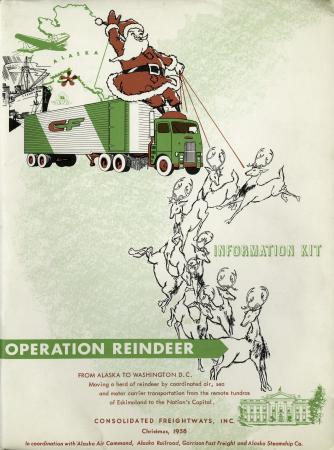
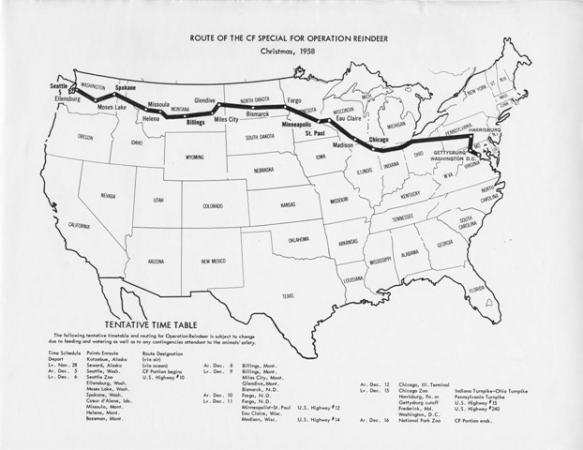
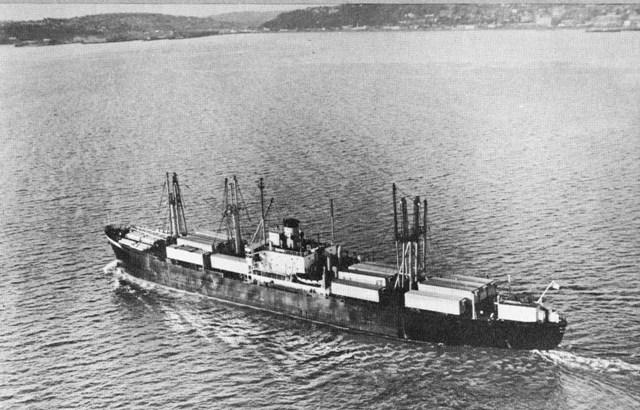
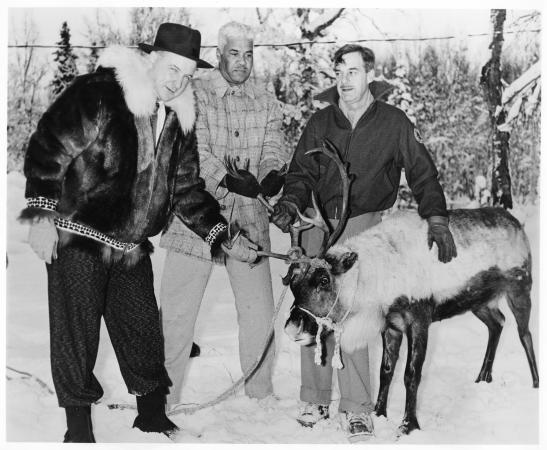
Operation Reindeer Kit, 1958, by Consolidated Freightways, Color document, Smithsonian Institution Archives, RU 365, Box 15, Folder 11, Negative Number SIA2011-0026. You have probably heard of Dasher, Dancer, Prancer, and Vixen. Even Comet, Cupid, Donder and Blitzen. And I know you have heard of Rudolph. But do you recall the Smithsonian’s National Zoo’s most famous reindeers of all? “Operation Reindeer” was the most publicized event of 1958. Fourteen reindeer and one caribou made their way, sans the open sleigh, to Washington, D.C., for the National “Pageant of Peace” and then to the National Zoo. You bet your jingle bells “Operation Reindeer” took planning and precision. Santa’s friends were a gift from Alaska in anticipation of their admittance to the United States as its 49th State on January 3, 1959.  The Greater Washington Board of Trade jumped at the opportunity to provide Santa with his favorite traveling companions for the National “Pageant of Peace” parade. Since the reindeer were not flying much those days, transporting them to D.C. posed a large problem. However, the Smithsonian Institution, Bureau of Indian Affairs, Department of the Interior, and several transportation companies joined forces to make sure the plan would get off the ground. Map of Operation Reindeer Route, 1958, Black and White Document, Smithsonian Institution Archives, RU 365, Box 15, Folder 11, Negative Number SIA2011-0027. In November of 1958, J. Lear Grimmer, Associate Director, and Charles Thomas, Senior Keeper, of the Smithsonian’s National Zoological Park embarked on a trip to Kotzebue, Alaska, on the edge of the Arctic Circle.  Once in Kotzebue, Grimmer and Thomas walked into a winter wonderland known as the tundra where temperatures can reach 50 below zero in the winter. With the help of the local Inuit community, despite tough conditions, they trapped a lively herd. Grimmer and Thomas  did not always win the reindeer games and quickly learned reindeer are a frisky breed—enroute one reindeer kicked the door open of the plane, 2,000 feet above Alaska. It took Grimmer and Thomas all of their might to get the door shut again. Grimmer later said that, “reindeer hate everybody and each other (I guess that is why they laughed and called Rudolph names). Given a chance they will impale you on their antlers like martini olives on a toothpick.” The Alaska Steamship Company’s S.S. Iliamna, 1957, Black and White Print, Smithsonian Institution Archives, RU 365, Box 14, Folder 11, Negative Number SIA2011-0028. The caravan flew 650 miles to Anchorage, Alaska, on an Alaska Air Command plane. The trek then continued via Alaska Railroad to Seward, Alaska, where they met up with the Alaska Steamship Company’s Iliamna. The group then sailed 1,400 miles to Seattle, Washington. Finally, under the watchful eye of Thomas and Grimmer, the animals were loaded onto a specially equipped, 40-foot aluminum livestock trailer from Consolidated Freightways. Operation Reindeer planning gets underway as Operations Engineer for Consolidated Freightways Edwin L. Isenberger (left), Smithsonian National Zoological Park’s Senior Keeper Charles Thomas and Associate Director J. Lear Grimmer map out a route, 1958, Smithsonian Institution Archives, RU 365, Box 15, Folder 11, Negative Number SIA2011-0030. The overland journey began on December 5th. The group went dashing through the snow for 3,100 miles. Two teams of two veteran Consolidated Freightways drivers split the journey in half. The first team, who drove the Seattle to Billings run, included Allen C. Lund and Douglas McCall. Once in Billings, the team of Norman B. Haglund and Allen C. Sagerhorn took the reins and finished the run to Washington, D.C. Traffic Manager for Garrison Fast Freight George M. Sullivan (left), helps Smithsonian National Zoological Park’s Senior Keeper Charles Thomas and Associate Director J. Lear Grimmer load a reindeer on the train set for Seward, Alaska, 1958, Smithsonian Institution Archives, RU 365, Box 15, Folder 11, Negative Number SIA2011-0029. To make the trip a little more merry and bright, each animal was settled into the truck in its own plywood, custom-made, stall where they could sit or stand. Since their normal plant of choice, lichen moss, was hard to come by in D.C., Thomas gradually integrated alfalfa hay into their feed. Along the way the herd made several stops including a trip to at Chicago’s Lincoln Park Zoo, where the animals enjoyed a rest and television appearance. On December 11th, D.C. residents may have heard bells in the snow as the animals safely arrived, with no incidents of running over grandma. After Zoo staff gave the animals a clean bill of health, eight reindeer took up temporary residence on the National Mall, where they entertained visitors for the holiday season. On December 23rd, the herd of eight led Santa’s sleigh in the “Pageant of Peace” parade, and were on hand to watch President Eisenhower light the National Tree. On New Year’s Day the eight reindeer reunited with their pals and took up permanent residence at the National Zoo. The reindeer did so well at the Zoo that within the year, the herd had seven new reindeer calves.
Categories: Collections in Focus, Smithsonian History
Tags: American History, Politics/Government, Event
Comments: View 8 comments, or Give us yours!
All comments are moderated and subject to approval. Further information is available in The Bigger Picture’s Commenting Guidelines.

Comments (8) – Leave a comment

Maureen

Great post! I was only 6 at the time, so I don't have a clear memory of this but it's wonderful to read about it.

Maureen December 22, 2010 at 12:37 pm
  • reply
Courtney

Thank you! I'm glad we could share it with you. Some more information on the “Pageant of Peace” might jog your memory. The event took place on Dec 23, 1958, at 5 p.m. President Eisenhower opened the ceremony by illuminating the National Community Christmas Tree in President’s Park, just south of the White House. The United States Information Agency broadcasted the President’s remarks and the ceremonies to the world in many languages. In addition to the reindeer, highlights from the ’58 celebration included music played by the Armed Services Bands, Church Choirs, and Community Choral Groups. Planners of the event encouraged communities around the country to join in and light their trees at the same time and that the Embassies in D.C. would open their doors for cultural events and activities. Have a Happy holiday!

Courtney December 22, 2010 at 2:15 pm
  • reply
Rob E

Great job!!!

Rob E December 23, 2010 at 10:48 am
  • reply
Margie Gibson

A lovely story! I was in Sami territory in August on a five day camping trip. My one reindeer sighting came on the last day and required the zoom lens on my camera to see what looked like a tiny spot with antlers. It's a lot easier to see the critters in a zoo!

Margie Gibson December 29, 2010 at 1:54 am
  • reply
Laura Esposito

Wow, Courts, it was very well done. You are evolving into an interesting and entertaining writer. Happy New Year sweetie. Love, Mom

Laura Esposito January 1, 2011 at 2:03 pm
  • reply
Jennifer Grandeau

My uncle Norman Haglund, who helped deliver the reindeer, just passed away 11-6-11.
How fun to know he was a part of this!

Jennifer Grandeau November 11, 2011 at 10:36 pm
  • reply
Mark Haglund

This was my father, Norman B. Haglund. He was very proud to drive for consolidated freightways and appreciated that he was awarded the Arthur Godfrey award for his heroic efforts saving a man from a burning car and had the opportunity to haul the reindeer across the United States to the President of the United States, Dwight D. Eisenhauer!

Mark Haglund November 11, 2011 at 11:35 pm
  • reply
Courtney Bellizzi

Mark and Jennifer,

First let me offer my condolences to your family. Thank you for sharing more of your father's story with us. I enjoyed researching the history of this event and really found it fascinating how these animals were transferred across America. Do you know any additional information about the leg of the drive your father drove? I am interested in learning more about the event. Please feel free to continue to share on the blog, or email me at espositoc@si.edu. Thank you again for sharing!

Courtney Bellizzi November 14, 2011 at 4:34 pm
  • reply

Leave a comment

The content of this field is kept private and will not be shown publicly.
  • Web page addresses and e-mail addresses turn into links automatically.
  • Lines and paragraphs break automatically.

More information about formatting options

CAPTCHA
This question is for testing whether you are a human visitor and to prevent automated spam submissions.
By submitting this form, you accept the Mollom privacy policy.

Produced by the Smithsonian Institution Archives. For copyright questions, please see the Terms of Use.

Stay in touch!

Facebook Twitter Flickr YouTube SlideShare
Join our eNewsletter

About

Connecting you to America’s past with a behind-the-scenes exploration of the Smithsonian’s history, treasures, and the challenges that Archives face preserving collections. More details...

Smithsonian on Flickr Commons

Topics/Tags

  • See Here (612)
  • American History (544)
  • Science (431)
  • Archive (332)
  • Cities/Places (279)
  • Exhibitions (235)
  • Web/Tech (211)
  • Photo History (189)
  • Link Love (154)
  • Politics/Government (153)

Blog Roll

All Smithsonian blogs
American Historical Association Blog
American Institute of Conservation Blog
Archives Next
Archives of American Art
Around the Mall
Field Book Project
Hanging Together
Library of Congress Blogs
National Archives (US) Blogs
National Museum of American History, O say can you see?
Smithsonian Collections Blog
Smithsonian Libraries
Teaching American History

Categories

  • Collections in Focus (991)
  • What Gets Saved (338)
  • Behind the Scenes (212)
  • Smithsonian History (136)

Recent Posts

  • See Here: 5/24/2013
  • Link Love: 5/24/2013
  • "If you feed them, they will come."
  • Women in Science Wednesday: Mary Alice McWhinnie
  • Twenty-Six and Blooming!

Monthly Archive

  • May 2013 (26)
  • April 2013 (26)
  • March 2013 (26)
  • February 2013 (26)
  • January 2013 (28)
  • December 2012 (26)
  • November 2012 (28)
  • October 2012 (32)
  • September 2012 (26)
  • August 2012 (31)
  • July 2012 (26)
  • June 2012 (27)
  • May 2012 (27)
  • April 2012 (27)
  • March 2012 (28)
  • February 2012 (27)
  • January 2012 (26)
  • December 2011 (31)
  • November 2011 (28)
  • October 2011 (35)
  • September 2011 (31)
  • August 2011 (35)
  • July 2011 (41)
  • June 2011 (43)
  • May 2011 (33)
  • April 2011 (40)
  • March 2011 (43)
  • February 2011 (35)
  • January 2011 (36)
  • December 2010 (42)
  • November 2010 (40)
  • October 2010 (44)
  • September 2010 (37)
  • August 2010 (39)
  • July 2010 (38)
  • June 2010 (37)
  • May 2010 (42)
  • April 2010 (44)
  • March 2010 (47)
  • February 2010 (40)
  • January 2010 (39)
  • December 2009 (43)
  • November 2009 (34)
  • October 2009 (11)
  • September 2009 (11)
  • August 2009 (12)
  • July 2009 (14)
  • June 2009 (10)
  • May 2009 (12)
  • April 2009 (14)
  • March 2009 (10)
  • January 2009 (1)
Smithsonian Institution Archives
eNewsletter Facebook Twitter Flickr Historypin YouTube SlideShare Browsealoud
Smithsonian Institution
  • Privacy
  • Copyright
  • Contact