
Smithsonian Institution Archives
  • Collections
  • Services
  • Smithsonian History
  • About
  • Education
  • Blog
  • Forums
  • Press
  • Audiences
  • Donate

The Bigger Picture: Visual Archives and the Smithsonian

The Bride Wore White (or Blue, Green, or Black!)

by Catherine Shteynberg on July 16, 2009

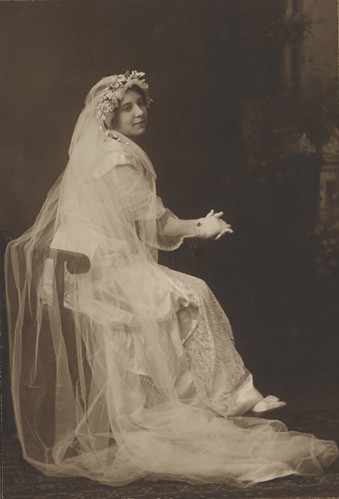
Untitled, by unidentified photographer, date unknown, Anacostia Community Museum.

Wedding season is upon us, and so it is no wonder that this beauty, with her frothy veil and layers of lace has been very popular on the Smithsonian Flickr Commons. Looking at this photo, I realized I didn’t know why brides wear white wedding dresses and so I decided to do some digging.

Many brides assume that the tradition of the white wedding dress comes from the color’s ancient symbolic association with virginity and purity, but in reality, the white wedding dress is a much more recent development. Surely brides wore white gowns before, but it was Queen Victoria who truly popularized this tradition. While royalty typically wore embroidered brocade and crimson robes for weddings, Victoria donned a white satin gown with layers of lace made by two hundred women and a white veil. The lavish dress and the wedding between Victoria and her cousin Albert in 1840 were written up and illustrated in thousands of publications worldwide. Soon, American etiquette books decreed that the white wedding was the "proper style." The white wedding dress became a symbol of wealth and social status—after all, white could not easily be cleaned or worn again outside of hot summer months, and very few women could afford to buy and wear a dress solely for one occasion.

And most likely, our bride above made sure to get to the photographer’s studio for that very reason—to demonstrate that she had the social standing and wealth to have a white wedding dress (and of course, to memorialize an important occasion, her youth, and beauty, as we all like to do!).
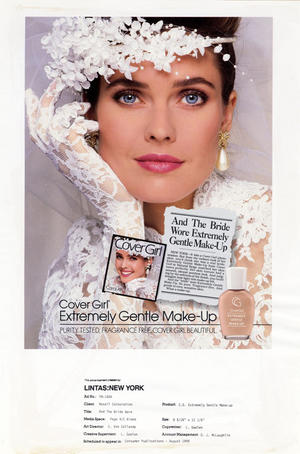
Cover Girl Extremely Gentle Make-Up, by unidentified photographer, 1988, National Museum of American History, Kenneth E. Behring Center, Archives Center.

Even so, until recently bridal attire was simply dictated by what a woman had in her closet and by what was au courant. So, while brides in the Western world have worn white, they’ve also donned every other color of the rainbow (yes, even black!). For example, during the Civil War brides often wore purple to respect and honor the dead. By the late 1800s, American and European brides went wild for dresses in the bright, rich colors created by new synthetic dyes. During WWI, many women considered it their duty to give up a "white wedding" in wartime, and during the Depression most brides had no choice, simply making do with their best dress or suit. But in the 1930s, garment manufacturers began specializing in making wedding dresses, and an onslaught of bridal magazines filled with photographs began marketing the white wedding dress as part of a romantic ideal, a custom from "the earliest ages." And whether contemporary brides embrace or vehemently reject the "traditional" white wedding dress, it is this marketing, rather than any ageless tradition, that has made the white wedding dress a ubiquitous part of our visual culture.

Categories: Collections in Focus
Tags: American History, Flickr Commons, Advertising, Fashion
Comments: View 14 comments, or Give us yours!
All comments are moderated and subject to approval. Further information is available in The Bigger Picture’s Commenting Guidelines.

Comments (14) – Leave a comment

Virginia Postrel

I went to a wedding a few years ago--couple in their late 30s/early40s, first marriage for both--where the bride wore a spectacular emerald green dress. Everyone was surprised, but it was gorgeous and expressed her personality.

Virginia Postrel July 19, 2009 at 2:26 am
  • reply
Catherine Shteynberg, Smithsonian Photography Initiative

Hi Virginia- I think that brides are more and more comfortable wearing something other than the white wedding dress. I think this is partly a result of dress companies now catering to brides who want something "unique". I bet simply advertising multi-colored dresses in magazines probably introduces the idea into the heads of many brides who may not have considered a colored dress before. Also, more and more brides share pictures of their non-white dresses on blogs, Flickr, and other sites, perhaps giving brides some visual encouragement?

Catherine Shteynberg, Smithsonian Photography Initiative July 20, 2009 at 1:01 pm
  • reply
Britton

As a wedding photographer for 5 years now, I've yet to see anything other than a white dress. Maybe that has something to do with the conservative culture of Cincinnati, but I had no idea that the origin of the white dress was pure marketing.

Britton August 3, 2009 at 6:19 am
  • reply
Alan B

I can echo Britton's response above. Almost every bride I photograph wears white. The white dress may be a recent tradition but it has a strong grip on most brides-to-be. It certainly makes an impact when couples think outside of this tradition and style their outfits using their own personalities and creativity.

Alan B August 4, 2009 at 7:30 am
  • reply
Kent

We are seeing a trend away from the pure white or ivory white wedding dress though but the history is fantastic. Queen Victoria was in many ways a spectacular person that did many things to shape the world today, despite being an opium addict! We have photographed several none white dresses, green for instance seems to be very popular due to the earthy and ecological connotations. We recently had a stunning white dress with black lace that was pretty spectacular and a deep rose red in sllk. Personally, I'm not sure but I can at least say that the amount spent on wedding dresses these days is just phenomenal!

Kent August 13, 2009 at 6:02 am
  • reply
Catherine Shteynberg, Smithsonian Photography Initiative

Kent- It is interesting to hear how brides are infusing new symbolism into weddings with their dress color choice (i.e. green = connection to the earth). I myself purchased a non-white wedding dress off the rack for both economical reasons and fashion preferences. On a side note, however, I have found no cited sources that note that Queen Victoria was an opium addict. She did influence the legality and availability of opium in Great Britain and abroad, and there was definitely some opiate addiction within the Royal Family. Nevertheless, while Victoria was most likely perscribed laudanum at some point (an opiate medication, both commonly used and legal at the time), there's no proof that she was addicted to the drug as so many others were (including her daughter) during her time.

Catherine Shteynberg, Smithsonian Photography Initiative August 13, 2009 at 12:27 pm
  • reply
Nottingham

Catherine Queen Victoria being an opium addict is an old wives tail as we call them, rumours passed down for generations but she was widely believed to be an opium addict by the general polulous after her death, not during it though. They do release 'state secrets' after 50 years here so it may be available but I doubt that it would be on the web! Red is definitely the new colour for wedding dresses, especially in the winter. They do remind me of 'little red riding hood' though in the photographs! I recently did a wedding where the bridesmaids were all in beautiful earthy green dresses with crowns made from leaves and twigs etc, they did look really nice and fantastic to photograph!

Nottingham September 17, 2009 at 9:33 am
  • reply
Michael Graham

I think white is here to stay. As a wedding photographer for over 8 years I am yet to see a non white wedding dress (with the exception of the occasional off-white dress). I think that the white color is so identified with weddings that its not really going to ever change. The trend these days is less fluffy dresses and sometimes dresses that look almost like lingerie with lace and all.

Michael Graham September 19, 2009 at 3:19 pm
  • reply
Vladimir Sterkin

As a wedding photographer in St. Louis for over 8 years, my company has seen only 1 non-white dress! It's interesting to finally learn the origin of the white wedding dress.

Vladimir Sterkin September 20, 2009 at 6:18 pm
  • reply
lora johns

WOW, I never knew that that was why brides always wore white dresses! I have been to several Chinese weddings in San Francisco, the brides would change into a red dress for the banquet, which i thought was very unusual, I was told it was to ensure good fortune!

lora johns October 24, 2009 at 9:29 pm
  • reply
northwest photography

I am a professional wedding photographer from Cheshire, UK and have seen a growing trend for brides to wear colours other than white. I have photographed several weddings this year where the bride wore black and it looked stunning in the wedding photographs.

northwest photography November 13, 2009 at 6:09 pm
  • reply
London Wedding Photographer

Most brides that I photograph certainly wear white, cream or ivory. One bride in a vivid red dress did look stunning. But for colours, the traditional muslim or Indian wedding gowns that I have covered win hands down. The make-up is also utterly amazing for colours.

London Wedding Photographer January 12, 2010 at 4:55 pm
  • reply
Steven Hill

I stumbled upon my grandmothers wedding photos the other day from her wedding in 1929. She did have a small petite veil and was wearing white. Even though they lived in a very poor community my grandfather was wearing a suit. It was interesting to see that my grandmothers wedding dress would still be very much in style today.

Steven Hill November 14, 2011 at 6:21 pm
  • reply
Leeds

White with a black pattern in the seams appears to have been one of the most recent trends, Green has gone in and out. Queen victoria would also be most happy as there is a definite trend back towards a classical styled wedding dress that is simplisitic in style with elegant lace. In hard times, trends tend to revert back to reflect a less oppulent history, perhaps the trends in dresses reflects the economic hardships that many are under now. It could also reflect the fact that financial extravagance and exhibiting wealth is probably less than fashionable in the current climes.

Leeds January 5, 2012 at 9:04 am
  • reply

Leave a comment

The content of this field is kept private and will not be shown publicly.
  • Web page addresses and e-mail addresses turn into links automatically.
  • Lines and paragraphs break automatically.

More information about formatting options

CAPTCHA
This question is for testing whether you are a human visitor and to prevent automated spam submissions.
By submitting this form, you accept the Mollom privacy policy.

Produced by the Smithsonian Institution Archives. For copyright questions, please see the Terms of Use.

Stay in touch!

Facebook Twitter Flickr YouTube SlideShare
Join our eNewsletter

About

Connecting you to America’s past with a behind-the-scenes exploration of the Smithsonian’s history, treasures, and the challenges that Archives face preserving collections. More details...

Smithsonian on Flickr Commons

Topics/Tags

  • See Here (484)
  • American History (433)
  • Science (338)
  • Cities/Places (224)
  • Archive (215)
  • Exhibitions (191)
  • Web/Tech (160)
  • Photo History (150)
  • Politics/Government (131)
  • World History (129)

Blog Roll

All Smithsonian blogs
American Historical Association Blog
American Institute of Conservation Blog
Archives Next
Archives of American Art
Around the Mall
Field Book Project
Hanging Together
Library of Congress Blogs
National Archives (US) Blogs
National Museum of American History, O say can you see?
Smithsonian Collections Blog
Smithsonian Libraries
Teaching American History

Categories

  • Collections in Focus (750)
  • What Gets Saved (255)
  • Behind the Scenes (170)
  • Smithsonian History (84)

Recent Posts

  • Sneak Peek: 02/22/2012
  • Tractorcade
  • See Here: 2/20/2012
  • Is that you, John Quincy Adams?
  • See Here: 2/17/2012

Monthly Archive

  • February 2012 (20)
  • January 2012 (26)
  • December 2011 (31)
  • November 2011 (28)
  • October 2011 (35)
  • September 2011 (31)
  • August 2011 (35)
  • July 2011 (41)
  • June 2011 (43)
  • May 2011 (33)
  • April 2011 (40)
  • March 2011 (43)
  • February 2011 (35)
  • January 2011 (36)
  • December 2010 (42)
  • November 2010 (40)
  • October 2010 (44)
  • September 2010 (37)
  • August 2010 (39)
  • July 2010 (38)
  • June 2010 (37)
  • May 2010 (42)
  • April 2010 (44)
  • March 2010 (47)
  • February 2010 (40)
  • January 2010 (39)
  • December 2009 (43)
  • November 2009 (34)
  • October 2009 (11)
  • September 2009 (11)
  • August 2009 (12)
  • July 2009 (14)
  • June 2009 (10)
  • May 2009 (12)
  • April 2009 (14)
  • March 2009 (10)
  • January 2009 (1)
Smithsonian Institution Archives
eNewsletter Facebook Twitter Flickr YouTube SlideShare
Smithsonian Institution
  • Privacy
  • Copyright
  • Contact