
On the evening of Friday, June 30 29, Washington, DC, Northern Virginia, and Eastern Maryland received unanticipated, severe thunderstorms, leaving in their wake downed trees, road closures, and more than a million people without electricity and modern conveniences. Adding to the frustration of being unable to check one’s Facebook page or Tweet from a friend or favorite celebrity were temperatures hovering around 100 degrees during daylight hours (even overnight, the temperature did not drop much lower than 80). No electricity = no air conditioning; thus many in the region fled for cooler accommodations, donned sweatbands and assisted with clean-up efforts, or perhaps found reprieve in the shade reading a book or sifting through old photographs. Similar to a good book, a photograph tells a story; moreover, a photograph forever captures a particular moment in time, and conveys that moment to all who view it.
The Arthur de Carle Sowerby Papers, 1904-1954 and undated, include stunning photographs taken by Sowerby during his career as a naturalist, explorer, artist, and editor. The son of a British missionary to China, Arthur de Carle Sowerby (8 July 1885-16 August 1954) was born in Tai-yuan Fu, Shansi province. In 1908, Sowerby was invited by Robert Stirling Clark, (adventurer, art collector, and heir to the Singer Sewing Machine fortune) to serve as naturalist during Clark’s 1908 scientific expedition into Shansi and Kansu provinces of north China.
The expedition, which lasted more than a year and produced the first known map of the region, is recounted in Through Shên-kan : The Account of the Clark Expedition in North China, 1908-9, by Robert Sterling Clark and Arthur de C. Sowerby, ed. by Major C. H. Chepmell. This volume may be reviewed online through the digital collections of The Sterling and Francine Clark Art Institute. The images from the Clark Expedition include landscapes, staged portraits, and impromptu local scenes. It is the latter which I find most intriguing, as such images document the people of a particular area merely going about their lives. There is, for instance, an image of a man spinning silk, perhaps his occupation, perhaps a hobby.

One of my personal favorites is an image of men pulling rickshaws through the streets in what appears to be a competitive manner.

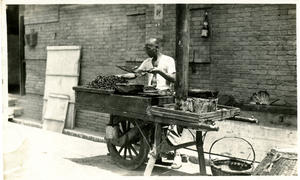
There is also an image of a street food vendor, a common site evident in many towns and cities still, and a testament that although many years may pass, some things remain unchanged.
The introduction of the digital camera and its incorporation into smart phones, tablets, and laptops permit us to freeze time almost without thought. Such technology is remarkable, as it permits us to click away without the limit of numbered frames on a roll of film. Our digital devices are, in most cases, lightweight, discreet, and require little in the way of formal training to operate; simply point and shoot. I wonder what future generations will think of our moments, frozen, somewhere, on a cloud.
One final item of note, in 2009, Li Ju, a Chinese freelance photographer, retraced the path of the Clark Expedition to mark its centennial. Using original images from the expedition as a guide, Li Ju digitally photographed many of the sites visited by Clark and Sowerby in 1908-1909. The resulting images may be viewed in Through Shen-Kan: Revisiting Loess Plateau, China Intercontinental Press, 2012, a truly beautiful book in which original images from the Clark Expedition are displayed adjacent to the modern images Li Ju captured during his journey. These contrasting images are striking, for they show the changes that have occurred across a century, as well as the resilience of the landscape and the people who inhabit the region. The volume serves as an intriguing view into the past, through modern eyes.
Related Resources
- Through Shên-kan: The Account of the Clark Expedition in North China, 1908-1909, Robert Sterling Clark and Arthur De C. Sowerby, London T. Fisher Unwin 1912.
- Through Shên-kan: Sterling Clark in China Online Exhibition, Sterling and Francine Clark Art Institute
Related Collections
- Record Unit 7263 - Arthur de Carle Sowerby Papers, 1904-1954 and undated, Smithsonian Institution Archives
Produced by the Smithsonian Institution Archives. For copyright questions, please see the Terms of Use.
Leave a Comment