
Smithsonian Institution Archives
  • Collections
  • Services
  • Smithsonian History
  • About
  • Education
  • Blog
  • Forums
  • Press
  • Audiences
  • Donate

The Bigger Picture: Visual Archives and the Smithsonian

The Smithsonian: Using and Archiving Facebook

by Lynda Schmitz Fuhrig on May 31, 2011

Did you know that the Smithsonian Institution has about eighty Facebook accounts spread across its museums, research centers, and offices? These Facebook pages document everything from listing upcoming speakers and films, to sharing photos of exhibitions and expeditions, to posting job announcements. Facebook is one of many tools the Smithsonian Institution uses to reach its multiple audiences around the globe. As of May 23, 2011, the main Smithsonian Institution Facebook site had more than 95,000 “Likes” from Facebook users. Since it’s the Smithsonian Institution Archives’ responsibility to retain the Institution’s history, it’s important for us to capture a representative sampling of Facebook pages to document how the Smithsonian used new technology in early 21st century, as well as to preserve content not available elsewhere. While traditional websites might only be updated once a day, weekly, or even less, Facebook pages give Smithsonian museums and offices the opportunity to distribute information more quickly and also allows the public a chance to interact by posting to Facebook Walls. In this sense, Facebook is more personal than a website and delivers more than the 140 characters of a Tweet.

Owney the Railway Mail Dog’s Facebook Info Page on March 2, 2011.

Here’s a sampling of what Smithsonian Facebook Pages had to offer, for example, in March:

  • Smithsonian Folkways Recordings offered an audio clip of “Chopin: Etude in C minor, Op. 25, No. 12” by Robert Pritchard.
  • Owney the Railway Mail Dog from the National Postal Museum posted a link about the use of pneumatic tubes being used for mail delivery in the 19th century.
  • The Smithsonian Marine Ecosystems Exhibit shared coral photos from a Belize research trip.
  • Smithsonian Theaters posted showing times for the film Arabia 3D.
  • The Hirshhorn Museum and Sculpture Garden posted an image of Dana Hoey's Waimea from its collections.

At that same time, a group of five students from the University of Michigan was spending their Alternative Spring Break at the Archives, participating in various projects including digitizing field books and transferring digital audio files. One student spent the week saving a multitude of recent Smithsonian Facebook pages and their additional components such as Info, Photo, and Notes tabs.
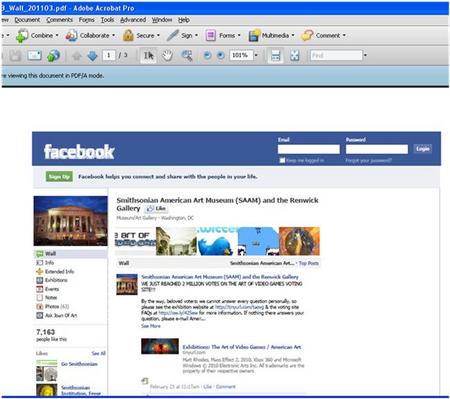
The Smithsonian American Art Museum and Renwick Gallery’s Facebook Wall.

While we have been using a web crawler known as Heritrix to archive the Smithsonian’s traditional websites, we decided we would archive Facebook differently since there are some complications with web crawlers and social media sites. So, we created PDF/A captures of the Facebook pages. PDF/A is a subset of PDF for long-term digital archiving. This international standard requires 100 percent self-containment, meaning fonts are embedded and no audio or video are allowed. The PDF/A file cannot rely on outside content such as hyperlinks. The files are to reproduce the same every time regardless of system. Overall, the archiving process went smoothly but was time consuming. Each Facebook page was opened in a web browser and “Print to PDF” with PDF/A settings was used. When some of the Notes tabs crashed, we experimented with other methods to try to create the PDF files. These captures immediately became records of moments in time. Some pages only have information from 2011. Others include content that goes back farther in history. The plan is to archive these pages on an annual basis, so that in the future viewing these pages can give a researcher a greater appreciation of the scope of what the Smithsonian is and does. Update: If you are interested in “archiving” your own personal account, Facebook offers a feature that allows you to download your information. Go to Account, Account Settings, and Download Your Information. This will copy all your photos, videos, Wall posts, messages, etc. into a compressed file that only you can download. To find out more information on PDF captures of web pages, do a search on screenshots of web pdf.

Categories: What Gets Saved
Tags: Web/Tech, Archive, Digitization
Comments: View 10 comments, or Give us yours!
All comments are moderated and subject to approval. Further information is available in The Bigger Picture’s Commenting Guidelines.

Comments (10) – Leave a comment

Lynda Schmitz Fuhrig

Hi Joyce, I think you are talking about the Arts and Industries Building next to the Smithsonian Castle. Please see these links for some additional information and photos: http://collections.si.edu/search/results.jsp?view=&date.slider=&q=arts+a... http://siarchives.si.edu/history/exhibits/arts/index.htm http://www.facebook.com/media/set/?set=a.10150099373244888.281005.801824... Lynda

Lynda Schmitz Fuhrig June 3, 2011 at 2:59 pm
  • reply
Joyce Keeley Rash

My favorite place to be as a child and as a teen was the Smithsonian. This was the Red Stone bldg at that time. I am ahhh, somewhat,ahem, mature in years. Every summer I would spend as many days as I could, all day long, there. I have spent most of my life away from the area but have those fond memories. I have been to, for me, the new museums and they are impressive but my favorite days were in that red stone bodg.

Joyce Keeley Rash June 2, 2011 at 7:31 pm
  • reply
Tom B

How do I get onto this page as a subscriber?

Tom B June 1, 2011 at 11:19 am
  • reply
Catherine Shteynberg

Hi Tom- Thanks for your interest in the Smithsonian Institution Archives. I don't know if you're referring to subscribing to the blog or if you're talking about our Facebook page, so I'll give you information about both. If you want to subscribe to THE BIGGER PICTURE blog (and we hope you do!) there are two ways to do so: click the orange RSS feed icon on the top right of this page and you can subscribe via Google Reader or any other feed reader that you use; or, enter in your email address into the box below the RSS feed button on the top right, and you'll automatically be subscribed to the blog via email. If you want to get information from the Archives via Facebook, go to our Facebook Page at: http://www.facebook.com/SmithsonianInstitutionArchives and click the "Like" button at the very top. Our status updates will automatically appear in your feed from there on. I hope this helps! Don't hesitate to contact us again if you have any questions. Thanks! Catherine

Catherine Shteynberg June 2, 2011 at 2:24 pm
  • reply
Catherine Shteynberg

Hi Sylvina- Lynda will be in touch with you directly! For everyone else, please note that Lynda updated the post above with information about archiving personal Facebook accounts and searching for PDF captures of web pages. Thanks! Catherine

Catherine Shteynberg June 6, 2011 at 4:28 pm
  • reply
Mat Kelly

Hi, I wanted to make you aware of another means of archiving Facebook pages that we've developed through a Firefox Add-on called Archive Facebook. Our plugin currently allows one to archive his/her own Facebook account while preserving the look-and-feel as well as the interactivity to which the user is accustomed. We have expanded the functionality of this add-on by also allowing one to download any of his/her friends' Facebook pages as well as archiving a Group/Fan page but have restricted the first release for quick approval by Mozilla and will deploy a subsequent version with this added version immediately upon approval. Please try the add-on out at https://addons.mozilla.org/en-US/firefox/addon/archivefacebook/ or see a blog post we did about it some time back at http://ws-dl.blogspot.com/2009/09/archivefacebook.html . Thanks!

Mat Kelly June 9, 2011 at 6:38 am
  • reply
Sylvina Tilbury

I'd be really interested to hear more about how you got Facebook to print to PDF successfully. We at the Highland Historic Environment Record (record of historic and archaeological sites in the Scottish Highlands) have launched a Facebook page to encourage user contributions. I wanted to do the same as you have done ie archive the actual Facebook content by printing to PDF. I managed it but not without a lot of difficulty. Any tips?

Sylvina Tilbury June 4, 2011 at 5:53 pm
  • reply
Lynda Schmitz Fuhrig

Robert,
Thank you for your comment. We are glad to hear the the Smithsonian Institution left a lasting impression on you.
Lynda

Lynda Schmitz Fuhrig September 8, 2011 at 12:18 pm
  • reply
Katina Lear

I was wondering what you all do about the comments at the tops of the pages getting cut off. Do you go back in and gather those separately or have you found another solution that you would like to share.

Thanks so much for all of your assistance and have a wonderful day.

Katina

Katina Lear September 27, 2011 at 1:21 pm
  • reply
Lynda Schmitz Fuhrig

Hi Katina,
You might need to adjust your print size settings. Good luck.

Lynda Schmitz Fuhrig September 29, 2011 at 4:35 pm
  • reply

Leave a comment

The content of this field is kept private and will not be shown publicly.
  • Web page addresses and e-mail addresses turn into links automatically.
  • Lines and paragraphs break automatically.

More information about formatting options

CAPTCHA
This question is for testing whether you are a human visitor and to prevent automated spam submissions.
By submitting this form, you accept the Mollom privacy policy.

Produced by the Smithsonian Institution Archives. For copyright questions, please see the Terms of Use.

Stay in touch!

Facebook Twitter Flickr YouTube SlideShare
Join our eNewsletter

About

Connecting you to America’s past with a behind-the-scenes exploration of the Smithsonian’s history, treasures, and the challenges that Archives face preserving collections. More details...

Smithsonian on Flickr Commons

Topics/Tags

  • See Here (611)
  • American History (542)
  • Science (429)
  • Archive (329)
  • Cities/Places (277)
  • Exhibitions (234)
  • Web/Tech (210)
  • Photo History (189)
  • Link Love (153)
  • Politics/Government (153)

Blog Roll

All Smithsonian blogs
American Historical Association Blog
American Institute of Conservation Blog
Archives Next
Archives of American Art
Around the Mall
Field Book Project
Hanging Together
Library of Congress Blogs
National Archives (US) Blogs
National Museum of American History, O say can you see?
Smithsonian Collections Blog
Smithsonian Libraries
Teaching American History

Categories

  • Collections in Focus (988)
  • What Gets Saved (337)
  • Behind the Scenes (212)
  • Smithsonian History (134)

Recent Posts

  • See Here: 5/17/2013
  • Link Love: 5/17/2013
  • Weird and Wonderful: The Surprising Mrs. Hilda Hempl Heller
  • Women in Science Wednesday: Anne Hagopian
  • Sneak Peek 5/15/2013

Monthly Archive

  • May 2013 (20)
  • April 2013 (26)
  • March 2013 (26)
  • February 2013 (26)
  • January 2013 (28)
  • December 2012 (26)
  • November 2012 (28)
  • October 2012 (32)
  • September 2012 (26)
  • August 2012 (31)
  • July 2012 (26)
  • June 2012 (27)
  • May 2012 (27)
  • April 2012 (27)
  • March 2012 (28)
  • February 2012 (27)
  • January 2012 (26)
  • December 2011 (31)
  • November 2011 (28)
  • October 2011 (35)
  • September 2011 (31)
  • August 2011 (35)
  • July 2011 (41)
  • June 2011 (43)
  • May 2011 (33)
  • April 2011 (40)
  • March 2011 (43)
  • February 2011 (35)
  • January 2011 (36)
  • December 2010 (42)
  • November 2010 (40)
  • October 2010 (44)
  • September 2010 (37)
  • August 2010 (39)
  • July 2010 (38)
  • June 2010 (37)
  • May 2010 (42)
  • April 2010 (44)
  • March 2010 (47)
  • February 2010 (40)
  • January 2010 (39)
  • December 2009 (43)
  • November 2009 (34)
  • October 2009 (11)
  • September 2009 (11)
  • August 2009 (12)
  • July 2009 (14)
  • June 2009 (10)
  • May 2009 (12)
  • April 2009 (14)
  • March 2009 (10)
  • January 2009 (1)
Smithsonian Institution Archives
eNewsletter Facebook Twitter Flickr Historypin YouTube SlideShare Browsealoud
Smithsonian Institution
  • Privacy
  • Copyright
  • Contact