
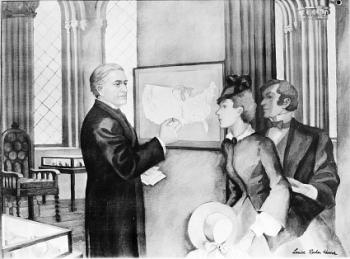
As a Smithsonian intern working on mobile strategies and initiatives, I’m conducting research into how crowdsourcing can be integrated into mobile applications, enabling the sharing of ideas and knowledge, and making the Smithsonian experience, for those inside our Institution and beyond, more valuable and engaging. A recent New York Times article that called attention to some of the recent crowdsourcing projects currently underway at the Smithsonian also noted that crowdsourcing has long been a part of the Institution’s strategy. As a first step in my research—and with the help of Pamela Henson and Courtney Esposito of the Smithsonian Archives—I’ve been looking at some interesting projects the Smithsonian has developed since its founding that demonstrate the Institution’s longstanding tradition of involving volunteers in its mission to “increase and diffuse knowledge.” One of the first crowdsourcing projects at the Institution was the Meteorological Project started by the Smithsonian’s first Secretary, Joseph Henry. In 1849 he set up a network of some 150 volunteer weather observers all over the country. Within a decade, the project had more than 600 volunteer observers and had spread to Canada, Mexico, Latin America, and the Caribbean. The amateur weather enthusiasts submitted monthly reports that were then analyzed by James H. Coffin, professor of mathematics and natural philosophy at Lafayette College in Easton, Pennsylvania, and finally published in 1861 in the first of a two- volume compilation of climatic data and storm observations based on the volunteers' reports.

One of the most amazing things about this project is that Henry used the telegraph to gather volunteers’ data and create a large weather map, making new information available to the public daily. Henry’s project is considered the origin of what later became the National Weather Service.
Spencer Fullerton Baird , scientist, collector and Secretary of the Smithsonian after Henry, was an important figure who helped the Institution enrich its natural history collections enormously with plants, animals, and minerals specimens. From the 1850s to the 1880s, he sent out expeditions to explore and map the North American continent and send back railroad cars full of new plants, insects, birds, and rocks. He also gathered together a group of young men, who called themselves the Megatherium Society, (see left) and taught them how to explore, collect, and conduct scientific research, channeling their interests into research that benefitted the Smithsonian.

Another incredible example of crowdsourcing in Smithsonian history is represented by the volunteer work many soldiers did during the World War II. At the U.S. National Museum (today’s National Museum of Natural History), curators wrote a pocket manual called Field Collector’s Manual in Natural History, which taught soldiers how to collect, prepare, and document specimens for shipment back to the Museum. One of these soldiers was Sammy M. Ray (whose letters are available at SIA in Record Unit 192, Box 557), (see above) recent graduate of Louisiana State University with a degree in biology, who collected birds in the Pacific islands during his military mission. Once back in the US after the war, he continued his natural history studies, becoming a professor of marine biology at Texas A&M University.

In the late 1950’s the Operation Moonwatch program started tracking the path of a satellite launched by the United States during the International Geophysical Year (7/1/1958–12/31/1958). This program involved more than 100 teams of volunteers worldwide in the tracking operations, recruited mainly thanks to the Smithsonian Astrophysical Observatory's Moonwatch Network.
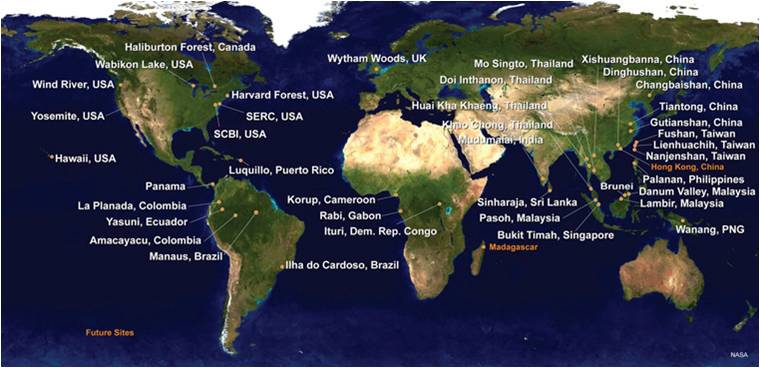
Finally, one of the most amazing crowdsourcing projects still running at the Smithsonian Institution today is the Center for Tropical Forest Science (CTFS). Started in the 1970’s by the Smithsonian Tropical Research Institute in Panama, CTFS is a global network of forest research plots planted for the study of tropical and temperate forest function and diversity with the aim of pursuing sustainability and conservation. This multi-institutional network comprises more than thirty locations across the Americas, Africa, Asia, and Europe, involving hundreds of scientists from more than 40 institutions worldwide. Today, the Smithsonian has even more powerful social media and mobile platforms that enable it to “recruit the world” to help with its important work.
Examples of 21st century crowdsourcing projects currently underway include:
- Smithsonian Flickr Commons
- The Encyclopedia of Life and its mobile “Uploader” app
- The “Leafsnap” leaf-identifier App in development by the National Museum of Natural History and scheduled for release in April 2011
- An application for visitors to the Smithsonian on the National Mall, currently in development and including features that will enable visitors to collaborate with the Institution in creating the guide to the Smithsonian that best serves their needs
- New mobile tools and other social media platforms exponentially increase the reach and opportunities for Smithsonian engagement with people around the world. But it’s nice to be reminded that we are continuing in a time-honored and well proven tradition of collaboration in building the Smithsonian of the 21st century. You can visit the Smithsonian’s mobile site as well as our public wiki for updates on all mobile projects at the Smithsonian, and you can see an updated list of how the Smithsonian is using social media to expand its mission on our public Web Strategy wiki.
Note: Elena's related presentation is available on Slideshare and below.
Produced by the Smithsonian Institution Archives. For copyright questions, please see the Terms of Use.
Leave a Comment