
Smithsonian Institution Archives
  • Collections
  • Services
  • Smithsonian History
  • About
  • Education
  • Blog
  • Forums
  • Press
  • Audiences
  • Donate

The Bigger Picture: Visual Archives and the Smithsonian

Mapping the Moon

by Ross Anderson on May 19, 2009

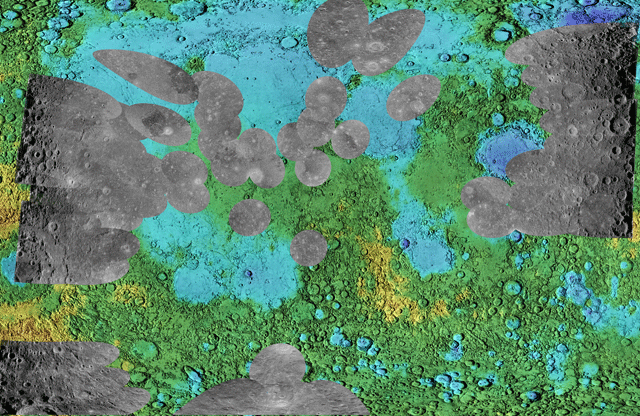
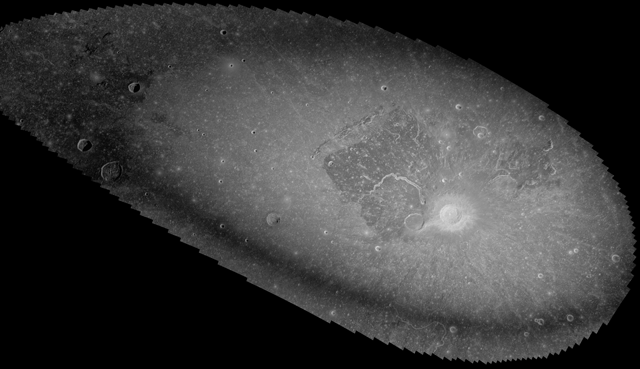
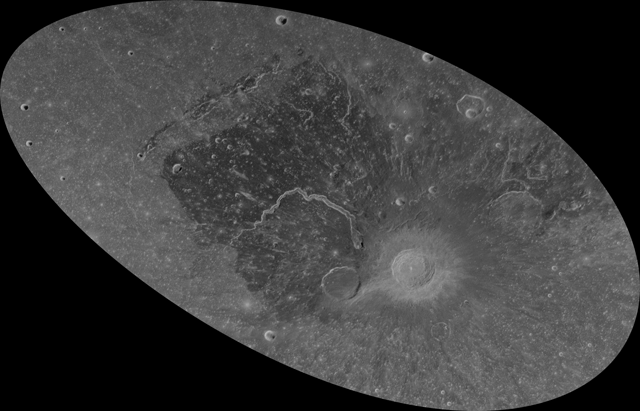
Though photographs are accepted as subjective but ultimately faithful visual reproductions of reality, in many instances they don’t correspond to our experience. Pupils don’t regularly glint red, and people don’t transform into the streaked, evanescent smears we so often witness in photos. Yet we have no trouble accepting these inconsistencies, knowing that taking a picture of a scene intrudes into the "reality" of that scene, and thus the resulting photograph is both a depiction of a real image and the story of its capture. And so we explain away the red eyes as a product of the camera’s flash, and the smear as the result of someone moving more quickly than the camera’s exposure time. We take intuitive steps in these instances to interpret the photos and reconcile them with reality. Something similar happens in understanding the photo-like reproductions of physical data produced by radar imaging, but the interpretive steps are far more complex. Bruce Campbell, of the Center for Earth and Planetary Sciences (CEPS) at the Smithsonian National Air and Space Museum, is at the forefront of Earth-based radar mapping of the moon. With the help of Lynn Carter and myself, both at CEPS, he has been working the last five years to make radar maps of the entire near side of the Moon and its poles. The maps are being constructed in a piecemeal fashion: about 120 egg-shaped patches, each covering a unique portion of the lunar surface and overlapping slightly with those adjacent to it, will be mosaicked together into a 72000 by 48000 pixel cylindrical map and two 23000 by 23000 pixel polar maps. Each patch is mapped at 80m/pixel, the highest resolution Earth-based radar maps of the Moon’s surface yet produced. As of today, the project is over half complete; around 60 of these patches have been processed and incorporated into the working mosaics. Lunar Nearside Mosaic Overlaid on Topographic Map, by Bruce Campbell, Mar. 2009, National Air and Space Museum With all of the high-resolution visible light images of the lunar surface obtained since the 1960’s, what additional information does radar imaging provide?  Radar employs radio waves, the longest in the electromagnetic spectrum, with wavelengths up to the meter scale. Longer waves are able to penetrate surfaces that would reflect shorter waves like those in the visible portion of the spectrum. Thus the 12.6-cm waves used in this mapping probe a meter or more into the regolith (the layer of dust and rock blanketing almost the entire Moon), and are reflected, or backscattered, by surface and subsurface rocks, providing data that can be manipulated into a realistic image. Knowledge of the surface and subsurface roughness helps elucidate the Moon’s history and provides information vital for future missions and geologic studies. Recently, for example, data from this project aided NASA’s LCROSS mission by providing high-resolution views of possible impact sites in craters near the north pole. Intermediate Delay-Doppler Image of Target Centered on Aristarchus Crater, by Bruce Campbell, Feb. 2009, National Air and Space Museum The process by which this backscattered energy is collected and translated into an accurate picture of the Moon’s surface is complicated. A radar signal is transmitted toward the Moon from the 300-m telescope in Arecibo, Puerto Rico. For 29 minutes, this pulsing beam follows a designated coordinate on the surface while the 100-m telescope in Green Bank, West Virginia samples the reflected signal, recording it as a string of voltage values. From these values, a matrix of time-delay and frequency measurements is derived that forms a crude image. The surreal image produced at this stage betrays the method of acquisition. The diffraction caused by the beam’s transmission from a circular aperture can be seen in the dark "nulls" and progressively dimmer rings surrounding the illuminated central oval. Moreover, during the 29 minutes the Moon and Earth are moving, a fact visible in the warped nature of the picture. At such a high resolution, it’s impossible for the mind to decode the convoluted effects of this motion in detail and thereby intuit the actual spatial layout of this portion of the surface. Specialized processing software is used to relate segments of the illuminated area to a latitude-longitude grid, in a "focusing" method based on quantitative models approximating the movement of the Moon in relation to the receiving telescope. The resultant focused image is trimmed to the boundary of the central beam - the bright, inner egg - and added to the mosaic. Processed Image of Aristarchus, Pre-Trimming, by Bruce Campbell, Feb. 2009, National Air and Space Museum Image of Aristarchus Used in the Mosaic, by Bruce Campbell, Feb. 2009, National Air and Space Museum As we intuitively do with camera images, we can account for the effects of the data collection method on the unfocused radar image to obtain a high-resolution picture of the surface of the Moon consistent with our conception of reality.
By Ross Anderson, Physical Scientist, Smithsonian Center for Earth and Planetary Sciences

Categories: Collections in Focus
Tags: Science, Archive
Comments: View 5 comments, or Give us yours!
All comments are moderated and subject to approval. Further information is available in The Bigger Picture’s Commenting Guidelines.

Comments (5) – Leave a comment

XM

Pics too small.

XM May 27, 2009 at 4:35 pm
  • reply
Catherine Shteynberg, Smithsonian Photography Initiative

Hi XM-
We're working to see if we can get larger pictures linked to the images on the post above, so you can examine them in detail.

Catherine Shteynberg, Smithsonian Photography Initiative May 29, 2009 at 2:55 pm
  • reply
Effie Kapsalis, Smithsonian Photography Initiative

Larger photos are available now!

Effie Kapsalis, Smithsonian Photography Initiative June 1, 2009 at 11:14 am
  • reply
migca

Very interesting images, thanks. Aristarchus has intrigued me for some time. This imaging method seems to really bring out the dark, near-rectangular patch adjacent to the crater. Is it solely because these radar waves better penetrate the regolith? I realize this blog pertains to photographic methods, but any other comments about that odd-shaped dark area?

migca July 23, 2009 at 5:20 pm
  • reply
Ross Anderson

Thanks for your comment and interest. The dark patch does appear in the radar data as a result of the signal's penetration of the regolith. A dark radar return in this case indicates the presence of few subsurface rocks, which cause the signal to be scattered more diffusely and thereby lead to a brighter return. There are few subsurface rocks in this area because it is a pyroclastic deposit composed of fine volcanic materials; hence the way the patch emanates out from the snaking rille formed by a lava flow. Also, all of the radar data is taken with a circular-polarized signal, which propagates in a helical pattern with a certain orientation. This orientation can reverse upon reflection or remain the same. Our receiving apparatus is set up so that it distinguishes these two type of reflected signal and records them separately. Ultimately, two images are produced from the backscatter from each target, a same-sense, or depolarized, image documenting the reflected signal that has retained its orientation, and an opposite-sense, or polarized, image documenting the signal with a reversed orientation. The image of Aristarchus you see is the depolarized image. These images generally have higher contrast, as they document the more diffusely scattered reflection and thus better register differences between areas with different concentrations of rocks. However, they have a lower signal-to-noise ratio than the polarized images, which capture the signal reflected in a more specular, or mirror-like, manner and better convey the overall structure of the subsurface, as opposed to more subtle, local details. We used the depolarized image here because of the greater contrast. Thanks again!

Ross Anderson July 27, 2009 at 9:45 am
  • reply

Leave a comment

The content of this field is kept private and will not be shown publicly.
  • Web page addresses and e-mail addresses turn into links automatically.
  • Lines and paragraphs break automatically.

More information about formatting options

CAPTCHA
This question is for testing whether you are a human visitor and to prevent automated spam submissions.
By submitting this form, you accept the Mollom privacy policy.

Produced by the Smithsonian Institution Archives. For copyright questions, please see the Terms of Use.

Stay in touch!

Facebook Twitter Flickr YouTube SlideShare
Join our eNewsletter

About

Connecting you to America’s past with a behind-the-scenes exploration of the Smithsonian’s history, treasures, and the challenges that Archives face preserving collections. More details...

Smithsonian on Flickr Commons

Topics/Tags

  • See Here (614)
  • American History (553)
  • Science (436)
  • Archive (338)
  • Cities/Places (282)
  • Exhibitions (236)
  • Web/Tech (215)
  • Photo History (190)
  • Link Love (157)
  • Politics/Government (154)

Blog Roll

All Smithsonian blogs
American Historical Association Blog
American Institute of Conservation Blog
Archives Next
Archives of American Art
Around the Mall
Field Book Project
Hanging Together
Library of Congress Blogs
National Archives (US) Blogs
National Museum of American History, O say can you see?
Smithsonian Collections Blog
Smithsonian Libraries
Teaching American History

Categories

  • Collections in Focus (1001)
  • What Gets Saved (342)
  • Behind the Scenes (213)
  • Smithsonian History (141)

Recent Posts

  • Mr. Rogers at the Zoo
  • Sneak Peek 6/17/2013
  • Link Love: 6/14/2013
  • Summertime on the Mall - Smithsonian Folklife Festival
  • Women in Science Wednesday: Libbie Henrietta Hyman

Monthly Archive

  • June 2013 (13)
  • May 2013 (32)
  • April 2013 (26)
  • March 2013 (26)
  • February 2013 (26)
  • January 2013 (28)
  • December 2012 (26)
  • November 2012 (28)
  • October 2012 (32)
  • September 2012 (26)
  • August 2012 (31)
  • July 2012 (26)
  • June 2012 (27)
  • May 2012 (27)
  • April 2012 (27)
  • March 2012 (28)
  • February 2012 (27)
  • January 2012 (26)
  • December 2011 (31)
  • November 2011 (28)
  • October 2011 (35)
  • September 2011 (31)
  • August 2011 (35)
  • July 2011 (41)
  • June 2011 (43)
  • May 2011 (33)
  • April 2011 (40)
  • March 2011 (43)
  • February 2011 (35)
  • January 2011 (36)
  • December 2010 (42)
  • November 2010 (40)
  • October 2010 (44)
  • September 2010 (37)
  • August 2010 (39)
  • July 2010 (38)
  • June 2010 (37)
  • May 2010 (42)
  • April 2010 (44)
  • March 2010 (47)
  • February 2010 (40)
  • January 2010 (39)
  • December 2009 (43)
  • November 2009 (34)
  • October 2009 (11)
  • September 2009 (11)
  • August 2009 (12)
  • July 2009 (14)
  • June 2009 (10)
  • May 2009 (12)
  • April 2009 (14)
  • March 2009 (10)
  • January 2009 (1)
Smithsonian Institution Archives
eNewsletter Facebook Twitter Flickr Historypin YouTube SlideShare Browsealoud
Smithsonian Institution
  • Privacy
  • Copyright
  • Contact