
Smithsonian Institution Archives
  • Collections
  • Services
  • Smithsonian History
  • About
  • Education
  • Blog
  • Forums
  • Press
  • Audiences
  • Donate

The Bigger Picture: Visual Archives and the Smithsonian

Location! Location! Location!

by Marvin Heiferman on July 6, 2011

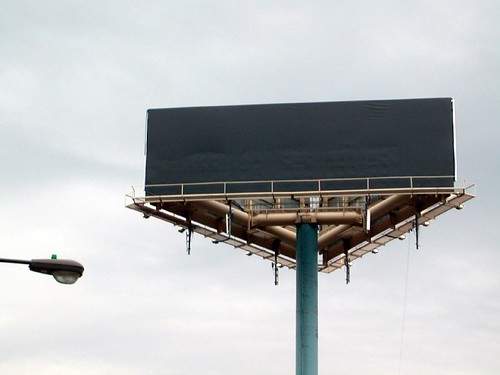
Your Message Here, by Steven Morris, Creative Commons Attribution: BY-NC-ND 2.0.

“Location, location, location” is a widely acknowledged mantra in real estate and marketing. To ultimately reap the biggest reward, situate yourself at the busy or prestigious intersection where the audiences you hope to reach congregate. The same hold true online and in virtual space; if you want to attract online attention, make sure to go play in traffic.

That’s what, according to a recent report in early June on The Atlantic’s website, the National Archives and Records Administration (NARA) has recently chosen to do. Acknowledging that Wikipedia has become the go-to first stop for impatient researchers, NARA has hired Dominic McDevitt-Parks, a graduate student working towards his master’s degree in history and archive management, as a “Wikipedian-in-residence” this summer.

While the National Archives is a unique repository of primary documents, records, and cultural records, “they don't do a great job,” McDevitt-Parks says, “of presenting this information to the public in a searchable, digestible format. This is exactly what Wikipedia does: presenting history and culture in a way that people use every day. For the Archives specifically, the mission is not just preserving documents, but promoting their use. Through some sort of collaboration, we can make these records available for regular use by the public at large."

As it turns out, the Smithsonian is also an active participant in the summer residency programs, and back in May announced that Sarah Stierch, a Museum Studies Masters student at George Washington University, would become a Wikipedian-in-Residence at the Archives of American Art (AAA), starting in June. Among her goals are to expand the Archives of American Art’s Wikipedia presence by creating new pages on notable topics, and making a content donation of documents and images from the archive’s collections, so that they can be used by educators and researchers worldwide with few copyright restrictions. (This leveraging of content on heavily trafficked public sites is something the Smithsonian Institution Archives has already been working on by digitizing sets of historic images and making them available to the public on sites like the Flickr Commons.)

"Women in Science," an example of one of the sets of Smithsonian Institution Archives images posted on the Smithsonian Flickr Commons.

With increasing frequency, national institutions around the world are signing on to partner with organizations like Wikipedia and experimenting with strategies to insure that their holdings not only reach larger audiences, but are accurately characterized on popular websites. In June 2010, according to a New York Times report, the British Museum invited dozens of Wikipedia contributors from the London area to spend time at the museum, granting them a “backstage pass” to take photographs and meet with curators in order to make sure the museum’s holdings and expertise are well represented. As Matthew Cock, who is in charge of the British Museum’s website, noted, “I looked at how many Rosetta Stone page views there were at Wikipedia…and five times as many people go to the Wikipedia article as to ours.”

There are, to be sure, intriguing options and tricky issues to deal with in such collaborations. Because Wikipedia is, as the Times mentioned, “strongly identified with the ‘free culture movement,’” problems can arise. They did when Wikipedia made high resolution images of objects from Britain’s National Portrait Gallery collection available, because it turned out that the rights and reproduction revenues generated by them were something the institution couldn’t afford to forgo.

Bumps in the road are, probably, inevitable as the sharing (and monetization) of information progresses, but the win-win impact of delivering archival content to larger audiences seems like something we’ll be hearing more about in the future.

Categories: What Gets Saved
Tags: Education, Web/Tech, Archive
Comments: View 3 comments, or Give us yours!
All comments are moderated and subject to approval. Further information is available in The Bigger Picture’s Commenting Guidelines.

Comments (3) – Leave a comment

Jenni

Personally I think it somewhat short sighted of the National Portrait Gallery. I understand the concern over forgoing rights and reproduction revenues, but those revenues are shrinking anyway. Allowing the sharing on popular sites will hopefully help grow interest and then there will be the possibility of ongoing revenue in some form or another - rather than an eventual death of all interest. Thanks for the post, gives me some hope :)

Jenni July 6, 2011 at 2:47 pm
  • reply
Marilyn Connors

There is another saying in marketing that you can have the best product in the world, but if it is not marketed correctly, then it will not benefit anyone. The repository at the National Archives contains the best documents and information. While Wikipedia is a master at marketing information in a very digestible manner to people. Combining the best product with some top marketers is very innovative, and should result in a win-win-win situation for the Archives, for Wikipedia, and for most importantly, the American public. There is an important lesson to be learned from this. Great post.

Marilyn Connors July 7, 2011 at 11:30 am
  • reply
Marvin Heiferman

Jenni: your point's a good one, partcularly if you subscribe to the saying "What goes around comes around." One can argue pretty convincingly that making archival assets more available and accessible will pay off in increased visibility and audience numbers. On the other hand, if you're charged with running a not-for-profit in a time of extreme budget cutbacks, maybe it's worth charging whatever you can get for repro fees, assuming the cost of administering those rights and collecting fees doesn't wipe out whatever profit there is to be made. We're definitely at a crossroad in terms of free vs. pay-for-view/use access. Look at media properties like the New York Times which a couple of months back instituted a sliding fee structure for varying levels of access to the news and its archive. In the next few years, and depending what happens in the global economy, I think we'll see a lot more options re: free/fee get tested out.

Marvin Heiferman July 7, 2011 at 1:53 pm
  • reply

Leave a comment

The content of this field is kept private and will not be shown publicly.
  • Web page addresses and e-mail addresses turn into links automatically.
  • Lines and paragraphs break automatically.

More information about formatting options

CAPTCHA
This question is for testing whether you are a human visitor and to prevent automated spam submissions.
By submitting this form, you accept the Mollom privacy policy.

Produced by the Smithsonian Institution Archives. For copyright questions, please see the Terms of Use.

Stay in touch!

Facebook Twitter Flickr YouTube SlideShare
Join our eNewsletter

About

Connecting you to America’s past with a behind-the-scenes exploration of the Smithsonian’s history, treasures, and the challenges that Archives face preserving collections. More details...

Smithsonian on Flickr Commons

Topics/Tags

  • See Here (612)
  • American History (544)
  • Science (431)
  • Archive (332)
  • Cities/Places (279)
  • Exhibitions (235)
  • Web/Tech (211)
  • Photo History (189)
  • Link Love (154)
  • Politics/Government (153)

Blog Roll

All Smithsonian blogs
American Historical Association Blog
American Institute of Conservation Blog
Archives Next
Archives of American Art
Around the Mall
Field Book Project
Hanging Together
Library of Congress Blogs
National Archives (US) Blogs
National Museum of American History, O say can you see?
Smithsonian Collections Blog
Smithsonian Libraries
Teaching American History

Categories

  • Collections in Focus (991)
  • What Gets Saved (338)
  • Behind the Scenes (212)
  • Smithsonian History (136)

Recent Posts

  • See Here: 5/24/2013
  • Link Love: 5/24/2013
  • "If you feed them, they will come."
  • Women in Science Wednesday: Mary Alice McWhinnie
  • Twenty-Six and Blooming!

Monthly Archive

  • May 2013 (26)
  • April 2013 (26)
  • March 2013 (26)
  • February 2013 (26)
  • January 2013 (28)
  • December 2012 (26)
  • November 2012 (28)
  • October 2012 (32)
  • September 2012 (26)
  • August 2012 (31)
  • July 2012 (26)
  • June 2012 (27)
  • May 2012 (27)
  • April 2012 (27)
  • March 2012 (28)
  • February 2012 (27)
  • January 2012 (26)
  • December 2011 (31)
  • November 2011 (28)
  • October 2011 (35)
  • September 2011 (31)
  • August 2011 (35)
  • July 2011 (41)
  • June 2011 (43)
  • May 2011 (33)
  • April 2011 (40)
  • March 2011 (43)
  • February 2011 (35)
  • January 2011 (36)
  • December 2010 (42)
  • November 2010 (40)
  • October 2010 (44)
  • September 2010 (37)
  • August 2010 (39)
  • July 2010 (38)
  • June 2010 (37)
  • May 2010 (42)
  • April 2010 (44)
  • March 2010 (47)
  • February 2010 (40)
  • January 2010 (39)
  • December 2009 (43)
  • November 2009 (34)
  • October 2009 (11)
  • September 2009 (11)
  • August 2009 (12)
  • July 2009 (14)
  • June 2009 (10)
  • May 2009 (12)
  • April 2009 (14)
  • March 2009 (10)
  • January 2009 (1)
Smithsonian Institution Archives
eNewsletter Facebook Twitter Flickr Historypin YouTube SlideShare Browsealoud
Smithsonian Institution
  • Privacy
  • Copyright
  • Contact