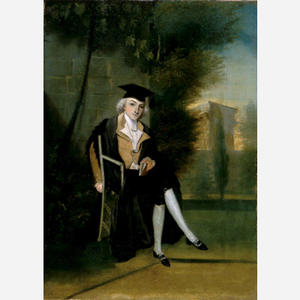
Some students look forward eagerly to the new school year; others dread the end of summer and the long year ahead. How did the Smithsonian’s founding donor,
James Smithson (1765-1829), feel about school? Smithson attended Oxford University in England from 1782 to 1786, receiving a Masters of Arts degree in chemistry and mineralogy. Smithson was a wealthy gentleman and so he could have approached his university years as many of his wealthy friends did—appearing early in the semester for a few days and reappearing at the end of term, throwing lavish parties, and obtaining degrees based on social status rather than their academic achievements.
James Smithson’s years at Oxford were quite different. Born James Lewis Macie, probably in Paris in 1765, he was the illegitimate son of the Duke of Northumberland, who had attended Oxford. On the college register, he is listed as a gentleman commoner, but the space for his father’s name is left blank, reflecting his difficult social position. Smithson lived in spacious rooms in the ivy-covered Pembroke College, a constituent of Oxford, and settled into some of his happiest years. Unlike many of his peers, Smithson plunged into the academic world with great determination and remained in residence, meeting with professors and attending lectures regularly. He was enthralled by the new science of chemistry that promised to unlock the secrets of the natural world.

In 2007, I visited Pembroke College to see where Smithson passed his university years, and spent time poring through the account books in the archives. The account books track how much each student spent on food and miscellaneous expenses every day. They reveal that, like many wealthy Oxford students, Smithson often entertained lavishly. But other wealthy students had only a few entries per term, demonstrating how little time they spent at school. Smithson’s accounts prove that he rarely left Oxford during those years. When he graduated, his good friend, the noted scientist Davis Gilbert, described him as the finest chemist and mineralogist of his year.
In addition to attending lectures by such figures as
Samuel Johnson (the noted English writer and scholar), Smithson conducted scientific experiments in what is now the Museum of History of Science in Oxford, and was introduced to coffee house culture. In this period, scientists would gather at the local coffee houses to talk about their research, new scientific papers received, and experiments observed. Smithson formed a close friendship with the noted and reclusive scientist
Henry Cavendish, among others. By the time he graduated in 1786, he had not only learned about the exciting new scientific field of chemistry, he was making original contributions himself.
Smithson wrote, "Chemistry is yet so new a science;. . .our knowledge in every department of it is so incomplete, consisting entirely of isolated points, thinly scattered, like lurid specks on a vast field of darkness, that no researches can be undertaken without producing some facts leading to consequences which extend beyond the boundaries of their immediate object." He became an active member of the scientific community, as the youngest member of the prestigious Royal Society of London in 1787 and a founding member of the Royal Institution of Great Britain in 1800. He presented his first paper on
"An Account of Some Chemical Experiments on Tabasheer," to the Royal Society in 1791.
The love of learning and the belief that science played a central role in human society that were instilled in James Smithson during his Oxford years sustained him throughout the rest of his life and inspired his bequest to the United States to found an institution for “the increase and diffusion of knowledge among men.”



Leave a Comment