
As any archivist would find familiar, during a recent survey of a collection consisting of thousands of archival materials dating from the early 1920's and onward, I discovered a wide variety of traditional paper attachment methods. From an archival standpoint, fasteners such as wire paperclips, straight pins, staples, and rubber bands are deemed inappropriate for long term archival storage. Although the creator and original custodian of this collection had thoughtfully and carefully organized its contents using common fasteners with the best of intentions, the passage of time in conjunction with an uncontrolled storage environment have actually had adverse affects on its overall condition. This collection is being surveyed as part of a risk assessment that will help the archivist and conservator decide on a course of action for the collection overall.
The following photographs along with a highlight of beneficial storage practices show examples of how these inappropriate attachments have caused damage despite its' creator's good intentions.
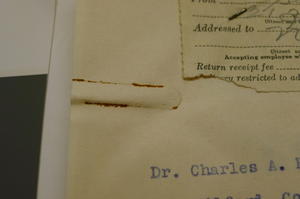
Staples, paperclips, and straight pins found in this collection were manufactured using galvanized steel, not stainless. Therefore, when exposed to sources of indirect moisture such as high humidity or direct contact such as flooding, rust corrosion products formed on the surface of the fastener. Once a corrosion material is present, it may transfer to other surfaces with which it is in direct contact. This transfer is evident in the following photos where a dark discoloration formed on the paper where it was touching the fastener.
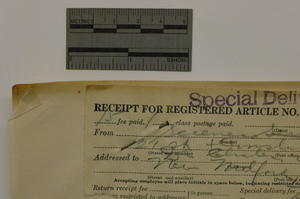
One way this discoloration can be removed is through a chemical oxidation reduction process, which is labor intensive. All of the damage shown was sustained during long-term storage prior to intake into our collections. Since it was known that these paper materials were previously stored in an uncontrolled environment where they were exposed to high levels of moisture, the removal of all metal fasteners from within the collection was a priority, so that further damage will not continue.
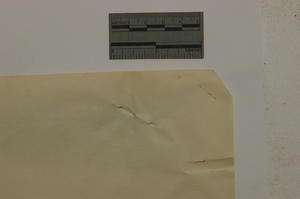
Other issues associated with fasteners include distortion of paper from tight-fitting paperclips and holes caused by straight pins and staples, especially when the paper is brittle. Remaining impressions, acidic rust burns, pinholes and gouges create a weak point in the paper making it more susceptible to tears, especially if the paper is thin or embrittled.
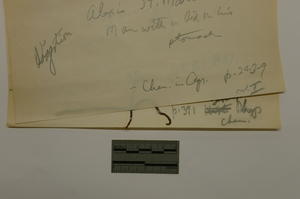
Another inappropriate attachment method noted in this collection is the use of rubber bands. In general, rubber bands tend to degrade over time, becoming brittle in a cold environment and sticky in a very warm environment. In this collection, the rubber bands had dried and adhered to the paper due to age and an uncontrolled storage environment. Conservation treatments will be required to safely remove the rubber bands without causing tears or abrasions to the paper, which could occur if the rubber materials were removed simply by pulling them off.

Appropriate archival storage practices are outlined in the Museum Conservation Institute's preservation document, Housing and Environmental Options for Storage of Documents. The National Park Service has also produced helpful publications including Removing Original Fasteners From Archival Documents and Attachments for Multi-Page Historic Documents.
Related Resources
- Conserve O Grams, Museum Management Program, National Park Service
- Housing and Environment Options for Storage of Documents, Museum Conservation Institute
- Welcome to the Gallery of Horrors! (Enter if you dare!), The Bigger Picture Blog, Smithsonian Institution Archives
Produced by the Smithsonian Institution Archives. For copyright questions, please see the Terms of Use.
Leave a Comment