
Smithsonian Institution Archives
  • Collections
  • Services
  • Smithsonian History
  • About
  • Education
  • Blog
  • Forums
  • Press
  • Audiences
  • Donate

The Bigger Picture: Visual Archives and the Smithsonian

Hunting for Watermarks

by Kirsten Tyree on November 29, 2012

One of the more exciting things I have been working on in the conservation lab of the Smithsonian Institution Archives over the past year has been to photograph the imaginative and beautiful watermarks found on our collection of archival documents.  For centuries, papermakers have been twisting thin wires into whimsical shapes, from unicorns to complicated crests with lions, swords and crowns, and imprinting their designs onto the paper during the paper making process.  What makes watermarks so fascinating is that they are like secrets hidden in the paper, invisible except when held up to the light, giving us clues as to where and when the paper was made.
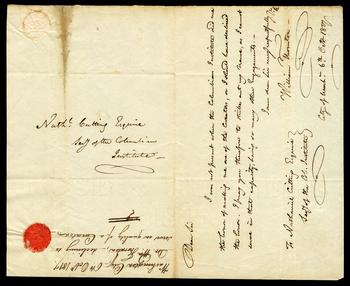
Letter photographed in visible light, where the watermark is not visible. The letter is from Dr. William Thornton to Nathaniel Cutting, dated October 6, 1817, RU 7051 - Columbian Institute Records, Smithsonian Institution Archives, Neg. no. SIA2012-2123.

Why would papermakers bother to include these fanciful and superbly executed shapes in the paper, especially if you cannot see them very well, you may wonder?  While their original purpose remains a mystery, it is widely believed that watermarks were used as the papermaker’s trademark and to indicate the size and quality of the paper.  Especially fancy chiaroscuro watermarks were even used to promote the superior quality of the artisans of certain workshops. More thrilling, perhaps, is that it is also thought some were used as symbols of secret brotherhoods and were used to identify their members.
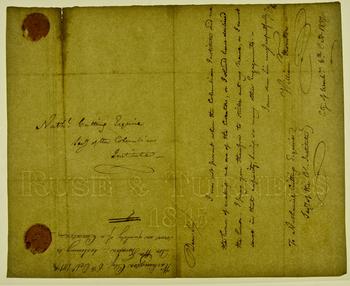
Same letter photographed in transmissive light, revealing the watermark “RUSE & TURNERS 1815” (now we know this paper was made by Joseph Ruse at the Upper Tovil Mill in Kent, England) (Gravell, 1983), December 21, 2011, by Kirsten Tyree, RU 7051 - Columbian Institute Records, Smithsonian Institution Archives.

Today, many of us are probably most familiar with the term watermark from its carry over to the digital realm as a "digital watermarking," where interestingly, no physical watermark exists or water for that matter (rather a sequence of codes embedded into electronic documents and images)! As for traditional watermarks, at present we are likely to encounter them mostly in our currency, government documents, and more as a security device.

Many of the watermarks in our collection are from American papermills, which tended to favor images of doves, eagles, tobacco plants, post-horns, stars, and lambs.  It may seem odd to us now, but there was a time in America before the 1800s when foreign papers, with their watermarks of Britannia and the crown, were considered far superior to domestically produced paper.  By the 1800s, though, paper with unique American watermarks had found their way into the hands of the most famous scientists and politicians, such as John Quincy Adams and Thomas Jefferson. 

Sadly, with the advent of large scale paper manufacturing at the end of the 19th century, the ancient craft of making paper by hand nearly came to an end in America.  The art of watermarking all but vanished and the tradition was on the verge of collapse.  Enter Dard Hunter, born on this day in 1883 in the town of Steubenville, Ohio.  A gifted artist and craftsman, Hunter was a leader in the Arts and Crafts movement and revived the art of handmade paper making.  His knowledge and experience led him to write the most comprehensive history of western papermaking of the time.  To celebrate Hunter’s birthday, I would like to share with you a sampling of the watermarks I have captured in our watermark gallery below.  An examination of our watermarks will lead you through the fascinating history of American papermaking.  It is an ongoing project and I will be adding interesting watermarks to the site often, so keep checking!

You too can make paper the way they did thousands of years ago or learn how to make watermarks. 

  • How to make paper
  • How to make watermarks

Related Collections

  • Record Unit 7051 - Columbian Institute, Records, 1816-1841, with related papers, 1791-1800, Smithsonian Institution Archives
Categories: Behind the Scenes
Tags: Archive, Conservation
Comments: View 3 comments, or Give us yours!
All comments are moderated and subject to approval. Further information is available in The Bigger Picture’s Commenting Guidelines.

Comments (3) – Leave a comment

Covadonga Miravalles

Nice article :) I am a Book and Paper Conservator and I always like to study the watermarks of the documents I work with. I have done a compilation of web resources for identifying and studying watermarks. I leave you here the link to the article: http://es.calameo.com/read/001356733b8040ce15e96

Covadonga Miravalles November 30, 2012 at 10:27 am
  • reply
Kirsten Tyree

Thank you!

Kirsten Tyree January 10, 2013 at 8:13 am
  • reply
Bo Caldwell

Amazing! Some great thinkers! Thank you.

Bo Caldwell April 10, 2013 at 5:13 pm
  • reply

Leave a comment

The content of this field is kept private and will not be shown publicly.
  • Web page addresses and e-mail addresses turn into links automatically.
  • Lines and paragraphs break automatically.

More information about formatting options

CAPTCHA
This question is for testing whether you are a human visitor and to prevent automated spam submissions.
By submitting this form, you accept the Mollom privacy policy.

Produced by the Smithsonian Institution Archives. For copyright questions, please see the Terms of Use.

Stay in touch!

Facebook Twitter Flickr YouTube SlideShare
Join our eNewsletter

About

Connecting you to America’s past with a behind-the-scenes exploration of the Smithsonian’s history, treasures, and the challenges that Archives face preserving collections. More details...

Smithsonian on Flickr Commons

Topics/Tags

  • See Here (614)
  • American History (553)
  • Science (436)
  • Archive (338)
  • Cities/Places (281)
  • Exhibitions (236)
  • Web/Tech (215)
  • Photo History (190)
  • Link Love (157)
  • Politics/Government (154)

Blog Roll

All Smithsonian blogs
American Historical Association Blog
American Institute of Conservation Blog
Archives Next
Archives of American Art
Around the Mall
Field Book Project
Hanging Together
Library of Congress Blogs
National Archives (US) Blogs
National Museum of American History, O say can you see?
Smithsonian Collections Blog
Smithsonian Libraries
Teaching American History

Categories

  • Collections in Focus (1001)
  • What Gets Saved (342)
  • Behind the Scenes (213)
  • Smithsonian History (140)

Recent Posts

  • Sneak Peek 6/17/2013
  • Link Love: 6/14/2013
  • Summertime on the Mall - Smithsonian Folklife Festival
  • Women in Science Wednesday: Libbie Henrietta Hyman
  • Transcription Beyond Description: Engaging Opportunities and Weaving Webs of Knowledge

Monthly Archive

  • June 2013 (12)
  • May 2013 (32)
  • April 2013 (26)
  • March 2013 (26)
  • February 2013 (26)
  • January 2013 (28)
  • December 2012 (26)
  • November 2012 (28)
  • October 2012 (32)
  • September 2012 (26)
  • August 2012 (31)
  • July 2012 (26)
  • June 2012 (27)
  • May 2012 (27)
  • April 2012 (27)
  • March 2012 (28)
  • February 2012 (27)
  • January 2012 (26)
  • December 2011 (31)
  • November 2011 (28)
  • October 2011 (35)
  • September 2011 (31)
  • August 2011 (35)
  • July 2011 (41)
  • June 2011 (43)
  • May 2011 (33)
  • April 2011 (40)
  • March 2011 (43)
  • February 2011 (35)
  • January 2011 (36)
  • December 2010 (42)
  • November 2010 (40)
  • October 2010 (44)
  • September 2010 (37)
  • August 2010 (39)
  • July 2010 (38)
  • June 2010 (37)
  • May 2010 (42)
  • April 2010 (44)
  • March 2010 (47)
  • February 2010 (40)
  • January 2010 (39)
  • December 2009 (43)
  • November 2009 (34)
  • October 2009 (11)
  • September 2009 (11)
  • August 2009 (12)
  • July 2009 (14)
  • June 2009 (10)
  • May 2009 (12)
  • April 2009 (14)
  • March 2009 (10)
  • January 2009 (1)
Smithsonian Institution Archives
eNewsletter Facebook Twitter Flickr Historypin YouTube SlideShare Browsealoud
Smithsonian Institution
  • Privacy
  • Copyright
  • Contact