
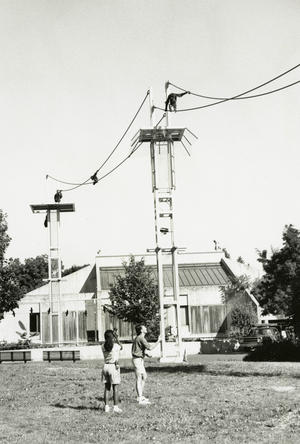
 On a recent trip to the Smithsonian’s National Zoological Park with my family we were fortunate enough to be passing the Great Ape House just as a few orangutans decided to climb the tower and travel across the O Line cables. Many people were standing underneath watching as they crossed the public pathway. They seemed so free from boundaries up there that it got me to wondering—has there ever been an escape?
I found the answer by doing a little bit of digging in the Archives’ collections about the history of the Zoo. The Orangutan Transportation System (OTS), or O Line, consists of eight 50 foot towers and a series of latex-coated steel cables by which the orangutans can travel as they would in nature. It links the Great Ape House to the "Think Tank" exhibit, where visitors can "think about thinking." There is one tower in the Great Ape House yard and one in the Think Tank building yard which they can climb. Six other towers connected by the cables traverse the public walkways in between. These six are designed with electrified "skirts" and grid "collars" that give the orangutans a small shock without causing injury to prevent them from climbing down onto the path below. Whenever the orangutans have access to the O Line, zoo staff are on hand to monitor them.
 It didn't take long to find out that yes, there has been an escape. The first escape occurred not long after the O Line was completed in 1994. While Bonnie was the first orangutan at the zoo to both climb the tower in the Great Ape House yard and cross over to the second tower using the cables, an orangutan named Azy took it a step further. According to an account found in our collections in the zoo's employee newsletter, The Gnu Yak Times, Azy had initially appeared uninterested in the tower in the yard. One day after he watched fellow orangutan, Iris, cross the cables a few times, Azy climbed the tower and crossed over on the cables. Then he quite easily stepped on the hot wires, swung down to the tower grid, and climbed down to the ground. From there, he set off towards the Think Tank on foot by the public pathway.
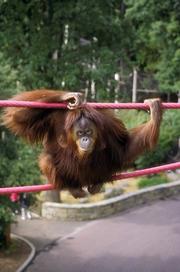 Zoo staff attempted to intervene and Azy became alarmed but did not cause serious injury. Eventually, he was tranquilized by a veterinarian and brought back into the enclosure. His adventure lasted a mere eighteen minutes. Zoo employees immediately went to work to try and figure out why Azy managed to get out of the enclosure and made modifications to the towers. Azy never attempted to travel on the O Line again.
There have been only two other escapes since then, which you can read about on the Zoo's website. Each escape has occurred during the orangutan's first trip across the cables and no orangutan has escaped twice. The system has since been modified to prevent future escapades.
Produced by the Smithsonian Institution Archives. For copyright questions, please see the Terms of Use.
Leave a Comment