
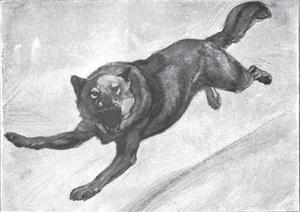
 As mentioned in my previous post on dogs and the Smithsonian, the National Zoological Park opened a domestic dog exhibit in 1896. Despite the zoo's good intentions, however, the exhibit proved something of a disaster. The dogs' incessant barking not only upset the neighbors, but also invited ever more stray dogs into the park. In March, 1896, roving dogs killed three goats. In December, 1897, dogs so harassed a mule deer buck that it ran into a fence, broke its horns, tore off one hoof and was otherwise so badly injured that it never recovered. When dogs killed several more deer in January of 1900, Head Keeper William H. Blackburne urged Dr. Frank Baker, the zoo's superintendent, to erect a fence. "Under the present state of the fencing of the Park it is absolutely impossible to prevent roving dogs from entering it… The only effectual remedy is to have a dog-proof fence about the whole Park with tight gates that shall be closed at night," Blackburne suggested. When strays killed several more mule deer that summer, he decided that the domestic dog exhibit was simply not worth the trouble. "I should advise that the dogs belonging to the Park be disposed of," he wrote to Baker. [See collection RU 74, Box 34, Letter from Blackburn to Baker (January 20, 1900)]
Yet even outside the park's boundaries, dogs continued to make trouble for the zoo. Consider the following episode, which also featured the dog's closest wild (never-domesticated) cousin, the gray wolf. This creature had been so thoroughly exterminated from the eastern half of the United States that the zoo accepted its first specimen from sparsely populated Montana in 1887. Others hailed from Wyoming and Colorado. On April 2, 1902, two of the Colorado wolves gave birth to a litter of five pups, one of whom (a female known as "catalogue no. 4459") would soon gain infamy across the city .
Around 10:30 in the morning on Tuesday, October 20, 1902, the six-month-old wolf pup escaped from her enclosure and wandered out of the zoo. By midday, the Cleveland Park neighborhood was in a state of panic. Four people (two of them children) had been viciously attacked by some snarling mystery canid. That afternoon, Keeper Blackburne was called to retrieve the truant wolf, which by this point had been riddled with buckshot and was barely clinging to life. Newspapers exclaimed that the ferocious and bloodthirsty "mad wolf" had escaped from the zoo, "snapping and attacking individuals, fighting every dog that came in its way." Shaken citizens recalled that "all Washington felt a thrill of terror." [See collection RU 74, Box 286, Scrapbooks]
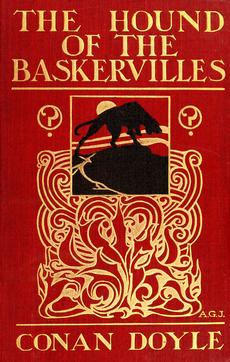
Zoo officials would hear nothing of it, insisting from the very beginning that the wolf had not attacked anyone. Keeper Blackburne explained that this particular wolf was "not of a ferocious disposition," and that being born and raised in captivity had engendered trust toward humans, not animosity. [See collection RU 74, Box 286, Scrapbooks] Baker indicated that it must have been a dog which perpetrated the violence. A pall hung over Northwest DC for three weeks, as citizens went about their lives unsure whether a mad dog still roamed among them. The mystery drew inevitable comparisons to Arthur Conan Doyle’s Hound of the Baskervilles, which had been published to popular acclaim just a few months earlier.
In the case of the zoo's truant wolf, the role of Sherlock Holmes was ably played by none other than the city's aforementioned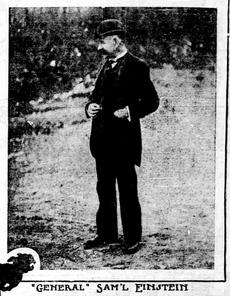 Poundmaster, Samuel Einstein. After countless interviews, a careful review of police blotter, and a thorough examination of the evidence, Einstein determined that the wolf was innocent, and that a dog had committed the vicious attacks. And it wasn’t just any dog, either. The guilty party was a collie named "Prince" that had been owned by Admiral George Dewey, revered hero of the recent Spanish-American War. The Admiral maintained a "country house" on Woodley Lane (now Belmont Road) in Cleveland Park, and had recently moved back to the city, where he lived at 1601 K Street NW. According to reports, "the hero of Manila Bay evidently did not care to take the collie he had owned to the city with him when he moved in from his country house, and the animal was left behind." Whether rabies or some other demons afflicted this dog we'll never know, for he was shot and killed the same day his rampage began, and his body was unceremoniously discarded long before its potential significance was known.
As for the wolf, she obviously just suffered from very bad luck. Soon after she escaped, she had unwittingly stumbled into the same back yard where just hours earlier Dewey's dog had cut its swath of terror. Mr. Bowles, a gardener working at the residence of Representative Francis G. Newlands, was already suffering from a bite wound when the wolf appeared. Under the assumption his assailant had returned, Bowles shot the lupine visitor in its left hip. Wolf no. 4459 never really recovered from the gunshot wound, and died a few months later.
Conditions slowly changed in the months and years thereafter, as both the city and the Smithsonian wrested ever greater control over their respective canids.
In 1902 Poundmaster Einstein bragged that fewer stray dogs roamed DC than at any other point in his 29-year tenure. The number of licensed dogs had also increased dramatically (from 6,000 in 1887 to 9,000 in 1902), while the zoo's remaining wolves were kept under secure lock and key (and nowhere else for hundreds of miles) from that point on.
These episodes demonstrate that it's not always easy to distinguish among wild, domestic, and feral animals, but that doing so has its rewards. Teasing apart their tangled histories can teach us about the animals themselves, of course, but it can also teach us about the people with whom they forged relationships. The way we engage (and disengage) with other animals has changed over the years, and examing our evolving relationship with the rest of nature promises to shed light on an important but underrepresented aspect of American history.
Related Resources
- History of the National Zoological Park, Smithsonian Institution Archives
Related Collections
- Record Unit 74, National Zoological Park, Records, 1887-1966, Smithsonian Institution Archives
- Record Unit 386, National Zoological Park, Animal Records, 1887-1976, Smithsonian Institution Archives
Produced by the Smithsonian Institution Archives. For copyright questions, please see the Terms of Use.
Leave a Comment