
Smithsonian Institution Archives
  • Collections
  • Services
  • Smithsonian History
  • About
  • Education
  • Blog
  • Forums
  • Press
  • Audiences
  • Donate

The Bigger Picture: Visual Archives and the Smithsonian

Digital Video Preservation: Continuing the Conversation

by Kira M. Cherrix on January 3, 2013

I recently attended the 2012 Association of Moving Image Archivists (AMIA) Annual Conference, and digital video was a common thread in most of the presentations.  The topics ranged from how to digitize film, to providing online access to digital files, and ways to preserve born-digital video files.  There was also a workshop on using FFmpeg, an open source command line program (like DOS for those who remember it) to convert audio and video files into a variety of different formats.  When digital video is created many different codecs are used to decode or translate the raw data into something you can view.  Additionally digital video is wrapped together with its audio in a container to form a package.  Usually, the codec and container for a given video file format is specific to the proprietary software that was used to create the file.  FFmpeg is a tool archivists can use to decode and convert a multitude of audio and video file formats with differing codecs and containers into a preservation standard.
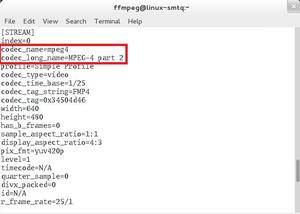
This screenshot from the FFmpeg command line interface shows the codec information that is provided by ffprobe, as well as other technical information about the video, such as frame size and aspect ratio.

Last summer, Killian Escobedo, intern for the Digital Services Division, wrote about some of the challenges of born digital video preservation, including the occasional inability to determine the codec and container format for a given video file.  The FFmpeg family contains a program called ffprobe, which uses libraries of various codecs and containers (specifically called: libavcodec and libavformat) to extract technical metadata to determine the codec and container of just about any digital video file.  Also, the libavcodec and libavformat libraries can be integrated with open source media players like VLC, which will allow the program to play back any file that has a codec and container listed in the libraries.  One important aspect of these libraries is that a once a codec or container is added, it will only be removed if it poses a security risk.  This is especially important since materials are usually accessioned several years after they were created and FFmpeg can be used by archivists to access information about file formats that may have become obsolete as both the codec and container information is needed in order to play back digital video.
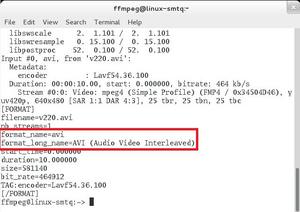
The information outlined in red is the container information provided by ffprobe for the specified file.

While FFmpeg contains several tools for analyzing existing digital video, its main purpose is to convert digital video and audio files from one codec and container format to another using a command line interface.  The transcoding process starts by removing the container and codec to get to the raw data of the video, and then encoding that information into the codec and container specified at the beginning of the transformation.  The commands to simply transcode the video from one container and codec to another are fairly basic, but FFmpeg also allows you to make additional transformations during the transcode process, such as specifying a new aspect ratio or bit rate for the video.  These transformations are not ideal for the preservation of digital video because they can drastically change how the video looks.  Additionally, FFmpeg can be used to perform a MD5 checksum on a video after it has been converted from one format to another with greater accuracy than programs like JHOVE or DROID because it will look at the frame by frame raw data contained within a video, which should remain the same, even once the codec and container have been changed.
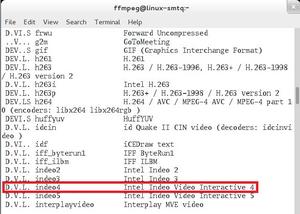
This is a screenshot of the libavcodec library which states it has the ability to decode the Indeo 4 codec, denoted by the “D” at the beginning of the line, which is a codec Killian was unable to play on any of the media players he tested.  According to this information, FFmpeg should be able to convert this to a preservation format, and VLC should now be able to play this file.

Thanks to the workshop, I now have a greater understanding of how to use FFmpeg to convert our born-digital video to a preservation format.  I am looking forward to running ffprobe on the files that Killian was unable to identify to see if it can determine the codec and container formats of some of the more complicated files.  Hopefully, this will help with the development of a long term preservation plan for the multitude of codecs and containers that are rapidly becoming obsolete.

Related Resources

  • Digital Video Preservation: Further Challenges for Preserving Digital Video and Beyond, The Bigger Picture blog, Smithsonian Institution Archives
  • Association of Moving Image Archivists
Categories: What Gets Saved
Tags: Archive, Film/Video, Digitization
Comments: View comments, or Give us yours!
All comments are moderated and subject to approval. Further information is available in The Bigger Picture’s Commenting Guidelines.

Leave a comment

The content of this field is kept private and will not be shown publicly.
  • Web page addresses and e-mail addresses turn into links automatically.
  • Lines and paragraphs break automatically.

More information about formatting options

CAPTCHA
This question is for testing whether you are a human visitor and to prevent automated spam submissions.
By submitting this form, you accept the Mollom privacy policy.

Produced by the Smithsonian Institution Archives. For copyright questions, please see the Terms of Use.

Stay in touch!

Facebook Twitter Flickr YouTube SlideShare
Join our eNewsletter

About

Connecting you to America’s past with a behind-the-scenes exploration of the Smithsonian’s history, treasures, and the challenges that Archives face preserving collections. More details...

Smithsonian on Flickr Commons

Topics/Tags

  • See Here (611)
  • American History (542)
  • Science (429)
  • Archive (329)
  • Cities/Places (277)
  • Exhibitions (234)
  • Web/Tech (210)
  • Photo History (189)
  • Link Love (153)
  • Politics/Government (153)

Blog Roll

All Smithsonian blogs
American Historical Association Blog
American Institute of Conservation Blog
Archives Next
Archives of American Art
Around the Mall
Field Book Project
Hanging Together
Library of Congress Blogs
National Archives (US) Blogs
National Museum of American History, O say can you see?
Smithsonian Collections Blog
Smithsonian Libraries
Teaching American History

Categories

  • Collections in Focus (988)
  • What Gets Saved (337)
  • Behind the Scenes (212)
  • Smithsonian History (134)

Recent Posts

  • See Here: 5/17/2013
  • Link Love: 5/17/2013
  • Weird and Wonderful: The Surprising Mrs. Hilda Hempl Heller
  • Women in Science Wednesday: Anne Hagopian
  • Sneak Peek 5/15/2013

Monthly Archive

  • May 2013 (20)
  • April 2013 (26)
  • March 2013 (26)
  • February 2013 (26)
  • January 2013 (28)
  • December 2012 (26)
  • November 2012 (28)
  • October 2012 (32)
  • September 2012 (26)
  • August 2012 (31)
  • July 2012 (26)
  • June 2012 (27)
  • May 2012 (27)
  • April 2012 (27)
  • March 2012 (28)
  • February 2012 (27)
  • January 2012 (26)
  • December 2011 (31)
  • November 2011 (28)
  • October 2011 (35)
  • September 2011 (31)
  • August 2011 (35)
  • July 2011 (41)
  • June 2011 (43)
  • May 2011 (33)
  • April 2011 (40)
  • March 2011 (43)
  • February 2011 (35)
  • January 2011 (36)
  • December 2010 (42)
  • November 2010 (40)
  • October 2010 (44)
  • September 2010 (37)
  • August 2010 (39)
  • July 2010 (38)
  • June 2010 (37)
  • May 2010 (42)
  • April 2010 (44)
  • March 2010 (47)
  • February 2010 (40)
  • January 2010 (39)
  • December 2009 (43)
  • November 2009 (34)
  • October 2009 (11)
  • September 2009 (11)
  • August 2009 (12)
  • July 2009 (14)
  • June 2009 (10)
  • May 2009 (12)
  • April 2009 (14)
  • March 2009 (10)
  • January 2009 (1)
Smithsonian Institution Archives
eNewsletter Facebook Twitter Flickr Historypin YouTube SlideShare Browsealoud
Smithsonian Institution
  • Privacy
  • Copyright
  • Contact