
Smithsonian Institution Archives
  • Collections
  • Services
  • Smithsonian History
  • About
  • Education
  • Blog
  • Forums
  • Press
  • Audiences
  • Donate

The Bigger Picture: Visual Archives and the Smithsonian

Digital Dilemma: Preserving Computer Aided Design (CAD) Files

by Greg Palumbo, Electronic Records Intern on December 1, 2011

As the record keepers of the Smithsonian’s past, our responsibilities include archiving information relating to the construction of Smithsonian museums themselves, and other building projects throughout the institution. Architectural plans for these jobs are primarily composed digitally using Computer Aided Design, or CAD, software. These born digital materials are eventually transferred to the Archives where the Digital Services Division is working on preserving them for long term use.

The Archives receives the majority of its CAD files in accessions from the Smithsonian’s Office of Facilities, Engineering, and Operations (OFEO). OFEO is in charge of building, operating, and maintaining all the Smithsonian facilities.

NMAI Architectural Plan, April, 2001

A previous intern with the Digital Services Division began working with CAD records last summer, and discussed the importance in preserving these records in a blog post about the architectural drawings and construction plans for the National Museum of the American Indian. She also noted the evolution of both CAD programs used to create the drawings, and the preservation methods that exist to maintain the records. Most of the drawings we have were produced using one of the CAD industry’s leading programs, and the native file format that the records were created in is not open and widely accessible. The files we have also range in date from 1995 to 2008, making it more of a challenge to preserve them since they were created with older versions of the CAD software that has continually undergone changes.
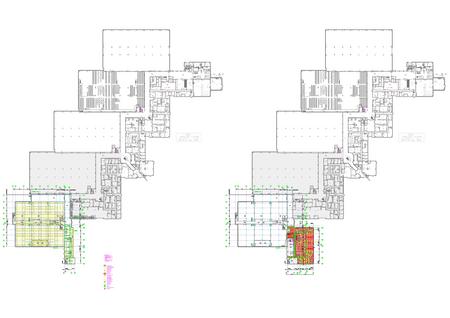
Museum Support Center, POD5, August, 2007

We continue to work with the architectural drawings of the National Museum of American Indian, which was completed in 2004, and also received new records documenting the 125,000 square foot addition to the Smithsonian’s Museum Support Center in Silver Hill, Maryland. The American Indian Museum has received a great deal of attention for its unique design, and the new storage and research wing at the Museum Support Center is known for its highly technical and complex structure. As a result, the files that the Archives received in conjunction with these projects were numerous, and extremely rich in detail.

This brings us to a few of the main issues being dealt with while trying to preserve these records. First is the issue of scale. In just one accession we received more than 1,200 CAD files, and more than 1,000 more in another. Second, the drawings are incredibly intricate, and constructed with several layers that are combined to produce one large file. When taking steps to preserve the drawings, one of our main goals is to maintain the visual integrity of the original, which has proved to be extremely difficult.

Additionally, the issue of access is being confronted through our work with these files. In our attempt to preserve these 2D architectural records, we have tried to convert the files into an open format that is both easily accessible, and long lasting. At this point in time, the evolving PDF/E format has been identified as the best possible solution to provide long-term access, but the majority of conversions have failed to produce quality results (PDF/E is an ISO, International Organization for Standardization, format intended for use in creation of documents in engineering workflows. This format allows easy exchange across multiple programs, and helps streamline the review and markup process for architects, engineers, and construction professionals). With the large number of files we have, working with each drawing individually is not an option, and so far batch conversions have unsuccessfully transferred the complex CAD information to the new format.

Design for National Museum of African American History and Culture, by Unknown, 2010, Smithsonian Archives - History Div, tmpF52C_tmp_tcm20-183729.

Current and future building projects throughout the Smithsonian will undoubtedly add more CAD files to the already large number that the Archives has. The ongoing renovation of the Arts and Industries Building and the construction of the National Museum of African American History and Culture (NMAAHC), scheduled to begin in 2012, are two major projects that will generate CAD records to be archived.

As is the case with most computer software, CAD programs are evolving and creating new processes that architects and engineers are using in their work. The plans for the NMAAHC will likely be executed using 3D modeling that is now standard with CAD software. This will present a whole new set of challenges and standards that the Digital Services Division and the Archives will continue to monitor and adapt to.

Categories: Behind the Scenes, What Gets Saved
Tags: Web/Tech, Architecture, Archive, Behind the Scenes
Comments: View 5 comments, or Give us yours!
All comments are moderated and subject to approval. Further information is available in The Bigger Picture’s Commenting Guidelines.

Comments (5) – Leave a comment

Euan Cochrane

CAD files are a great example of a type of content that would best be preserved by using emulation as the digital preservation strategy. Being interactive, complex and difficult to migrate they make excellent emulation candidates.

The http://www.openplanetsfoundation.org site has a lot of information on emulation approaches and current practise. Emulation experts can also be contacted through the website if you have any questions.

Euan Cochrane December 5, 2011 at 3:20 pm
  • reply
bill lefurgy

Thanks for this frank discussion about working with digital materials that are among the most difficult of all to preserve with their original functionality intact. I'm glad the Smithsonian sees the wisdom of bringing in the files and keeping them while we wait for the necessary preservation technology to develop.

bill lefurgy December 6, 2011 at 9:15 am
  • reply
Dirk von Suchodoletz

Its great to read about a practical problem involving more complex digital objects. CAD files of non trivial short living consumer products are often referenced in the digital preservation and emulation community as an example of not-easy-to-migrate-or-preserve artefacts. Those files typically involve many more different views and renderings than it would make sense to just print or produce PDF from to capture all presumed important aspects.

Instead, a better option may be to preserve the whole original environment along side the CAD files, i.e. preserve the operating system and application on which they were created or viewed. This original environment could be run in appropriate virtual machines or better in emulators. The package of the object and it's original environment ought to be kept and run within the emulator when someone needs to access them. One way to do this could be to aquire the needed software, all neccessary components which might be linked into the object and some suitable operating system.

There was quite a bit of research done on this within the finished PLANETS and ongoing KEEP
research projects. The other way to accomplish this would be to completely dump a hard drive image from a machine that the object was rendered successfully on and preserve the entire system. This would ensure that no important components of the rendering environment would be
missed. This approach has been demonstrated by the team at the University of Emory’s Manuscript, Archives, and Rare Book Library (MARBL) where they have preserved an image of
the hard disk from Salman Rushdie’s early 1990s Macintosh desktop and use an emulator to access it. Researchers from Universities of Maryland, Albany, Texas at Austin recommend
disk imaging of comprehensive systems for future scholarship and research.

Another demonstration of the versatility of the emulation approach for complex objects was shown with a complete MySQL database and CMS running on X86 Linux machine by dumping it and re-running it in a virtual machine. It wouldn't otherwise be possible to extract all the database information and the website rendering application to preserve it by migration in
a meaningful way. Unfortunately, imaging and maintaining access to old computers like CAD workstations is still a niche endeavor for a number of reasons including the perceived complexity and difficulty for average, non-technically trained preservation practitioners.

To prove the opposite (that it is actually quite straight forward) a number of system imaging
experiments on different Microsoft operating systems were run at the National Archives of New Zealand. The work flow rendered from them was presented at iPRES 2011 conference. Real CAD files preserved in the described way would definitely make a fine test and show case!

Dirk von Suchodoletz December 6, 2011 at 9:51 am
  • reply
Greg

Thank you for your comments gentlemen. Working with the CAD records has proved to be a difficult endeavor, but using emulation as a preservation method is something that I think might ultimately help the situation.

I agree with you Dirk that these files include multiple layouts and model spaces that make converting them to single PDF’s tough, and can possibly loose vital information. That has been one of the most troublesome aspects of this whole project. The variation that exists between one file to the next is sometimes extreme, and has demanded that each one be dealt with individually.

In my research I can across the concept of emulation mainly in MIT’s FAÇADE project,http://facade.mit.edu/index.html, but at the time they seemed to think that more demand and funding would be required for that type of preservation to advance. It seems since that study there has been an increase in interest. There is also some talk about licensing and copyright issues with preserving proprietary software. I haven’t seen much talk about that, and it may be a non-issue is the institution already has purchased the program, but I just wondered what you all knew about that?

Greg December 9, 2011 at 9:40 am
  • reply
Dirk von Suchodoletz

Yes, beside the technical issues a range of legal implications need to be considered. While in theory the copying of a software installation from one computer to another without duplicating it was not prohibited by the original license terms of many older software applications and operating systems, the whole domain is fairly undefined as yet. Newer licensing terms are more limited and often require re-licensing when changing the setup like some hardware components. Only the license agreements of newer operating systems tend to explicitly deal with the option of virtualization. Nevertheless the duration of modern licenses is often not unlimited any more.

Thus, when dealing with emulation, software becomes pretty fast an issue in two aspects: Software needs to be archived alongside with the primary object (the object of primary interest). The software archive should contain all components which are required to reproduce the original environment or some equivalent the primary object should be rendered in. Alongside managing the software components and associated documentation, a software archive definitely must tackle the legal and technical problems of licensing. Copyrights on application software packages, additional components like fonts or designs and operating system are usually valid for a particular limited time period. Troditional copyrights, depending on the national legal system, are applied over many years and usually restrict the usage. In general for proprietary software, this may severely limit the rights of the holding institution to use the software to provide preservation services and access. Furthermore, technical approaches to protecting intellectual property, such as Digital Rights Management, copy protection mechanisms, online update or registration requirements all create significant problems for a software archive.

Tackling these problems will require the cooperation of software manufacturers with a designated software archiving institution, to provide suitably licensed unprotected copies of software for long-term preservation purposes. A possible solution might be to extend the concept of legal deposit approach used by many national or copyright libraries onto software. Thus, despite the considerable efforts on digital preservation and access research, the groundwork on software archiving has until now been largely neglected. This could lead to fatal gaps in the emulation based preservation and access workflows.

Dirk von Suchodoletz December 14, 2011 at 9:42 am
  • reply

Leave a comment

The content of this field is kept private and will not be shown publicly.
  • Web page addresses and e-mail addresses turn into links automatically.
  • Lines and paragraphs break automatically.

More information about formatting options

CAPTCHA
This question is for testing whether you are a human visitor and to prevent automated spam submissions.
By submitting this form, you accept the Mollom privacy policy.

Produced by the Smithsonian Institution Archives. For copyright questions, please see the Terms of Use.

Stay in touch!

Facebook Twitter Flickr YouTube SlideShare
Join our eNewsletter

About

Connecting you to America’s past with a behind-the-scenes exploration of the Smithsonian’s history, treasures, and the challenges that Archives face preserving collections. More details...

Smithsonian on Flickr Commons

Topics/Tags

  • See Here (611)
  • American History (542)
  • Science (429)
  • Archive (329)
  • Cities/Places (277)
  • Exhibitions (234)
  • Web/Tech (210)
  • Photo History (189)
  • Link Love (153)
  • Politics/Government (153)

Blog Roll

All Smithsonian blogs
American Historical Association Blog
American Institute of Conservation Blog
Archives Next
Archives of American Art
Around the Mall
Field Book Project
Hanging Together
Library of Congress Blogs
National Archives (US) Blogs
National Museum of American History, O say can you see?
Smithsonian Collections Blog
Smithsonian Libraries
Teaching American History

Categories

  • Collections in Focus (988)
  • What Gets Saved (337)
  • Behind the Scenes (212)
  • Smithsonian History (134)

Recent Posts

  • See Here: 5/17/2013
  • Link Love: 5/17/2013
  • Weird and Wonderful: The Surprising Mrs. Hilda Hempl Heller
  • Women in Science Wednesday: Anne Hagopian
  • Sneak Peek 5/15/2013

Monthly Archive

  • May 2013 (20)
  • April 2013 (26)
  • March 2013 (26)
  • February 2013 (26)
  • January 2013 (28)
  • December 2012 (26)
  • November 2012 (28)
  • October 2012 (32)
  • September 2012 (26)
  • August 2012 (31)
  • July 2012 (26)
  • June 2012 (27)
  • May 2012 (27)
  • April 2012 (27)
  • March 2012 (28)
  • February 2012 (27)
  • January 2012 (26)
  • December 2011 (31)
  • November 2011 (28)
  • October 2011 (35)
  • September 2011 (31)
  • August 2011 (35)
  • July 2011 (41)
  • June 2011 (43)
  • May 2011 (33)
  • April 2011 (40)
  • March 2011 (43)
  • February 2011 (35)
  • January 2011 (36)
  • December 2010 (42)
  • November 2010 (40)
  • October 2010 (44)
  • September 2010 (37)
  • August 2010 (39)
  • July 2010 (38)
  • June 2010 (37)
  • May 2010 (42)
  • April 2010 (44)
  • March 2010 (47)
  • February 2010 (40)
  • January 2010 (39)
  • December 2009 (43)
  • November 2009 (34)
  • October 2009 (11)
  • September 2009 (11)
  • August 2009 (12)
  • July 2009 (14)
  • June 2009 (10)
  • May 2009 (12)
  • April 2009 (14)
  • March 2009 (10)
  • January 2009 (1)
Smithsonian Institution Archives
eNewsletter Facebook Twitter Flickr Historypin YouTube SlideShare Browsealoud
Smithsonian Institution
  • Privacy
  • Copyright
  • Contact