
Smithsonian Institution Archives
  • Collections
  • Services
  • Smithsonian History
  • About
  • Education
  • Blog
  • Forums
  • Press
  • Audiences
  • Donate

The Bigger Picture: Visual Archives and the Smithsonian

Bearly Survived to become an Icon

by Tad Bennicoff on May 27, 2010

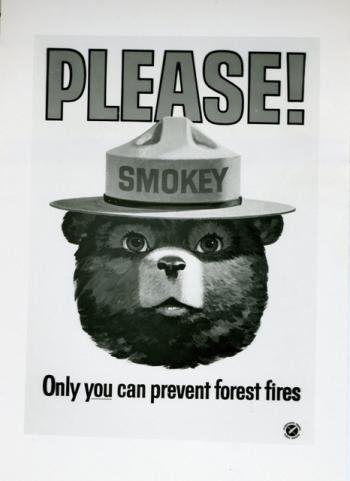
Smokey the Bear Poster, U.S. Forest Service, Date Unknown, Smithsonian Institution Archives, Record Unit 365, Box 21, Folder 2.

Some of you may recall the symbol of the United States Forest Service fire prevention program, Smokey the Bear. Perhaps I am dating myself, however I distinctly recall posters and television commercials between Saturday morning cartoons depicting the almost human looking bear wearing his park ranger hat and blue jeans, with shovel in one hand and stern finger pointed with the other, convincingly proclaiming, “Only you can prevent forest fires . . . only you!” Using a bear to warn against the danger and destruction of forest fires makes perfect sense—bears live in the forest, and are pretty intimidating and powerful in appearance; only a fool would challenge a bear, especially if the bear has the ability to speak! Herein is the story of a living, breathing bear who became known as Smokey, and lived at the Smithsonian National Zoological Park in Washington, DC from 1950–1976.

Smokey was born in 1950 in the Lincoln National Forest in New Mexico. He was found by members of the New Mexico Game and Fish Department during the aftermath of a fire that raged through forest, clinging to a charred pine tree, the soles of his feet badly burned, and his hair singed. He weighed all of five pounds, and his future appeared dim. Despite the poor odds for survival, he was nursed back to health by veterinarians in Santa Fe, NM and in June of 1950 was given to the federal government with the stipulation that his life be devoted to forest fire prevention and wildlife conservation.

Transporting Smokey to the National Zoological Park proved to be a challenge. Commercial airlines would not allow Smokey in the passenger cabin, and would not permit a person to accompany him in the baggage compartment. Fortunately, the Piper Aircraft Company became aware of this dilemma, and offered a Piper Pacer to serve as Smokey’s private airplane. Traveling in personalized style, the plane was adorned with a mural of Smokey with his paw in a sling and ranger hat on his head. The St. Louis Zoo reserved a special room for Smokey during an overnight fuel stop, and several hundred spectators, including members of the Boy Scouts, Girl Scouts, photographers, and media were awaiting his arrival in Washington, DC on June 27, 1950.

The original Smokey Bear frolicking in a pool at the National Zoological Park, Smokey Bear was brought from New Mexico in June of 1950 after being burned as a cub from a forest fire that swept through a portion of the Lincoln National Forest, Smokey Bear served as a living symbol of the Smokey Bear forest fire prevention program, c. 1950s, by Francine Schroeder, Photographic print, Smithsonian Institution Archives, Record Unit 371, Box 2, Folder: December 1976, Negative Number: 	92-3559.

Smokey was a popular attraction at the National Zoo, and received millions of visitors during his twenty-six year residency. He became so popular in fact that he received more than 13,000 letters a week and was granted his own zip code. He developed a love for peanut butter sandwiches, in addition to his daily diet of trout and bluefish.

Smokey Bear enjoying the honey and berries that are dispensed from his new automated dispensing tree, National Zoological Park staffers from the offices of Graphics and Exhibits and Facilities Management put together the honey tree in Smokeys exhibit area in the summer of 1984, by Jessie Cohen, Photographic print, Smithsonian Institution Archives, Record Unit 371 Box 4 Folder November 1984, Negative Number: 95-1209.

Goldie, a female black bear, was brought to the National Zoo in 1962 as a mate for Smokey. Unfortunately, no offspring were produced. Little Smokey, who also was born in the Lincoln National Forest but was not the victim of fire (he was orphaned and rescued from starvation by the Forest Service) was added to the zoo in 1971. Little Smokey would carry the torch of his namesake, who was nearing retirement (Smokey would turn 25 in 1975, which is the equivalent to roughly 70 human years, the mandatory retirement age for federal employees).

Smokey officially retired on May 2, 1975 in a ceremony which anointed Little Smokey as Smokey Bear II. Smokey remained at the National Zoological Park until his passing on November 9, 1976. A Congressional resolution of 1974 stipulated that Smokey’s remains would be returned to New Mexico, where he would be buried at the Smokey Bear Historical Park in Capitan, NM, not far from where he was found twenty-six years prior. More than 250 people were on hand for his memorial service, and he received an official obituary on the front page of the November 11, 1976 edition of the Wall Street Journal. During his lifetime, his likeness appeared on millions of pieces of fire prevention literature and products, and countless hours of broadcast advertisements.

Categories: Collections in Focus
Tags: American History, Advertising, Environment, Conservation
Comments: View 3 comments, or Give us yours!
All comments are moderated and subject to approval. Further information is available in The Bigger Picture’s Commenting Guidelines.

Comments (3) – Leave a comment

Paul Bick

The location of Smokey Bear Historical Park is Capitan NM, not Captain NM. Just a little FYI for you folks at the Smithsonian. Paul Bick Santa Fe NM

Paul Bick June 18, 2010 at 5:21 pm
  • reply
Tad Bennicoff

Thank you, Mr. Bick, for correcting this error on my behalf. Smokey Bear Historical Park is indeed in Capitan, NM. http://www.emnrd.state.nm.us/FD/SmokeyBear/SmokeyBearPark.htm.

Tad Bennicoff June 21, 2010 at 10:27 am
  • reply
Shem Peachey

Just to let you know that the New Mexico Game and Fish employees did not find the bear. He was actually found and carried off the mountain by GW Chapman and given to Elliot Parker from the Game and Fish Department. Mr. Chapman, age 20, was a US Forrest Service road maintance employee and voluteered to fight help fight the fire to earn extra money to pay for his wedding. Mr. Chapman was not credited for his part in the story for many years. An internet search on GW Chapman should verify the story. Thank you

Shem Peachey August 3, 2010 at 11:01 am
  • reply

Leave a comment

The content of this field is kept private and will not be shown publicly.
  • Web page addresses and e-mail addresses turn into links automatically.
  • Lines and paragraphs break automatically.

More information about formatting options

CAPTCHA
This question is for testing whether you are a human visitor and to prevent automated spam submissions.
By submitting this form, you accept the Mollom privacy policy.

Produced by the Smithsonian Institution Archives. For copyright questions, please see the Terms of Use.

Stay in touch!

Facebook Twitter Flickr YouTube SlideShare
Join our eNewsletter

About

Connecting you to America’s past with a behind-the-scenes exploration of the Smithsonian’s history, treasures, and the challenges that Archives face preserving collections. More details...

Smithsonian on Flickr Commons

Topics/Tags

  • See Here (612)
  • American History (544)
  • Science (431)
  • Archive (332)
  • Cities/Places (279)
  • Exhibitions (235)
  • Web/Tech (211)
  • Photo History (189)
  • Link Love (154)
  • Politics/Government (153)

Blog Roll

All Smithsonian blogs
American Historical Association Blog
American Institute of Conservation Blog
Archives Next
Archives of American Art
Around the Mall
Field Book Project
Hanging Together
Library of Congress Blogs
National Archives (US) Blogs
National Museum of American History, O say can you see?
Smithsonian Collections Blog
Smithsonian Libraries
Teaching American History

Categories

  • Collections in Focus (991)
  • What Gets Saved (338)
  • Behind the Scenes (212)
  • Smithsonian History (136)

Recent Posts

  • See Here: 5/24/2013
  • Link Love: 5/24/2013
  • "If you feed them, they will come."
  • Women in Science Wednesday: Mary Alice McWhinnie
  • Twenty-Six and Blooming!

Monthly Archive

  • May 2013 (26)
  • April 2013 (26)
  • March 2013 (26)
  • February 2013 (26)
  • January 2013 (28)
  • December 2012 (26)
  • November 2012 (28)
  • October 2012 (32)
  • September 2012 (26)
  • August 2012 (31)
  • July 2012 (26)
  • June 2012 (27)
  • May 2012 (27)
  • April 2012 (27)
  • March 2012 (28)
  • February 2012 (27)
  • January 2012 (26)
  • December 2011 (31)
  • November 2011 (28)
  • October 2011 (35)
  • September 2011 (31)
  • August 2011 (35)
  • July 2011 (41)
  • June 2011 (43)
  • May 2011 (33)
  • April 2011 (40)
  • March 2011 (43)
  • February 2011 (35)
  • January 2011 (36)
  • December 2010 (42)
  • November 2010 (40)
  • October 2010 (44)
  • September 2010 (37)
  • August 2010 (39)
  • July 2010 (38)
  • June 2010 (37)
  • May 2010 (42)
  • April 2010 (44)
  • March 2010 (47)
  • February 2010 (40)
  • January 2010 (39)
  • December 2009 (43)
  • November 2009 (34)
  • October 2009 (11)
  • September 2009 (11)
  • August 2009 (12)
  • July 2009 (14)
  • June 2009 (10)
  • May 2009 (12)
  • April 2009 (14)
  • March 2009 (10)
  • January 2009 (1)
Smithsonian Institution Archives
eNewsletter Facebook Twitter Flickr Historypin YouTube SlideShare Browsealoud
Smithsonian Institution
  • Privacy
  • Copyright
  • Contact