
Results for "Taxidermists"

Celebrate National Teacher's Day with Education Resources at the Archives
- Date: May 8, 2012
- Creator: Courtney Bellizzi
- Description: In honor of National Teacher's Day, the Archives shares some of its K-12 teaching resources and lesson plans.
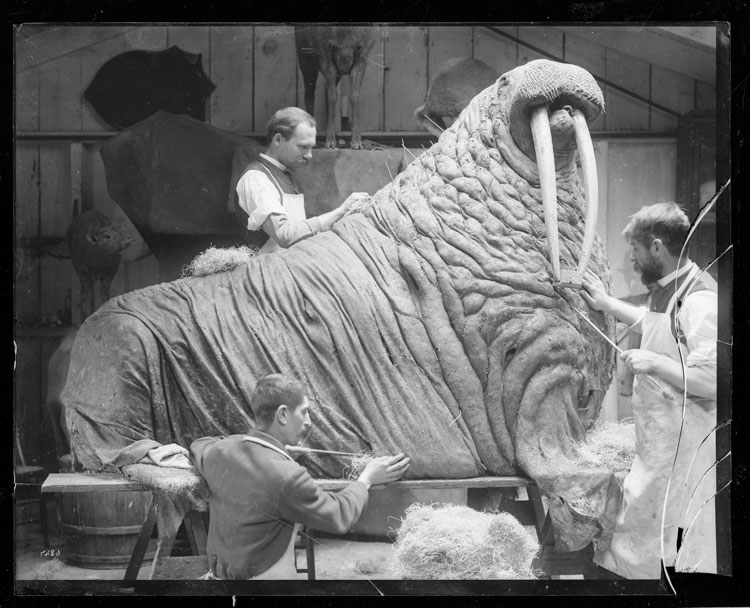
Sneak Peek 5/1/2013
- Date: May 1, 2013
- Creator: Marguerite Roby
- Description: Taxidermists prepare a walrus for exhibition.

Sneak Peek 9/16/2013
- Date: September 16, 2013
- Creator: Marguerite Roby
- Description: Taxidermists prepare a giraffe for installation at the National Museum of Natural History.
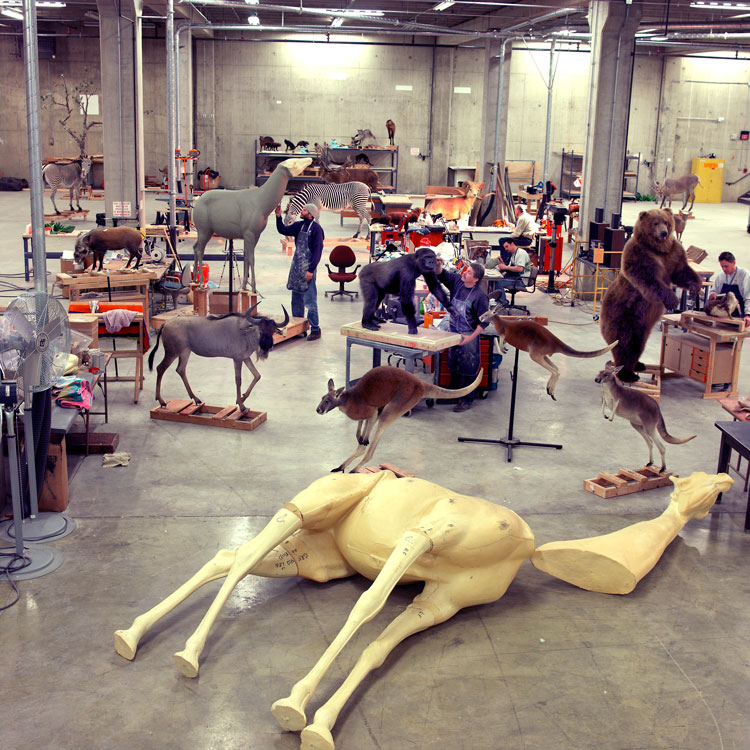
Sneak Peek 2/10/2014
- Date: February 10, 2014
- Creator: Marguerite Roby
- Description: Taxidermists Paul Rhymer, John Matthews, Ken Walker, Walter Sorrell, and Glenn Rankin prepare specimens for exhibit in Mammal Hall at the National Museum of Natural History.
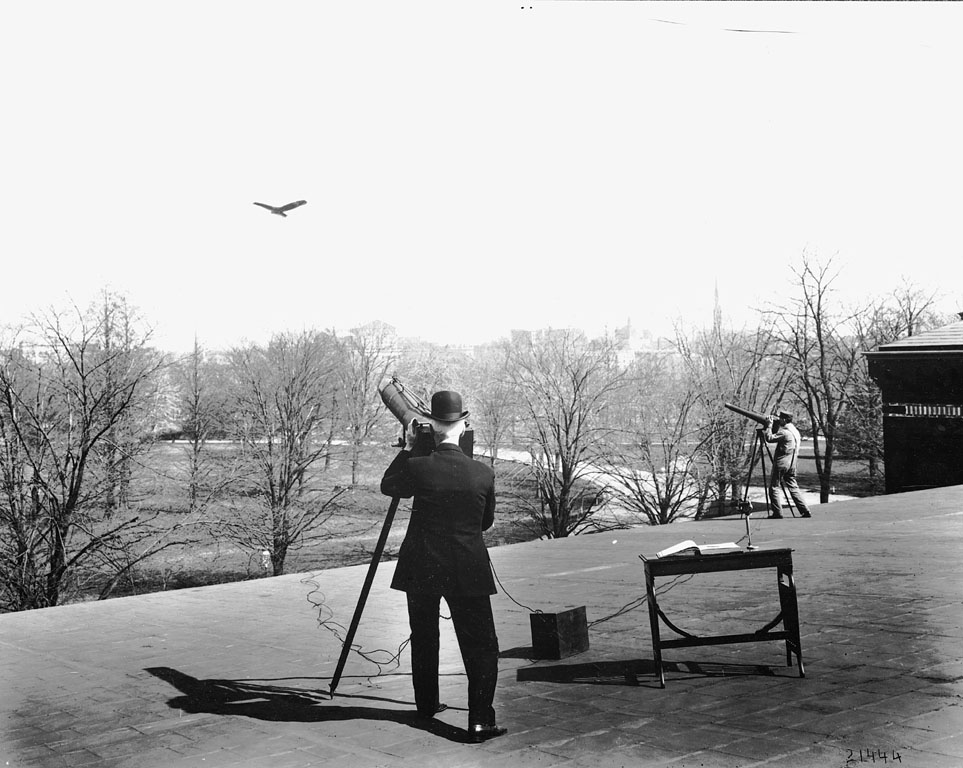
Hot Topics in Archival Research
- Date: March 12, 2015
- Creator: Mary Markey
- Description: Quarterly review of topics researched at the Smithsonian Institution Archives.

Sneak Peek 10/15/2018
- Date: October 15, 2018
- Creator: Marguerite Roby
- Description: Taxidermist Sybil Costanzo works on zebra model at Museum of Natural History, SIA Acc. 16-126, MNH-045B.
- Blog Post
Collections in Context
- Date: March 22, 2010
- Creator: Mitch Toda
- Description: [edan-image:id=siris_sic_12311,size=250,right]Walking into the rotunda of the National Museum of Natural History one immediately comes face to face with the Fénykövi Elephant (also affectionately known as Henry). Taken at a glance, the African elephant is impressive and imposing, standing over guests to a tune of 13 feet and 2 inches when measured at the shoulder. The Fénykövi
- Blog Post
See Here: 12/8/2009
- Date: December 8, 2009
- Creator: The Bigger Picture
- Description: A daily photo highlight from Smithsonian collections. [caption id="" align="aligncenter" width="393" caption="Taxidermists Mounting Hippopotamus, 1930s, by Unknown photographer, Photographic print, Smithsonian Institution Archives, Record Unit 9516, Box 1: Watson M. Perrygo Oral History Interviews, Negative Number:MAH 11087-A."][/caption]

Reconstructing William Temple Hornaday’s 1888 Extermination Series
- Date: March 2, 2017
- Description: A look at taxidermist turned conservationist William Temple Hornaday's "Extermination Series" highlighting the environmental impact of man on North American mammals.

Sneak Peek 4/8/2019
- Date: April 8, 2019
- Creator: Marguerite Roby
- Description: Taxidermist Francis “Frank” Greenwell repairs a Nubian giraffe in an exhibit containing animals from Africa in the Hall of Mammals in the National Museum of Natural History, February 10, 1982, by Kim Nielsen, SIA Acc. 11-009, 82-2558-26A.
- Blog Post
The Legacy of I. Michael Heyman
- Date: December 7, 2011
- Creator: Pamela M. Henson
- Description: A discussion of the legacy of I. Michael Heyman, who served as the eleventh Secretary of the Smithsonian Institution from 1994 to 1999.
- Blog Post
See Here: 5/17/2010
- Date: May 17, 2010
- Creator: The Bigger Picture
- Description: [caption id="" align="aligncenter" width="446" caption="Taxidermists Charles R. Aschemeier (right) and Watson M. Perrygo (left) are at work in a laboratory in the United States National Museum (now the National Museum of Natural History) preserving a sailfish caught by Franklin Delano Roosevelt, 1935, by Unknown photographer, Photographic print, Smithsonian Institution