
Results for "Smithsonian Collections Blog"
- Blog Post
Smithsonian Digitization Update
- Date: April 14, 2009
- Creator: Effie Kapsalis
- Description: Even if you have visited the Smithsonian in person, you probably don’t know that it’s comprised of 19 museums and 9 research centers. You can’t see it all by visiting the Mall in Washington D.C. since there are museums in New York and research centers in Maryland, Massachusetts, and Panama. Each museum and research center researches and collects around different topics, from

Wonderful Women Wednesday: Margaret Brown Klapthor
- Date: June 29, 2016
- Creator: Effie Kapsalis
- Description: Margaret Brown Klapthor, National Museum of American History, was an expert on White House history, curated the Smithsonian’s First Ladies collection, and wrote several books on First Ladies history. #Groundbreaker

Wonderful Women Wednesday: Mary Parrish
- Date: May 10, 2017
- Creator: Effie Kapsalis
- Description: Scientific illustrator Mary Parrish, Smithsonian's National Museum of Natural History, collaborates with paleobiologists to show the public what extinct landcapes looked like. #Groundbreaker
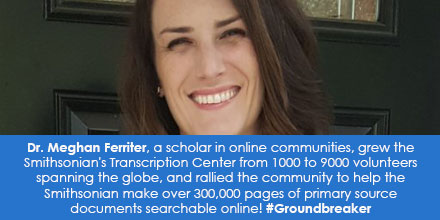
Wonderful Women Wednesday: Dr. Meghan Ferriter
- Date: August 16, 2017
- Creator: Effie Kapsalis
- Description: Dr. Meghan Ferriter, a scholar in online communities, grew the Smithsonian's Transcription Center from 1000 to 9000 volunteers spanning the globe, and rallied the community to help the Smithsonian make over 300,000 pages of primary source documents searchable online! #Groundbreaker
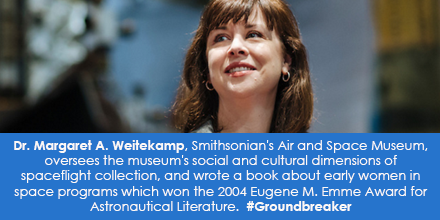
Wonderful Women Wednesday: Dr. Margaret A. Weitekamp
- Date: February 14, 2018
- Creator: Effie Kapsalis
- Description: Curator Dr. Margaret A. Weitekamp, Smithsonian's Air and Space Museum, oversees the museum's social and cultural dimensions of spaceflight collection, and wrote a book about early women in space programs which won the 2004 Eugene M. Emme Award for Astronautical Literature. #Groundbreaker

Wonderful Women Wednesday: Dr. Shadia Habbal
- Date: June 21, 2017
- Creator: Effie Kapsalis
- Description: Astrophysicist Dr. Shadia Habbal, researches solar wind and eclipses, and established the solar-terrestrial physics research group at the Smithsonian's Astrophysical Observatory. #Groundbreaker
Sidedoor Podcast: Megatherium Club
- Date: June 22, 2017
- Creator: Effie Kapsalis
- Description: [edan-image:id=siris_sic_5844,size=250,left]A staff-favorite story in the Smithsonian’s history is that of the Megatherium Club — a revolving group of young naturalists who made the Castle their temporary home in between expeditions to the outer reaches of the United States. Who could not be intrigued by this photo of the Club where they look to be sharing a joke, or a plan?
Link Love: 1/15/16
- Date: January 15, 2016
- Creator: Effie Kapsalis
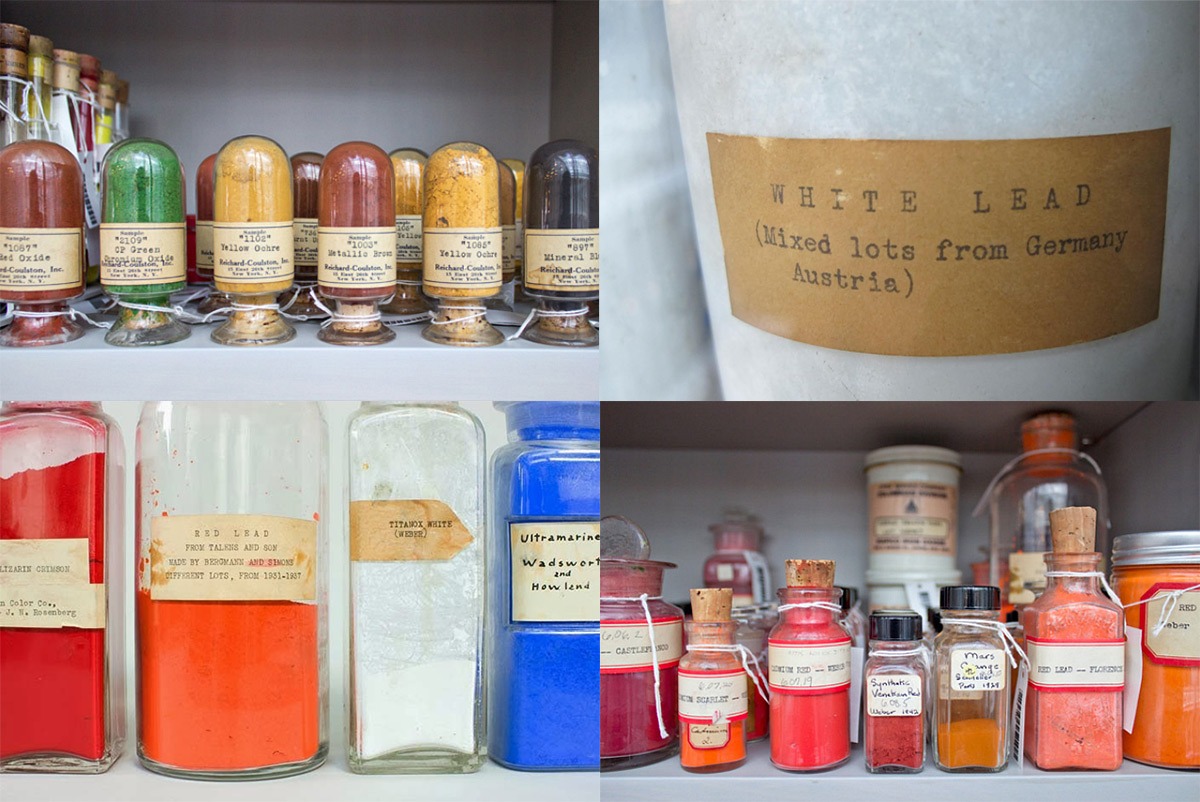
- Description: Harvard's pigment collection. [via Collossal]Also with gorgeous colors, a 700+ page Dutch book from 1692 documenting "every color in the spectrum." [via Open Culture] A new online exhibit examining what it's like to work in the U.S. on a H-1B visa from the Smithsonian's Asian Pacific American Center. [via Smithsonian Magazine] Later this year, scientists (including our own
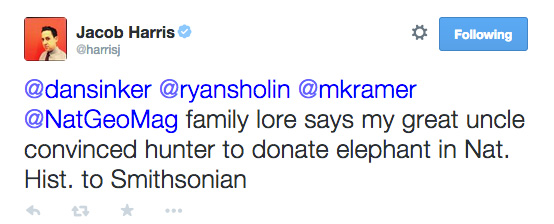
Hunting for Elephants in Archives
- Date: February 17, 2015
- Creator: Effie Kapsalis
- Description: I was intrigued to receive a tweet from a digital colleague over at the NY Times pertaining to a family story that could very well be solved at the Archives. I’m continuously surprised at the variety of papers we hold here, but by now, I shouldn’t be given how far-reaching and varied the scope of the Smithsonian has been through history. Back to the story. THE elephant that
Link Love: 5/18/2018
- Date: May 18, 2018
- Creator: Effie Kapsalis
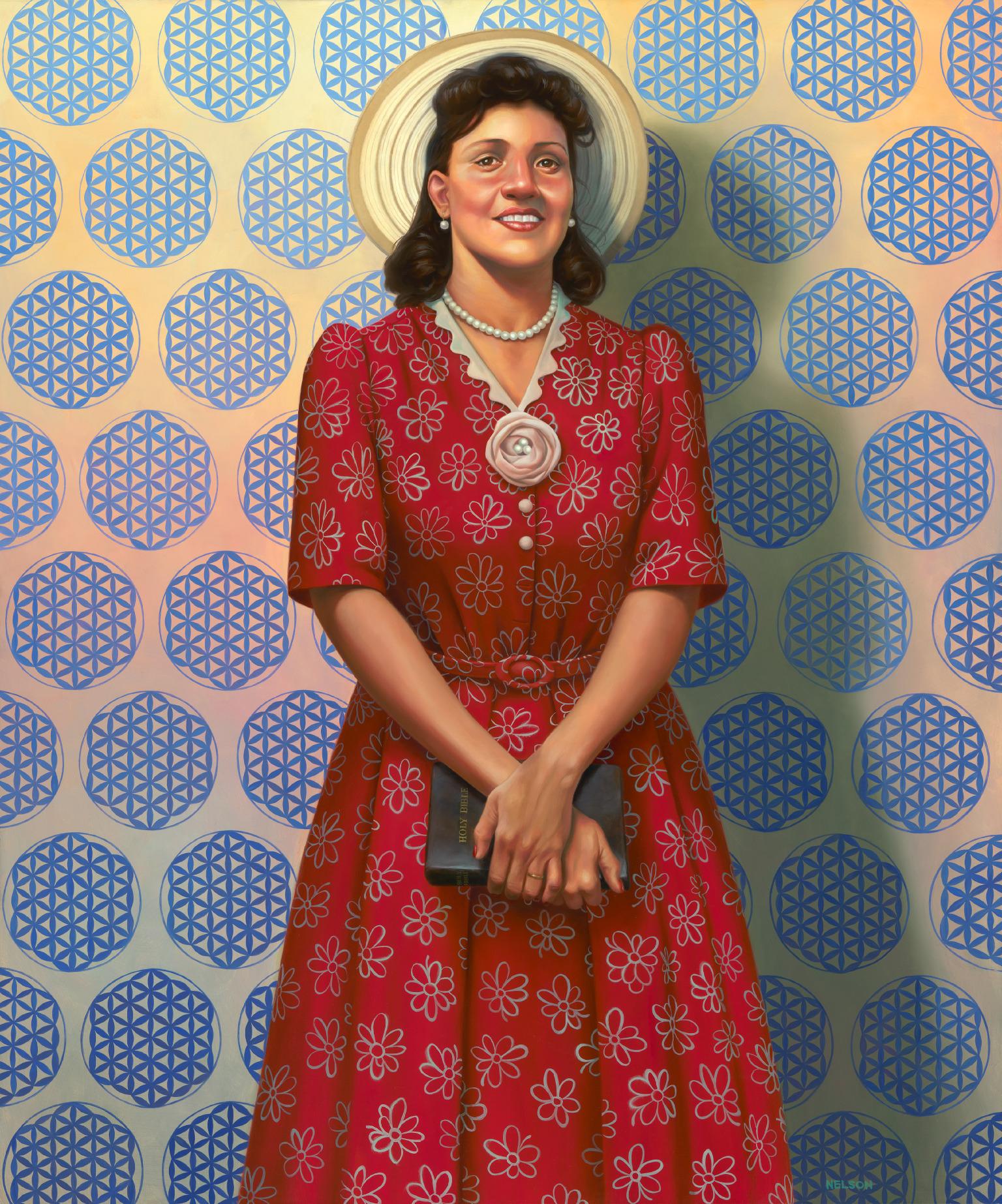
- Description: The Smithsonian's National Portrait Gallery and National Museum of African American History and Culture acquired a portrait of Henrietta Lacks, the African American woman whose cells were unknowingly contributed to over 10,000 medical patents, aiding research and benefiting patients with polio, AIDS, Parkinson’s disease and other conditions. [via Smithsonian
Link Love: 4/22/16
- Date: April 22, 2016
- Creator: Effie Kapsalis
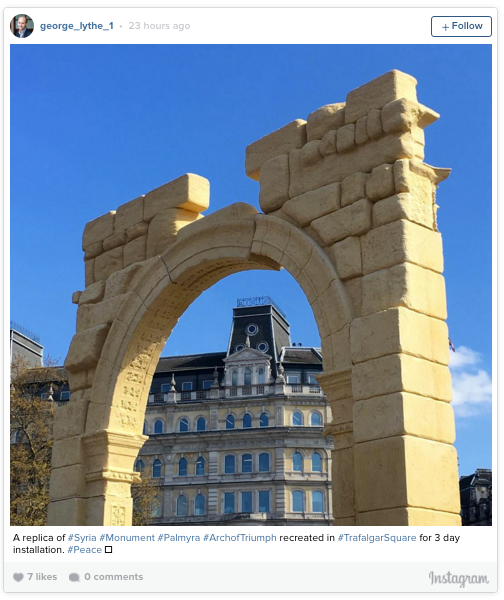
- Description: Palmyra's Arch de Triumph (recreated) stands again in London, brought to you by 3D tech. [via Hyperallergic]New digital collection available; Cold War archives. [via InfoDocket]A new book of Pablo Neruda poetry found by archivists is about to be published. [via Link Love: a weekly blog feature with links to interesting videos and stories regarding archival issues, the

Link Love: 4/1/2016
- Date: April 1, 2016
- Creator: Effie Kapsalis
- Description: Art Deco beetles and butterflies from Smithsonian Libraries. [via Hyperallergic]Depression-era faces lost to history by an editor's hold punch. [via PetaPixel]A new online archive: the Digital Transgender Archive. [via Smithsonian Magazine]The Photographers' Identities Catalog, a collection of biographical data for over 115,000 photographers, studios, etc. [via NYPL LABS]A new