
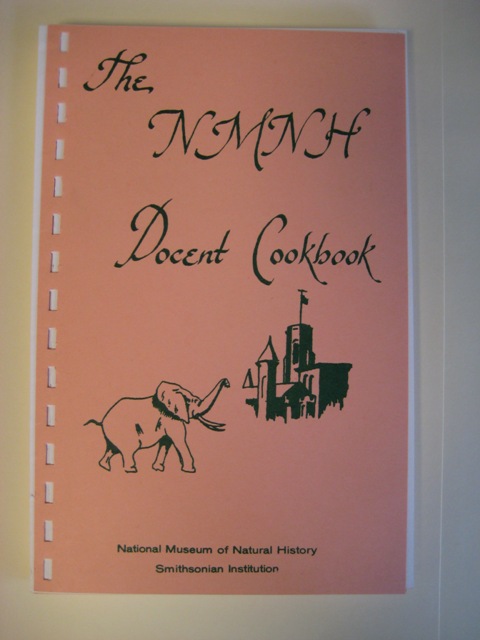
 Recently, while exploring the history of the Smithsonian’s docent program, I came across a copy of the National Museum of Natural History Docent Cookbook that was published in May 1984. It contains 116 pages of recipes contributed by the museum's docents and Office of Education staff, each linked to the name of the contributor and the discipline in which she (and occasionally he) volunteered. The cookbook contains a hodgepodge of recipes with names like Brandied and Herbed Very Special Chicken Liver Paté, Foolproof Chocolate Fudge, Janet's Polish In-Law's Walnut Cake, Medieval Beef, and Delectable Beans.
 The recipe that first caught my attention, though, is for Elephant Hide and Ivory, contributed by Magda Schremp, Coordinator of Docents. The candy serves as a sort of keynote recipe and, no, does not contain any actual elephant parts. An elephant was a common symbol used in the National Museum of Natural History's docent publications, most notably in The Elephant and Castle, the museum's docent newsletter, and referred to the Fénykövi Elephant in the museum's rotunda (learn more about the elephant in an earlier post by Mitch Toda). The recipe appears below as published, but there appear to be gaps in the instructions. My assumption was that the instructions were to be followed twice, omitting the jelly beans the second time, to create squares of hide and squares of ivory.
Elephant Hide and Ivory
- 2 cups sugar
- 1 cup heavy cream
- 1/8 teaspoon salt
- 1 teaspoon vanilla
- 24 black jelly beans
Place jelly beans in a small soup bowl. Pour just enough boiling water over them to cover. Agitate the jelly beans gently and just long enough for the color to be soaked off them. Remove the jelly beans from the black-colored liquid with a fork, and throw them away. Pour the black liquid into a very small pan and, over a low/medium heat, bring to a boil and boil away a little of the liquid. Do not boil so much away that you have a thick black syrup, as this would be difficult to combine later with the fudge syrup. In a heavy pan, combine one-half the sugar, one-half the cream and one-half the salt, stirring to blend well. Place over a medium heat and, while stirring, gradually add the black-colored liquid. Bring to a boil. Cover and let boil gently for 2-3 minutes. Uncover, and wash down the sides of the pan with a pastry brush dipped in cold water. Continue to boil over medium heat, without stirring, until the syrup reaches the soft-ball stage (234 degrees -240 degrees Fahrenheit). Place the pot on a cooling rack and, without stirring, let cool to lukewarm (110 degrees). While syrup is cooling, butter 2 small pans. When syrup has cooled to 110 degrees, add vanilla, stir until creamy, then spread in one of the buttered pans. Cover the pan with a damp cloth for half an hour. This keeps the candy creamy. Uncover, let stand until firm and then cut into squares.
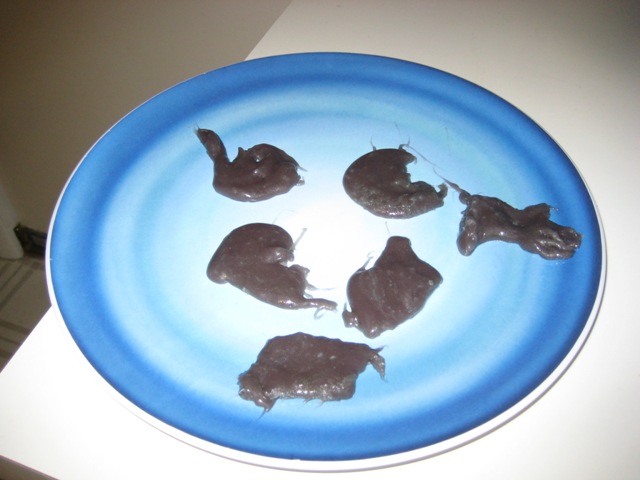 My interest piqued, I decided to attempt the recipe (I say attempt because I've never actually made candy before). All went well until I tried to remove the candy from the pans. The "hide" stretched like taffy and the squares looked more like blobs by the time they reached the plate. The "ivory" had a consistency closer to fudge, but almost every square crumbled to pieces.
 Perhaps I just made an amateur mistake. Do you think you can do better? Try the recipe and let us know how it came out!

Produced by the Smithsonian Institution Archives. For copyright questions, please see the Terms of Use.
Leave a Comment