
Smithsonian Institution Archives
  • Collections
  • Services
  • Smithsonian History
  • About
  • Education
  • Blog
  • Forums
  • Press
  • Audiences
  • Donate

The Bigger Picture: Visual Archives and the Smithsonian

A Race On the Wild Side

by Courtney Bellizzi on February 21, 2013

Panoramic View of Washington, D.C. - Looking Toward West Side of U.S. Capitol, by Unknown, Smithsonian Archives - History Div, 2004-4101.On March 8, 1903, more than just the animals went wild at the National Zoo. Around noon that day, nine year old Raymond Welty, of 1228 H Street NE, Washington, DC, had a little too much free time on his hands. While trying to ward off boredom, Raymond came across a Mr. Henry Tate's horse and buggy. With no Mr. Tate around and the horse looking oh so lonely, Raymond – not one to look a gift horse in the mouth – hopped into the driver's seat and took up the reins. Careful to avoid his father's house, Raymond took a ride to 15th and M streets, where he convinced his unwitting friend, ten year old William B. Palmer, to come along for the adventure.

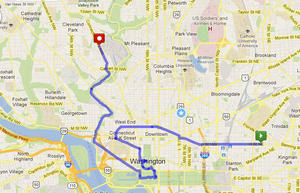
Estimated Route Welty and Palmer Traveled.With Raymond wielding the whip, the boys raced around the city. First, they excitedly steered the horse down Pennsylvania Avenue, careening past some of their favorite spots. They then shot down to the Ellipse, and took the horse through the muddied National Mall. For almost three hours they ran the horse to the ground, but Raymond eventually tired of this and thought it would be great fun to travel up to the National Zoo. He steered the horse towards the Pike and they made their way to Rock Creek Park.  Once there, they entered the Zoo at its main entrance and began to tear down the hill. It was raining, and the muddy roads were very slippery. All at once little Raymond was unable to guide the beleaguered horse, and the horse, buggy, and boys flew over a fifteen-foot embankment, and crashed in a giant heap.

Elephant House, National Zoo, by Unknown, Smithsonian Archives - History Div, 2002-10618.Fortunately, an alert police officer R. L. Carroll, of the tenth precinct, witnessed the boys' attempt at reliving the Kentucky Derby, and rushed to their aid when their sport went afoul.  Officer Carroll pulled Raymond and William from underneath the buggy, and led Mr. Tate's horse to safety. The boys came out unscathed; but the horse sustained injuries to its legs and chest. Exhausted from the long trek, it was treated by a veterinarian and taken back to the police station to wait for Mr. Tate.

Now apprehended, the two criminals were also taken to the station, while an angry Mr. Tate identified what was left of his buggy.  After questioning the boys, William, speechless with terror, received only a summons and lecture about his behavior. However, Raymond – the mastermind of this ill-fated escapade – was sent to the House of Detention where he told authorities that he had the time of his life, explaining:

If the horse had held out, Bill and I'd have had a great time...We wasn't thinking  about anything but the animals in the cages at the Zoo. We was driving along pretty fast, down the hill by the main entrance. The horse was going some, too, let me tell you - say, whose horse was it anyhow? I forgot to ask...Was I scared. Say you can't scare me with horses. I like horses.

Model of the National Zoo, by Unknown, Smithsonian Archives - History Div, 2002-10703.Not one for remorse, Raymond was kept at the House of Detention for safekeeping, though his father, James Welty, was able to visit his wayward son.

It turns out this was not the first offense for young Raymond. Prior to his jaunt around DC, Raymond was picked up by police on two separate occasions for running away. A 1910 census entry for a Raymond Welty showed that the then seventeen year old was a member of the National Training School for Boys, a juvenile correction institution. Could this be the same Raymond? His rap sheet would suggest it as a strong likelihood.

Related Collections

  • Record Unit 74 - National Zoological Park, Records, 1887-1966, Smithsonian Institution Archives
Categories: Smithsonian History
Tags: Cities/Places, Archive
Comments: View 1 comments, or Give us yours!
All comments are moderated and subject to approval. Further information is available in The Bigger Picture’s Commenting Guidelines.

Comments (1) – Leave a comment

Luca

interesting article

thank you for sharing

Luca February 27, 2013 at 2:37 pm
  • reply

Leave a comment

The content of this field is kept private and will not be shown publicly.
  • Web page addresses and e-mail addresses turn into links automatically.
  • Lines and paragraphs break automatically.

More information about formatting options

CAPTCHA
This question is for testing whether you are a human visitor and to prevent automated spam submissions.
By submitting this form, you accept the Mollom privacy policy.

Produced by the Smithsonian Institution Archives. For copyright questions, please see the Terms of Use.

Stay in touch!

Facebook Twitter Flickr YouTube SlideShare
Join our eNewsletter

About

Connecting you to America’s past with a behind-the-scenes exploration of the Smithsonian’s history, treasures, and the challenges that Archives face preserving collections. More details...

Smithsonian on Flickr Commons

Topics/Tags

  • See Here (612)
  • American History (544)
  • Science (431)
  • Archive (332)
  • Cities/Places (279)
  • Exhibitions (235)
  • Web/Tech (211)
  • Photo History (189)
  • Link Love (154)
  • Politics/Government (153)

Blog Roll

All Smithsonian blogs
American Historical Association Blog
American Institute of Conservation Blog
Archives Next
Archives of American Art
Around the Mall
Field Book Project
Hanging Together
Library of Congress Blogs
National Archives (US) Blogs
National Museum of American History, O say can you see?
Smithsonian Collections Blog
Smithsonian Libraries
Teaching American History

Categories

  • Collections in Focus (991)
  • What Gets Saved (338)
  • Behind the Scenes (212)
  • Smithsonian History (136)

Recent Posts

  • See Here: 5/24/2013
  • Link Love: 5/24/2013
  • "If you feed them, they will come."
  • Women in Science Wednesday: Mary Alice McWhinnie
  • Twenty-Six and Blooming!

Monthly Archive

  • May 2013 (26)
  • April 2013 (26)
  • March 2013 (26)
  • February 2013 (26)
  • January 2013 (28)
  • December 2012 (26)
  • November 2012 (28)
  • October 2012 (32)
  • September 2012 (26)
  • August 2012 (31)
  • July 2012 (26)
  • June 2012 (27)
  • May 2012 (27)
  • April 2012 (27)
  • March 2012 (28)
  • February 2012 (27)
  • January 2012 (26)
  • December 2011 (31)
  • November 2011 (28)
  • October 2011 (35)
  • September 2011 (31)
  • August 2011 (35)
  • July 2011 (41)
  • June 2011 (43)
  • May 2011 (33)
  • April 2011 (40)
  • March 2011 (43)
  • February 2011 (35)
  • January 2011 (36)
  • December 2010 (42)
  • November 2010 (40)
  • October 2010 (44)
  • September 2010 (37)
  • August 2010 (39)
  • July 2010 (38)
  • June 2010 (37)
  • May 2010 (42)
  • April 2010 (44)
  • March 2010 (47)
  • February 2010 (40)
  • January 2010 (39)
  • December 2009 (43)
  • November 2009 (34)
  • October 2009 (11)
  • September 2009 (11)
  • August 2009 (12)
  • July 2009 (14)
  • June 2009 (10)
  • May 2009 (12)
  • April 2009 (14)
  • March 2009 (10)
  • January 2009 (1)
Smithsonian Institution Archives
eNewsletter Facebook Twitter Flickr Historypin YouTube SlideShare Browsealoud
Smithsonian Institution
  • Privacy
  • Copyright
  • Contact