
Smithsonian Institution Archives
  • Collections
  • Services
  • Smithsonian History
  • About
  • Education
  • Blog
  • Forums
  • Press
  • Audiences
  • Donate

The Bigger Picture: Visual Archives and the Smithsonian

All Shook Up: A History of Earthquakes at the Smithsonian

by Courtney Bellizzi on September 21, 2011

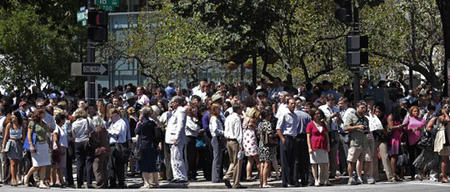
DC workers evacuate to the National Mall, August 23, 2011.Here at the Smithsonian we love to observe. So of course on August 23, 2011, at 1:51 PM, when a 5.8 magnitude earthquake shook the Washington, DC region and many of us with it, we immediately started to observe what happened and how we could document it. As the Institution's historians, inevitably we needed to know, had this happened before and what were the effects? After much research and investigation we found several reports of earthquakes in the DC region, with the mid to late 1800s being a very active time. Here are accounts of two powerful earthquakes.

Smithsonian Institution Building and The Mall, 1855, by Unknown, Smithsonian Archives - History Div, 2004-10647 or 18603.

On April 29, 1852, an earthquake sent moderate shockwaves through Washington, DC. With a probable epicenter in Virginia, the papers reported citizens feeling two distinct shocks around 1 pm. Though no noticeable damage occurred in the city, there was at least one report of a chimney coming down in Wytheville, Virginia. Interested in weather observations and natural phenomena, the Smithsonian's first Secretary Joseph Henry responded to the quake by writing up a list of questions to send out to volunteer observers in the shock zone. He collected observations and constructed a map of the shockwave's path from the responses that he received. Numerous observers came back with information like that of Lewis F. Steiner of Frederick, Maryland, who wrote about his friend's earthquake experience, Mr. F. regrets that he could not observe the attendant phenomena, with as much care as he desired in consequence of the great alarm of the ladies who were in the room with him. He compares the vertical movement, to that produced by riding rapidly over a suspension or common wooden bridge where the string pieces are long, and the piers distant from each other; and the horizontal, to that of a ship on the ocean. The sound accompanying the shock, he compares to that heard over a rail-road tunnel during the passage of a train of cars through it."

Louise Hoover's Painting of Joseph Henry, by Hoover, Louise Rochon, Smithsonian Archives - History Div, 84-2074 and 31052-E and 94-12563.The most powerful earthquake of the era was the estimated 7.0 earthquake occurring on August 31, 1886. The destructive quake's epicenter was located in South Carolina and killed sixty people in Charleston, South Carolina. The quake also caused significant damages to buildings in Charleston, and its shocks reached up and down the east coast. Though no damage was reported in the Smithsonian's Buildings Reports, it was clearly felt by occupants of the Smithsonian Institution Building or Castle. In a Washington Post article from September 2, 1886, Lucien M. Turner, a member of the Army Signaling Corp, natural history collector for the Smithsonian's United States National Museum and a meteorological observer, recounted his earthquake experience while sitting in ornithologist Robert Ridgway's office on the 5th floor of the south tower:

Panoramic View of the City of Washington, D.C, by Jackson, William Henry 1843-1942, Smithsonian Archives - History Div, 61686-C or MAH-61686C.

At 9:53:31, I was sitting in the south tower of the Smithsonian building, with my chair tilted back and my heels resting on the table, certainly an excellent position to enable me to detect the least tremor. I recognized the cause, and looked at my watch. An old gas fixture, shaped like an inverted T suspended from the ceiling and not more than two feet from my head, served admirably as a seismometer. Its height from the floor is six feet six inches and sixty-six feet six inches from the surface of the ground. The disturbance was so great as to cause the fixture to swing five inches. The oscillations were indicated to move from west to east. The movements of the tremors were observed to last until 9:55 p.m. Several slight disturbances occurred until 10:04 pm when they ceased. At 10:08 pm a second series of tremors began. The first of these moved from north northwest to south southeast; the middle tremors had a peculiar circulatory motion, as though changing direction. The latter vibrations of this series were certainly from east to west, as indicated by the fixture. This lasted until 10:09 pm. A third series occurred at 10:30:10 pm, but were not so strongly characterized as the first, but were more severe than those occurring at 10:03 pm. The third series lasted until 10:31:15 pm.

Robert Ridgway Sitting at a Desk, by Unknown, c. mid 1890s, Smithsonian Archives - History Div, SIA2011-0031.

Ever the observer, it is nice to know that Turner kept his calm to document the effects of the shockwaves. So it would seem that Smithsonian staff of yesteryear had a similar reaction to the employees today, shake, observe, and document... not that much has seemed to change after all.

Categories: Smithsonian History
Tags: American History, Science, Event
Comments: View 1 comments, or Give us yours!
All comments are moderated and subject to approval. Further information is available in The Bigger Picture’s Commenting Guidelines.

Comments (1) – Leave a comment

Christopher Lethbridge

a terrific post - thanks

Christopher Lethbridge September 26, 2011 at 12:04 pm
  • reply

Leave a comment

The content of this field is kept private and will not be shown publicly.
  • Web page addresses and e-mail addresses turn into links automatically.
  • Lines and paragraphs break automatically.

More information about formatting options

CAPTCHA
This question is for testing whether you are a human visitor and to prevent automated spam submissions.
By submitting this form, you accept the Mollom privacy policy.

Produced by the Smithsonian Institution Archives. For copyright questions, please see the Terms of Use.

Stay in touch!

Facebook Twitter Flickr YouTube SlideShare
Join our eNewsletter

About

Connecting you to America’s past with a behind-the-scenes exploration of the Smithsonian’s history, treasures, and the challenges that Archives face preserving collections. More details...

Smithsonian on Flickr Commons

Topics/Tags

  • See Here (611)
  • American History (542)
  • Science (429)
  • Archive (329)
  • Cities/Places (277)
  • Exhibitions (234)
  • Web/Tech (210)
  • Photo History (189)
  • Link Love (153)
  • Politics/Government (153)

Blog Roll

All Smithsonian blogs
American Historical Association Blog
American Institute of Conservation Blog
Archives Next
Archives of American Art
Around the Mall
Field Book Project
Hanging Together
Library of Congress Blogs
National Archives (US) Blogs
National Museum of American History, O say can you see?
Smithsonian Collections Blog
Smithsonian Libraries
Teaching American History

Categories

  • Collections in Focus (989)
  • What Gets Saved (337)
  • Behind the Scenes (212)
  • Smithsonian History (134)

Recent Posts

  • Sneak Peek 5/20/2013
  • Link Love: 5/17/2013
  • See Here: 5/17/2013
  • Weird and Wonderful: The Surprising Mrs. Hilda Hempl Heller
  • Women in Science Wednesday: Anne Hagopian

Monthly Archive

  • May 2013 (21)
  • April 2013 (26)
  • March 2013 (26)
  • February 2013 (26)
  • January 2013 (28)
  • December 2012 (26)
  • November 2012 (28)
  • October 2012 (32)
  • September 2012 (26)
  • August 2012 (31)
  • July 2012 (26)
  • June 2012 (27)
  • May 2012 (27)
  • April 2012 (27)
  • March 2012 (28)
  • February 2012 (27)
  • January 2012 (26)
  • December 2011 (31)
  • November 2011 (28)
  • October 2011 (35)
  • September 2011 (31)
  • August 2011 (35)
  • July 2011 (41)
  • June 2011 (43)
  • May 2011 (33)
  • April 2011 (40)
  • March 2011 (43)
  • February 2011 (35)
  • January 2011 (36)
  • December 2010 (42)
  • November 2010 (40)
  • October 2010 (44)
  • September 2010 (37)
  • August 2010 (39)
  • July 2010 (38)
  • June 2010 (37)
  • May 2010 (42)
  • April 2010 (44)
  • March 2010 (47)
  • February 2010 (40)
  • January 2010 (39)
  • December 2009 (43)
  • November 2009 (34)
  • October 2009 (11)
  • September 2009 (11)
  • August 2009 (12)
  • July 2009 (14)
  • June 2009 (10)
  • May 2009 (12)
  • April 2009 (14)
  • March 2009 (10)
  • January 2009 (1)
Smithsonian Institution Archives
eNewsletter Facebook Twitter Flickr Historypin YouTube SlideShare Browsealoud
Smithsonian Institution
  • Privacy
  • Copyright
  • Contact